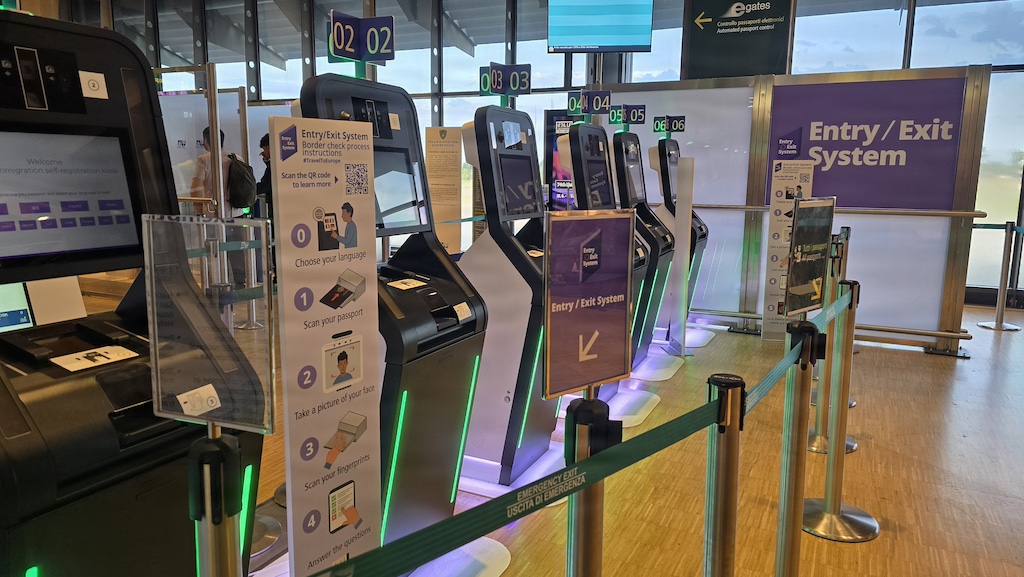



The European Union could extend temporary flexibility measures for its new Entry/Exit System (EES) beyond September 2026, as concerns grow that fully enforcing biometric border checks could worsen queues and disruption at European airports.
According to The Times, industry sources say European Commissioner for Sustainable Transport and Tourism Apostolos Tzitzikostas has privately indicated that flexibility around the checks could continue if necessary. The reported assurances come amid mounting pressure from European governments, airlines and airports over the impact of the system during the peak summer travel season.
The EES began its phased rollout in October 2025 and became fully operational across 29 European countries in April 2026. It replaces manual passport stamping with the electronic registration of non-EU nationals entering and leaving the Schengen Area, recording information including fingerprints and facial images.
The new Entry/Exit System (EES) has started recording all non-EU nationals travelling to Europe for short stays.
— EU Home Affairs (@EUHomeAffairs) August 6, 2026
29 European countries using the EES hold reliable data on who crosses their borders with a foreign passport.
It helps safeguard #securityEUpic.twitter.com/2YHD9j4Ylp
September deadline under pressure
The latest reports follow a joint appeal by nine European countries to extend flexibility on EES border checks.
Belgium, France, Germany, Greece, Italy, Malta, the Netherlands, Portugal and Switzerland wrote to European Commissioner for Internal Affairs Magnus Brunner in July, warning that the current partial suspension mechanism should remain available beyond its scheduled expiry on 6 September 2026.
The mechanism allows border authorities, in exceptional circumstances, to temporarily suspend the collection of travellers’ biometric data while continuing to register their entry and exit from the Schengen Area. Governments argue that removing that safeguard could create serious operational problems at busy border crossings.
The European Commission has so far stressed that existing legislation contains flexibility provisions and that it remains in contact with member states experiencing difficulties, but has not formally confirmed that the current arrangements will be extended.
According to The Times, however, Tzitzikostas has privately reassured industry representatives that the checks could be paused where necessary. He is also reported to have given similar assurances to the UK following a meeting with British Transport Secretary Heidi Alexander on 14 July.
“We want everyone to have the summer holidays they deserve – and yesterday’s meeting shows everyone is pulling in the same direction,” Alexander said following the meeting. “I was reassured that the EU commissioner for transport understood the concerns of holidaymakers and recognised the need for us to work together.”
Airports and airlines warn of queues
Pressure on Brussels has intensified after passengers faced lengthy queues at some European airports following the introduction of biometric checks.
As Travel Tomorrow previously reported, Airports Council International Europe (ACI EUROPE), Airlines for Europe (A4E) and the International Air Transport Association (IATA) have called for greater flexibility after reporting border delays of up to five hours at some airports.
Ryanair has also warned of “queue chaos”, arguing that some airports do not yet have sufficient staffing, kiosks or infrastructure to handle EES procedures efficiently during periods of high demand. Alicante-Elche Miguel Hernández Airport in Spain has been among the airports singled out over concerns about preparedness.
The Spanish airport is preparing a major expansion and redevelopment project that will include infrastructure intended to improve the handling of EES procedures.
EasyJet chief executive Kenton Jarvis has similarly described queues linked to the new controls as “completely unacceptable”, while Fraport Greece chief executive Alexander Zinell has warned that temporary suspension measures have been crucial in preventing even greater disruption at the 14 Greek airports operated by the company.
British travellers among those most affected
The issue is particularly significant for British travellers. Following Brexit, UK citizens are treated as third-country nationals when entering the Schengen Area and are therefore required to use the EES.
Under the system, travellers on short stays of up to 90 days within any 180-day period have their entry and exit electronically registered. Biometric information is collected when required, replacing the passport stamps previously used to track stays in the Schengen Area.
@bethwill_x 3 hours later and no air con 🥵 • • • #verona #veronaairport #italy #ees #airportsecurity ♬ som original – Marketing digital
The disruption is particularly significant for British travellers. Following Brexit, UK citizens are treated as third-country nationals when entering the Schengen Area and are therefore subject to EES requirements. Concerns over delays have also increased interest in European destinations outside the EES, including EU countries such as Cyprus and Ireland, which are outside the Schengen Area, as well as destinations such as Albania, Montenegro, Serbia and Türkiye.
The current debate is therefore not about abandoning the EES itself. European governments continue to support the digital border system and its security objectives, but are increasingly calling for authorities to retain the ability to temporarily ease biometric requirements when passenger volumes threaten to overwhelm border infrastructure.
With the partial suspension mechanism currently due to expire on 6 September, Brussels is under growing pressure to clarify whether that flexibility will remain available into the autumn.