

A coalition of eleven European countries is pressuring the European Commission to introduce stricter visa rules for Russian citizens. While Russians can currently apply for Schengen visas to travel within the Schengen Area, Russia’s invasion of Ukraine in 2022 and the ongoing war have fuelled calls for further restrictions.
On Wednesday, 3 June 2026, Sweden and ten other European nations sent a letter to EU foreign policy chief Kaja Kallas and Internal Affairs Commissioner Magnus Brunner asking to tighten visa rules for Russian citizens. Alongside Sweden, the call for action was signed by EU-member states Czechia, Denmark, Estonia, Finland, Latvia, Lithuania, the Netherlands, and Poland, as well as Iceland and Norway.
The letter was sent on the eve of a Justice and Home Affairs Council, which took place on Thursday, 4 June in Luxembourg.
Letter from 🇸🇪 🇩🇰 🇫🇮 🇨🇿 🇳🇱 🇵🇱 🇪🇪 🇱🇻 🇱🇹 🇮🇸 🇳🇴 proposing new measures to limit EU tourist visas for Russian citizens 👇 pic.twitter.com/iFuOYKhqwx
— Sweden in EU (@SwedeninEU) June 4, 2026
“I think it’s insane, frankly speaking, that we are seeing hundreds of thousands of Russian tourists coming to Europe, enjoying sunshine. They are having weekend shopping trips, drinking rosé wine, while at the same time Ukrainians are dying on the battlefield,” Swedish Migration Minister Johan Forssell said in an interview with Reuters during the Justice and Home Affairs Council.
In the letter, the 11 nations mention that although the European Commission had issued guidelines on handling visa applications from Russian nationals in 2022 following Russia’s aggression against Ukraine, many EU members tend not to follow these.
“However, the uneven implementation of these guidelines across member states leaves much to be desired, as it lacks both solidarity and consistency. It also risks placing member states in unequal economic positions,” the letter specifies, according to news outlet Euronews, which was able to look into the document.
Contrary to what one might expect given the guidelines, data from the Schengen Barometer indicate that Russian citizens were awarded an increasing number of visas between 2023 and 2025. For example, 477,878 Schengen visas were granted to Russian citizens for tourism purposes in 2025, compared to 440,558 in 2024.
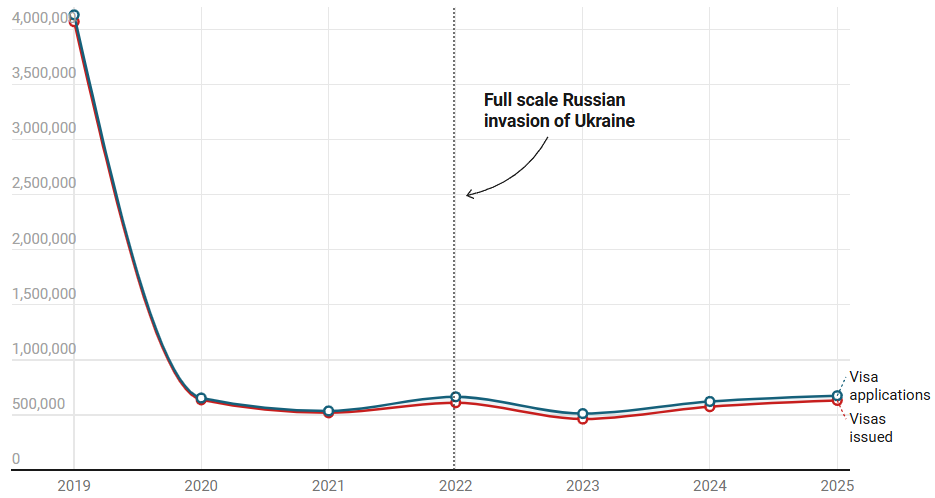
According to Sweden, Czechia, Denmark, Estonia, Finland, Latvia, Lithuania, the Netherlands, Poland, Iceland, and Norway, not only does this weaken the EU’s leverage, but it also sends mixed messages regarding the EU’s stance towards Russia’s offensives against Ukraine. Moreover, the letter states that uneven visa practices for Russian tourists may result in a security risk within the Schengen area.
In their call for action, the 11 nations are thus asking for binding visa restrictions, for a stricter follow-up of the existing guidelines, for regular statistics, and for a mechanism to identify former Russian combatants.
“This situation is completely insane, and it needs to be stopped,” Forssell said on 4 June.
Schwedens Migrationsminister Forssell: „Es ist wahnsinnig dass fast 500.000 russische Touristen 2025 nach Europa kamen während Ukrainer auf dem Schlachtfeld sterben."
— Anna (@AnnaDeMilanese) June 5, 2026
Elf Länder haben einen gemeinsamen Brief an Kallas und Kommissar Brunner geschickt: Polen, Schweden, Tschechien,… pic.twitter.com/L7KvZcOUJE
During the ministerial meeting in Luxembourg, the subject of Russian visas was not officially part of the agenda, and no decision was made. However, the eleven countries are waiting for the EU institutions to take the initiative to relaunch the subject.
At the time of writing, the Russian government has not yet reacted to the document. Previously, however, it accused European nations of being victims of anti-Russian hysteria and of being openly racist towards Russians.