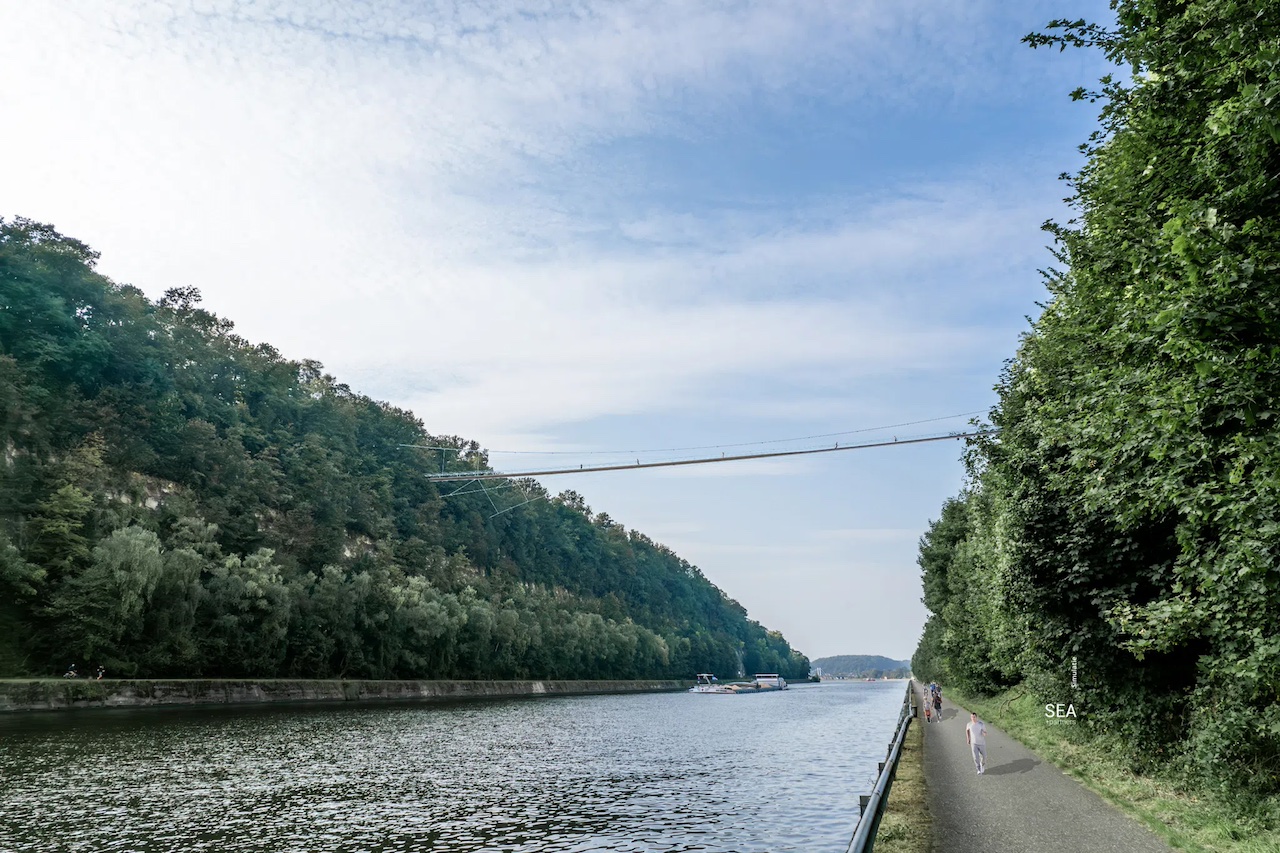

A new footbridge over the Albert Canal has opened to the public, reconnecting not only Wallonia and the Netherlands, but also a shared history. Suspended 55 metres above the ground, however, it is not for the faint-hearted or those suffering from vertigo.
The 195-metre-long Passerelle de Caster, also known as the Caster Footbridge, restores a direct link that was lost when the Albert Canal was dug in the 1930s. Construction was completed in 1939. The canal was designed to create a strategic domestic waterway, linking the industrial heartland of Liège directly to the port of Antwerp, thus avoiding Dutch territory. It also formed part of Belgium’s military defence strategy against potential invasions. History, of course, had other plans.
Long before the canal was cut through the landscape, the area was located along an important military and trade route between Liège and Maastricht. This border region was also renowned for smuggling, with gin, butter, and Belgian beers crossing borders under the cover of night.
Now the tallest pedestrian bridge in the Benelux region, it offers sweeping, 360-degree panoramic views of the Geer and Meuse river valleys and the surrounding Border Park. Stretching across the canal between Bassenge and Visé, it is located near the Flemish municipality of Riemst and just a short distance from Maastricht.
While the bridge itself is not exactly a tourist attraction, it forms part of several hiking and walking routes in the region, ranging from 6.5 to 17 kilometres. One of these even leads all the way to Maastricht.
“The Caster footbridge is not a destination in its own right but should be included as part of a wider tour of the region. That is why we have created four new circular walking routes that include it,” Jérôme Vandermaes, director of the non-profit organisation Vialta, told The Brussels Times.
Protecting nature was at the heart of the project launched by Vialta, a joint initiative formed by the Walloon municipalities of Visé, Bassenge and Oupeye. The bridge was designed to connect regions, communities and countries while preserving the exceptional environments of the Caster plateau and Montagne Saint-Pierre nature reserves.
Construction began in 2025, following the project’s initial proposal in 2022. The total cost amounted to €2.1 million, 80% of which was funded through the Walloon recovery plan, with the remaining 20% covered by the three municipalities.
Vandermaes also described the bridge as a “feat of engineering”. Designed by Servais et Partners, the structure is supported by a single cable attached to two pylons of different heights. Due to the steep terrain and highly protected natural surroundings, traditional heavy machinery could not be used to install the initial connecting cable. Instead, engineers relied on drones to fly it across the canal. The central walkway varies in width from 1.2 to 2.5 metres.
@highfliershahbaz Belgium just opened a breathtaking new adventure spot! Suspended 50m above the Albert Canal, the brand-new Passerelle de Caster takes you across dramatic limestone cliffs with unreal panoramic views over the Lanaye locks and surrounding nature. 🌿✨ A perfect hidden gem for hikers, photographers, drone lovers, and anyone looking to discover another side of Belgium. And this is only the beginning ,more hiking trails are expected to open soon around the area 👀 📍Passerelle de Caster, Eben-Emael 🅿️ Parking du Fort d’Eben-Emael 🎟️ €3 online • €5 on-site ♿ Accessible with all-terrain wheelchair Would you walk across this bridge? 😍 #visitwallonia #visitbelgium #wallonie #visiteurope #creatorsearchinsights @Belgium ♬ Forever (From "Euphoria: Season 1" Soundtrack) – Labrinth
Crossing the bridge incurs a fee. Access costs €3 online or €5 on site. Daily capacity is currently limited to 600 walkers, though this could eventually rise to 1,000. Revenue generated from ticket sales will be reinvested in maintenance and conservation.
“We invite all visitors to enjoy the region and even to spend several days exploring it. Our border park is brimming with treasures that are far too little known”, adds Vandermaes.
Beyond the engineering feat, the wider ambition is to breathe new life into a region of striking landscapes and small towns that remains relatively untouched by overtourism. At a time when many Europeans are opting for shorter trips closer to home, the bridge may prove to be exactly the kind of quiet, cross-border getaway that travellers are looking for.