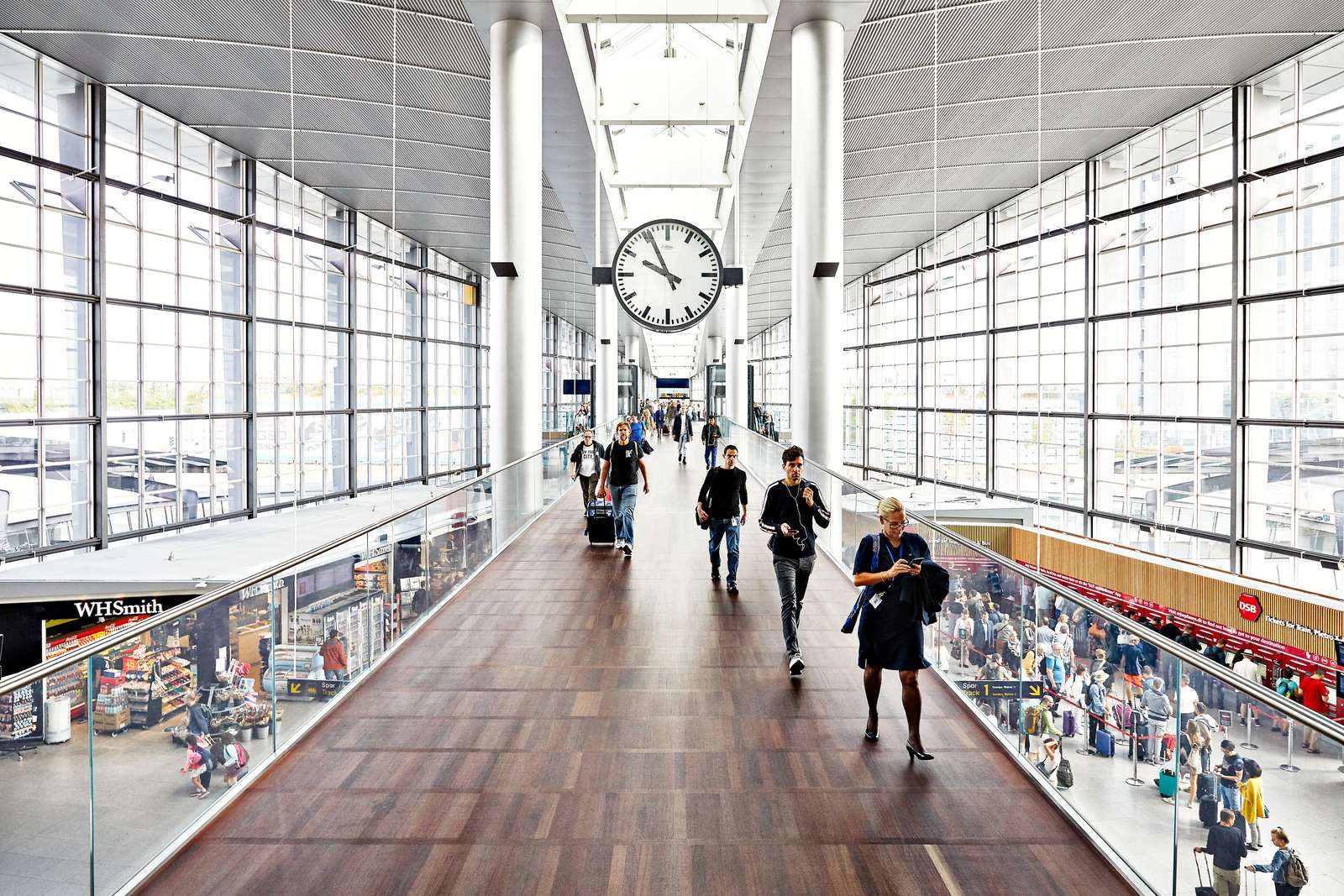



Copenhagen Airport is planning a major expansion, which would allow its infrastructure to welcome up to 55 million passengers per year, a nearly 60% increase in passenger volume compared to 2026. The works aim to adapt the airport to a rising demand in global air travel.
On Monday 23 November 2026, Copenhagen Airports A/S announced that the Danish Planning and Rural Authority is working on a new planning basis for the airport in order to accommodate rising demand in global air travel. As the International Air Transport Association (IATA) expects demand to double by 2050, the draft will draw the overall outline for a vast expansion of the infrastructure.
“As a small country with an open economy, Denmark is deeply dependent on connections to the rest of the world. They give Danish companies access to markets, bring tourists and investments to Denmark and connect us with the world. Therefore, we must already now create a flexible framework for the airport to develop in line with Denmark’s needs,” Christian Poulsen, CEO of Copenhagen Airport, said in a statement.
Although the planning basis has not yet been finished, the expansion plans should eventually allow the airport to handle up to 55 million passengers per year within the existing area. With 34.5 million passengers projected to travel through the airport by the end of 2026, this represents a growth potential of nearly 60%.
According to the press release, the planning basis will include pitches able to welcome larger aircraft in the airport’s northwestern area. Moreover, it will move and shorten the airport’s transverse lane to create space for development, and it will expand the airport’s terminals and passenger facilities. Finally, it will allow for a flexible airport design, which can be adapted to new needs and requirements for safety, sustainability, and technology.
However, the development of the airport must not only ensure Denmark’s international connections and workplaces but also limit the local environmental impact as much as possible. On the one hand, the plan therefore allows space for new aircraft. New planes are able to transport more passengers on board, all while generally creating less noise and having a lower carbon footprint than older models.
On the other hand, the airport plans to expand and increase its noise barriers, and to integrate noise-cancelling cladding on buildings. The expansion will also be designed in such a way as to reduce a plane’s time spent on the ground with the engines running as much as possible, which helps to reduce air pollution.
“We are very aware that the many benefits of a strong airport come with a disadvantage for the environment. Therefore, we must continue to find new ways to reduce our footprint. It is our responsibility to ensure that the increase in routes and passengers does not mean a corresponding increase in noise and pollution,” Christian Poulsen commented.
The Planning and Rural Administration expects the work on the new planning basis to be completed by 2028. Once the planning basis is approved, the airport will be able to start implementing individual elements of the plan. A final timeline for the expansion has not been shared yet at the time of writing.