


A new study has analysed the effect of travelling long east-west distances on migrating seabirds. The results show that animals, too, can suffer from what is widely known as jet lag, and the research may offer clues to better understanding the phenomenon in humans.
A lot has been written and said about jet lag, especially since the rise of commercial aviation in the 20th century. The phenomenon is defined as the discrepancy that occurs between our circadian rhythm and the actual time when travelling over large east-west distances. Aside from having difficulty staying awake during the flight or upon arrival, this can create a long list of problems, both short-term and long-term.
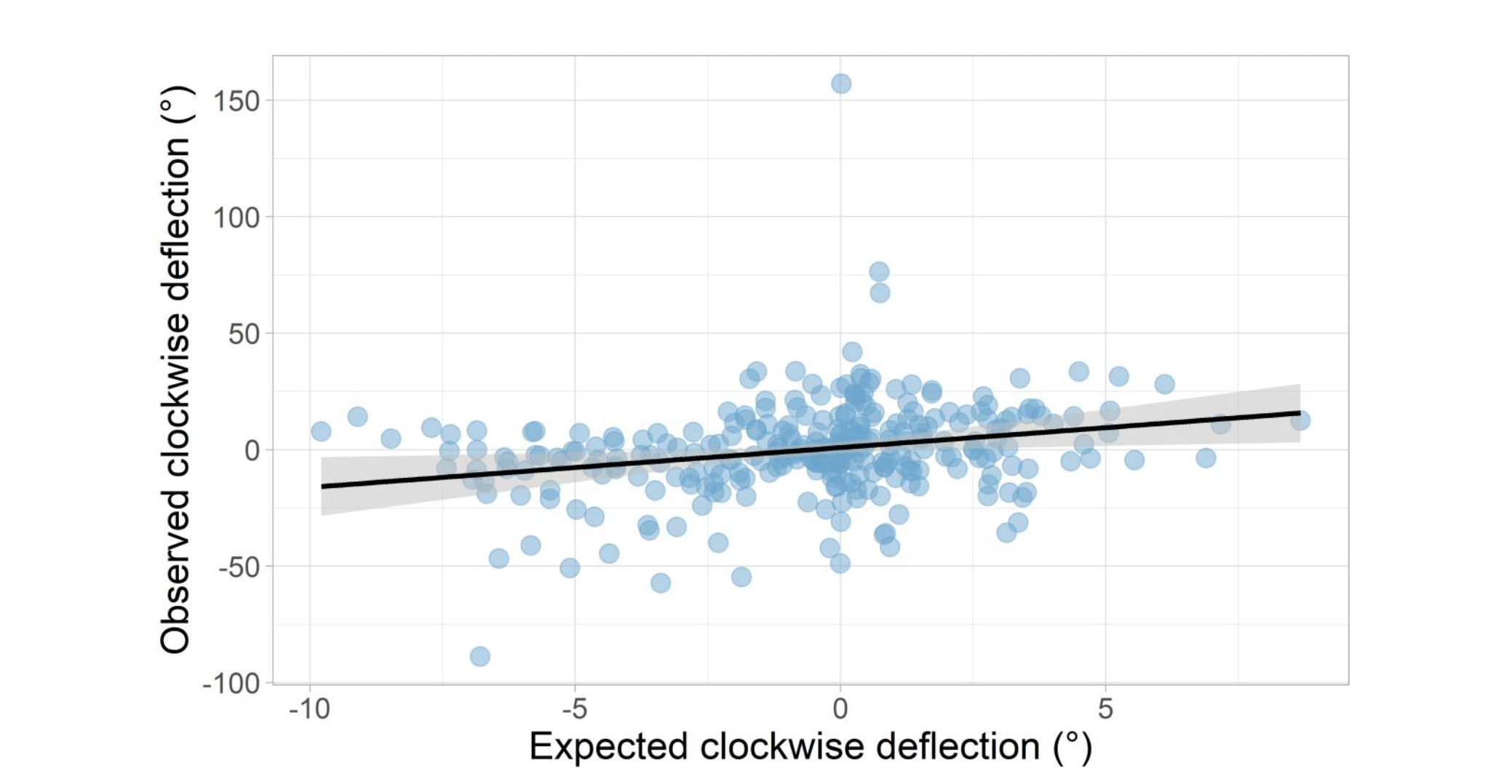
The relationship between observed and expected deflection within the 19 trips with
absolute expected sun compass errors >7°. © Lewin et al., Science | AAAS
But what about animals? Do they also suffer from jet lag? While most do not travel over such long distances under normal circumstances, as they lack the speed and endurance, some do. Migrating (sea)birds in particular are used to cover long distances, navigating on their internal compass, led by the sun and the surroundings. And they may thus very well get jet-lagged, in theory.
A new study publish in Science has analysed the effect of long east-west journeys on Manx shearwaters (Puffinus puffinus), a kind of migrating seabird living on the west coast of the United Kingdom. After GPS tracking a substantial number of Manx shearwaters for over 20 years, the researchers came to some interesting conclusions.
According to the study, when the birds fly home to their colonies after foraging trips over the Atlantic Ocean – trips that may cover distances of up to 1,000 kilometres – their sense of time and navigation was sometimes disrupted by the speed at which they were travelling.
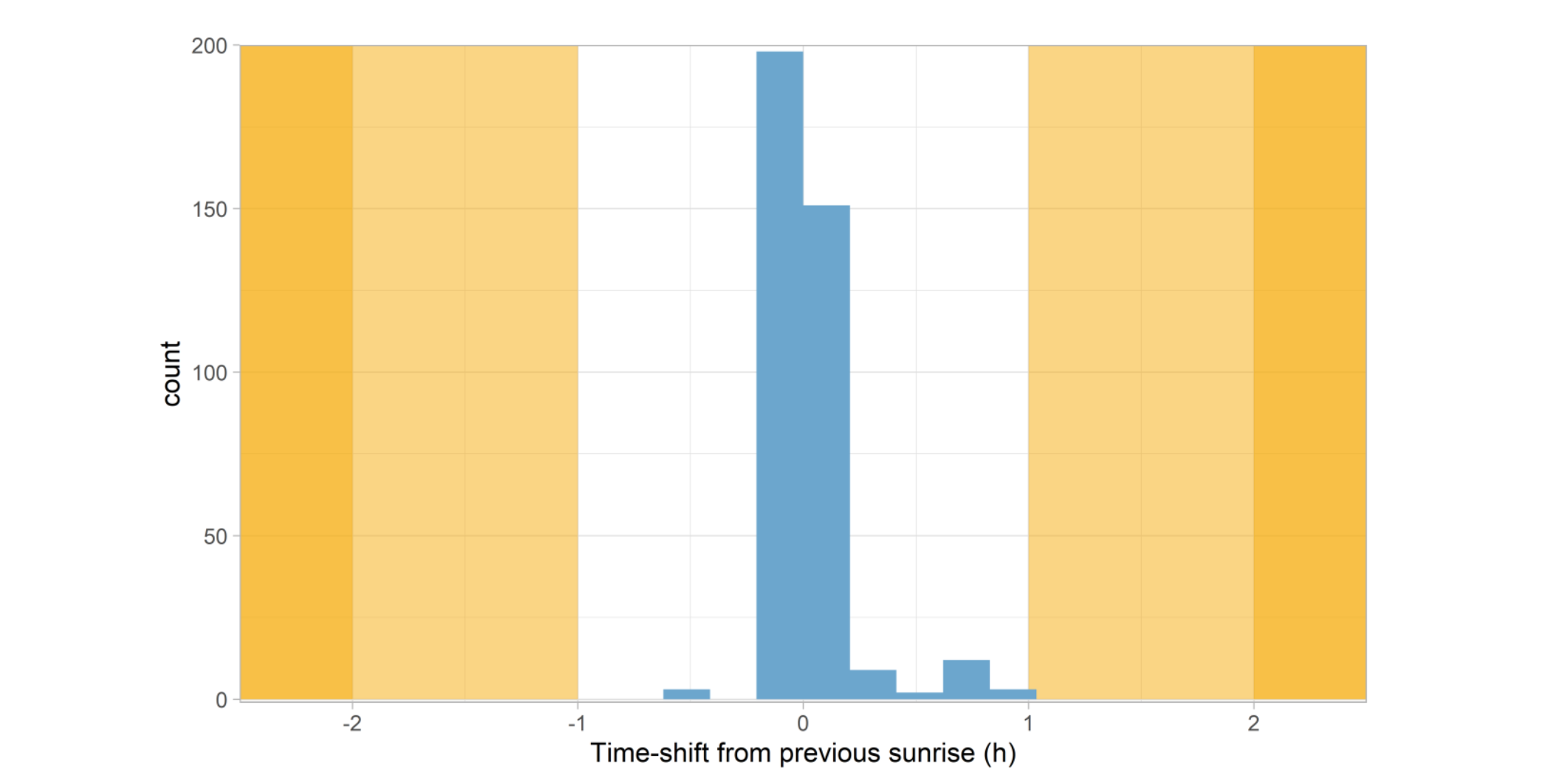
bout of homing in the analysis. The maximum time-shift is 0.94 hours, below the 1-2 hours by
which animals can reset their clock within a single light-dark cycle. © Lewin et al., Science | AAAS
This error is made possible by the fact that their internal compass relies on the Sun, more specifically on the endogenous clock to track the Sun’s arc. When travelling east-west, time shifts can cause mismatches between their internal clock and local time.
“For most navigational tasks, it is thought that compass systems are used in conjunction with a map system in a kind of two-step process. In the map step, the animal determines where it is in relation to a goal, such as a home colony. Then in the compass step it uses a compass to translate that into movement,” Tim Guilford, a University of Oxford professor of animal behaviour and one of the study’s lead authors, told Reuters.
Due to this double control system, most adult shearwaters did not steer off course very much. At most, their route was off by 15 degrees, which they were able to correct rather quickly. Generally speaking, this led to an extra 5 kilometres during a 1,000 kilometre journey. However, first-time migrant birds could be thrown off by hundreds of kilometres as they do not yet have a map sense to set them straight.
Scientists have discovered that humans aren’t the only species to suffer from jet lag: Birds can get it, too. While studying Manx Shearwaters who fly over the Atlantic Ocean, they noticed the time zone change would cause them to veer off course and lose track of where they are. https://t.co/9GR0LFmEF5
— Pubity (@pubity) October 30, 2026
“Animals use an internal clock to do this, the same one that tells our bodies when to sleep, when to be active. The process behind what we’re observing here — the mismatch between the internal clock and external time caused by longitudinal movements — is exactly the same as what causes jet lag in humans,” stated Patrick Lewin, an ecologist at the University of Oxford and the study’s lead author, in an interview with Reuters.
The study is a first of its kind, tracking the effect of large east-west journeys on birds under natural circumstances. As the errors remain relatively small, it is not yet clear what the effect of the jet lag on the birds may be. However, consequences on their diet, reproductive scheme, and other aspects of their lives are not ruled out. By studying and understanding the effect of such jet lags on the birds, the researchers believe they may gain a better understanding of the long-term effects on humans.