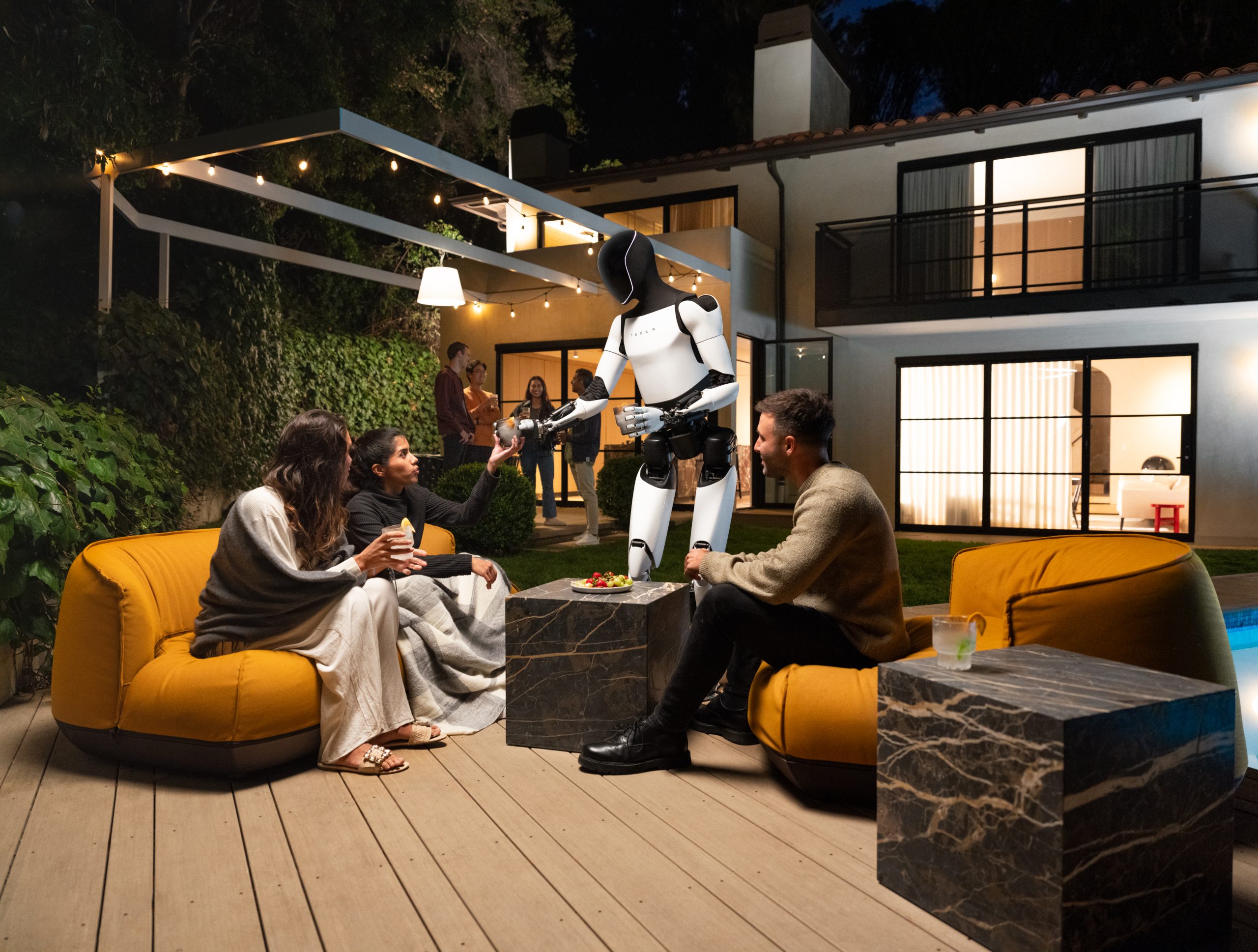

Tesla has announced that manufacturing has begun in Fremont, California, on its Optimus humanoids, with a view to scaling up to 20,000 of the robots by the end of 2027. The news came in a quarterly update to shareholders.
The development might, for some, conjure images of a Star Wars droid army production line; however, Tesla CEO Elon Musk has been accused of hyperbolic claims for his products in the past and, this time, even he warned investors that the path to full-scale consumer-ready production would be “bumpy.” He noted there are “still some things we need to tweak about the design, because you need to deliver a robot that is safe and reliable and has long duration.”
Nonetheless, the vision of a droid training facility may not be so far from the truth. One of the biggest problems to solve, according to Musk, is building robot hands. He said Tesla is creating an “Optimus Academy,” where robots will practice tasks and generate data to improve the AI models that power them. The company needs to reach 400 megawatts of training computing capacity by the end of 2026, and Musk added it will be April 2027 before the new Tesla AI5 chip can be installed in the robots, giving the droids a “big step change in intelligence.”
Q3 Shareholder Update → https://t.co/u0UcDOuMNa Highlights – FSD Supervised attach rate grew to over 75% of new vehicle deliveries in NA – Unveiled the next-gen Roadster – Record deliveries in Canada, Australia, Japan & Taiwan – Tesla Semi now in volume production. Top variant can go up to 500 miles at a full 82,000 lbs while achieving efficiency of 1.7 kWh/mile – about a third of the energy a comparable diesel truck burns for the same load – Ended the quarter with the largest backlog for our passenger vehicles in 4 years! FSD Supervised – 4 new approvals since Q2 (Croatia, Slovenia, Czech Republic, Slovakia) – FSD is now live in nine EU countries & used by over 100,000 customers logging more than 160 million kilometers since initial approval Robotaxi – Deployed Cybercab into our Austin fleet – Hit nearly 2 million cumulative unsupervised miles, 8x growth in the quarter – Austin service now runs 6 am to midnight, with wait times continuing to come down as we add cars & improve the orchestration algorithms – Added Grok to Cybercab with Grok Bot & Connectors, letting you interface with your inbox, calendar, files, chats and tasks, all by voice. Transport, office & living room in one Robotics – Started production of @Tesla_Optimus on our high-volume lines in Fremont. These are the first production-quality bots we’ve built, proving that the current manufacturing process for Optimus is suitable for a commercial product SI Compute – On track for 400 MW of training compute by year end, feeding both vehicle & humanoid autonomy – Austin Fab construction continues, equipment commissioning planned for 2027 Battery – Battery supply is still the limiter on how fast we ramp vehicles globally, so we’re expanding on every front: pack capacity in Berlin, cathode and lithium refining in Texas, LFP cells in Nevada – Shipped the first Megapacks built entirely with our own LFP cells – Increasing 4680 output to support ramp of Cybercab, Semi & Model Y Energy – Megafactory Texas is up & running, with Megapack 3 production started – Highest-ever order rate & backlog for energy storage Grid constraints & power availability are making Megapack the answer for SI infrastructure demand: it excels at supplying large data center loads, smooths out demand spikes, helps new projects meet grid connection rules & makes the grid itself more stable All with less local fossil fuel generation Supporting Infrastructure – Added 2,100+ net new Supercharger stalls, up 14% year over year
— Tesla (@Tesla) October 21, 2026
Despite those challenges, Tesla’s message remains that, “The bots coming off this line are the first production-quality bots that we have manufactured,” adding that their current processes are “suitable for a commercial product.” What could that product offer consumers, particularly travellers?
The first thing to note is the cost. Optimus robots are projected to cost between $20,000 and $30,000 (around €18,000 to €27,000) and, according to Tesla comments in July 2026, are currently being tested for deployment in factories, performing sorting, parts handling, and quality inspection tasks. But, as Kim Kardashian has already demonstrated, future consumer-level functions could include butler-type services, such as making cocktails or dinner when on return from a trip, packing or unpacking bags, tidying, carrying luggage, or helping navigate complex environments (a potential gamechanger for travellers with limited mobility or cognitive challenges).
Aside from computing and battery capabilities, obstacles include resistance to robot assistants within the aviation sector, which at present is imposing widespread bans on droids over battery safety concerns.
But, in 2024, at the Future Investment Initiative Institute, Musk predicted “by 2040 there will probably be more humanoid robots than there are people,” saying: “I think every one of the eight billion people of Earth, I think everyone’s going to want their Optimus buddy.” And he is not the only one attempting to answer that demand. In the US alone, competitors include Oregon State University spin-off, Agility; Archer Aviation co-founder Brett Adcock’s Figure AI; as well as Sunday Robotics, 1X, and Weave Robotics, which are all slated to roll out manufacturing this autumn. Meanwhile, around the world, firms such as Lenovo are developing similar bots, including the Daystar Legged Robot. Already reported by Travel Tomorrow, it’s a six-limbed dog-like assistant promising high mobility and stability across complex terrains that can carry up to 100kg upstairs, conduct wilderness surveys, and potentially perform emergency rescues, working for 24 hours a day without getting tired.
Spending on such developments is huge at a time when Tesla, for one, faces pressure on profits in its core automotive business. But these products could transform how we reach, explore, and inhabit the world (and space), with potentially groundbreaking implications.