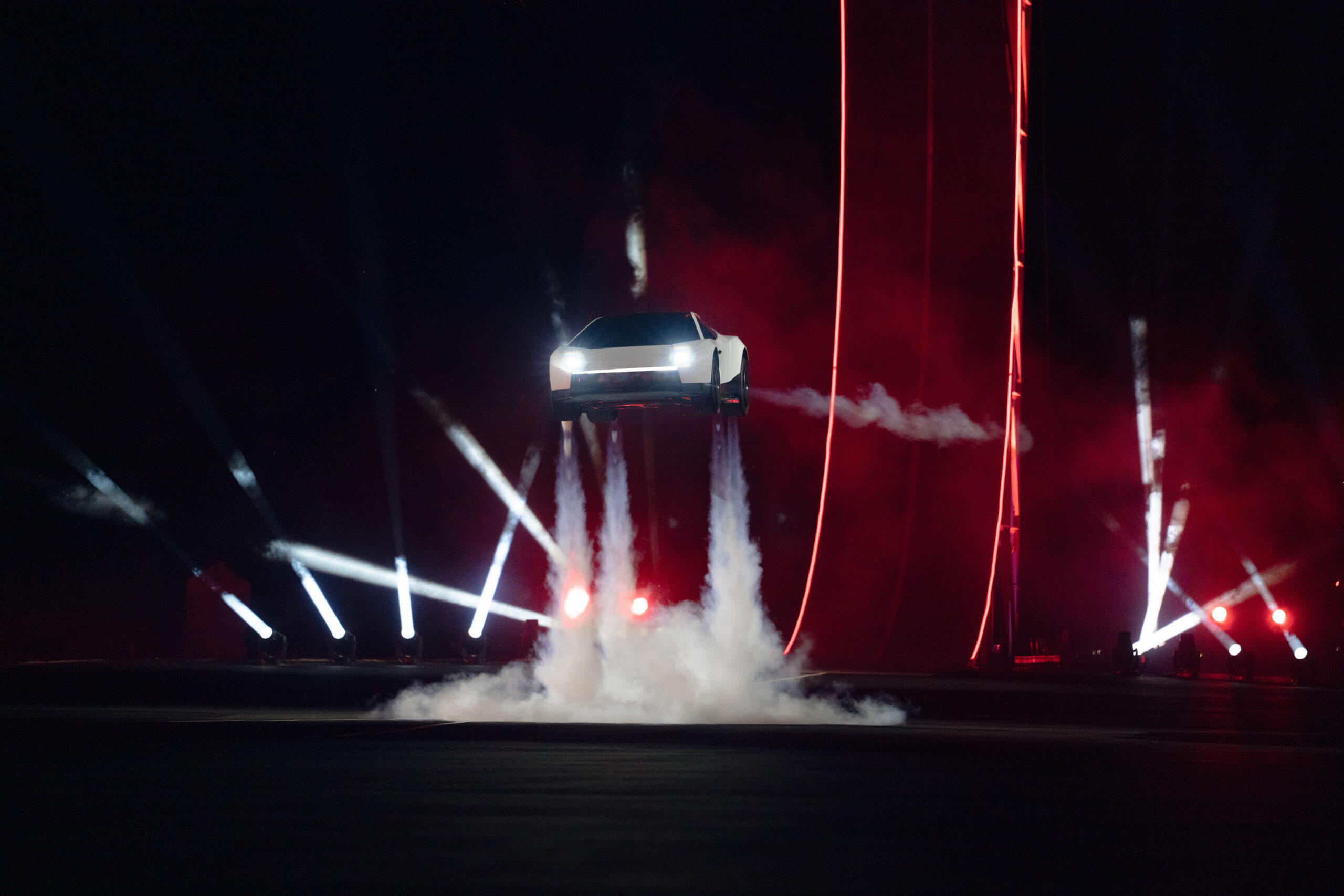


Tesla has unveiled a new version of its long-awaited Roadster that can briefly take to the air, adding rocket-inspired manoeuvres to the debate over the future of personal travel.
Presented at SpaceX’s Rocket Test and Development Center in McGregor, Texas, on 15 October, the two-seater performed airborne flips and a claimed 0–60 mph acceleration run of 0.81 seconds. Elon Musk said production was now targeted for 2028, extending the wait for a car first unveiled in 2017 with deliveries initially promised for 2020.
For travellers, the distinction is between an airborne demonstration and a vehicle capable of making practical journeys through the sky. The launch showcased short aerial manoeuvres, rather than a passenger flight between destinations.
SpaceX technology takes the Roadster airborne
During the demonstration, the Roadster climbed a curved ramp, travelled upside down and launched into the air before flipping and landing. Another manoeuvre sent it over a line-up of Tesla vehicles.
Tesla’s engineering team said the car combines an underside fan system, which increases grip by creating suction, with compressed-air thrusters developed using SpaceX technology. Separate nozzles control the vehicle’s orientation in the air.
Real life, baby https://t.co/3QEqn18wig
— Tesla (@Tesla) October 16, 2026
There was no human driver aboard for the airborne stunt. Musk said the demonstration used autonomous control to avoid putting anyone inside at risk.
The company’s Roadster page states that its Thrust features are an optional upgrade and that the Rocket trim will not be available in every region.
What could it mean for travel?
The unveiling adds another interpretation to the term “flying car”, which already covers markedly different approaches to transport.
Slovakia’s AirCar received airworthiness certification in 2022 after completing more than 70 hours of flight testing. Its development included a 35-minute flight between Nitra and Bratislava, demonstrating the kind of journey that could connect road travel with regional aviation.
Tesla’s presentation focused instead on extreme performance and brief airborne stunts. It offered no passenger service, intercity flight schedule or evidence of sustained flight between destinations.
Holy smokes https://t.co/rTnRobllwc
— Tesla (@Tesla) October 16, 2026
For now, its relevance to tourism lies more in the potential appeal of an unusual driving experience than in replacing airport transfers or regional flights. Whether such experiences become commercially available will depend on production, operating restrictions and the permissions granted in individual markets.
European availability remains uncertain
Musk acknowledged that the Roadster might not be legal in every jurisdiction. Tesla’s UK website also specifies left-hand drive only, a consideration for prospective British buyers.
The launch leaves questions about where owners could use its airborne capabilities and under what conditions. A demonstration at a controlled test site does not establish permission to perform the same manoeuvres on public roads.
Tesla’s wider transport ambitions include its Cybercab and Robovan concepts, presented in 2024 as part of its push towards autonomous mobility. Musk positioned the Roadster as an exception, saying it would eventually be the company’s only manually driven model.
The final purchase price has not been announced. With production targeted for 2028, the Roadster remains a prospective product whose everyday travel applications have yet to be demonstrated.