

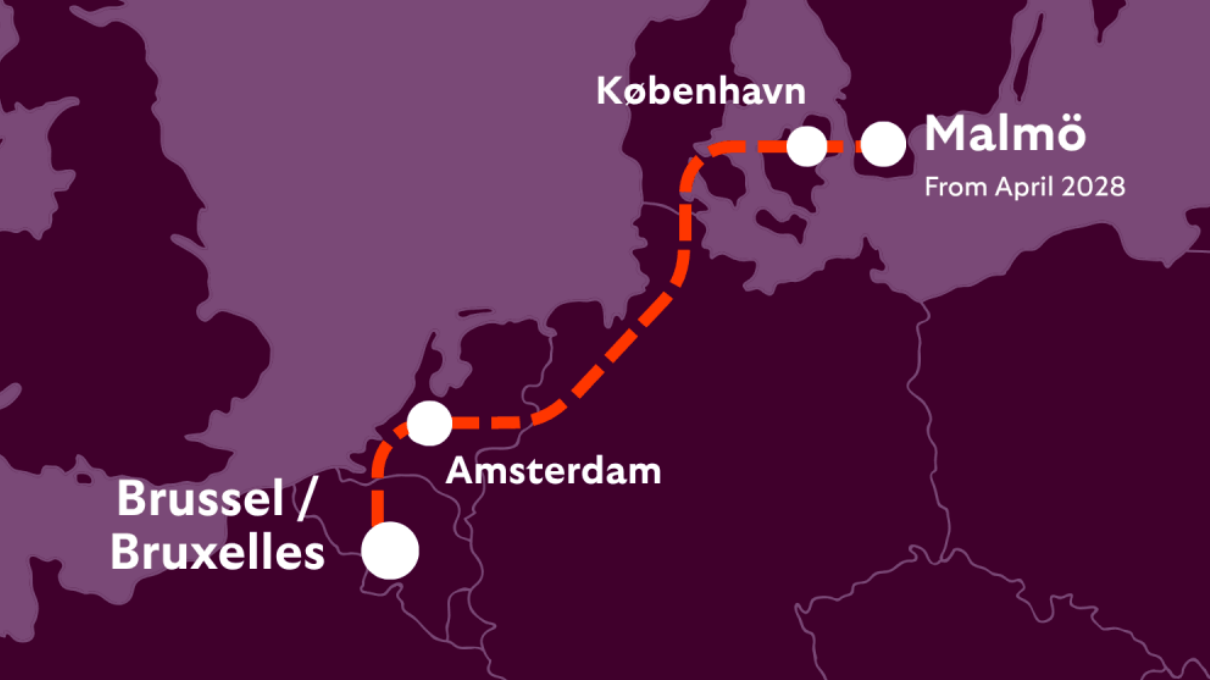
A new night train connecting the heart of Europe with its Nordic neighbours could be on its way by spring 2028, according to an announcement by European Sleeper hailing the advent of a train from Belgium and The Netherlands to Denmark and Sweden.
Stops currently listed on the European Sleeper website for the future route include Brussels, Antwerp, Rotterdam, The Hague, Amsterdam, and Copenhagen. Departures from both Brussels and Malmö will be timetabled three times a week at around 7:00 pm, European Sleeper said in promotional materials, with arrival at around 10:00 am the following morning. This way, the train firm says, “you can start your day in the Benelux or Scandinavia well rested.”
On-board accommodation is likely to include European Sleeper’s typical range of seats, couchettes, and sleeping compartments but, amid the “premiumization” of travel, more “luxurious” configurations such as double beds and private en-suite bathrooms are “being considered,” press information reveals.
The service will be the Belgian-Dutch operator’s first to Scandinavia, and will rely on a partnership with Germany’s RDC, a rail firm that already works with European Sleeper on Paris-Berlin and Milan routes.
Markus Hunkel, chief executive officer of RDC, explained: “RDC has many years of experience operating night trains between Germany and Scandinavia. Together with European Sleeper, we can build on that experience and create a strong new connection between the Benelux, Denmark, and Sweden. We see real potential in combining our operational expertise with European Sleeper’s growing network and customer reach.”
European Sleeper already runs a suite of night trains to destinations in Germany, including Hamburg, Berlin, and Dresden, as well as to Prague in the Czech Republic. Delayed by a few months due to track works and regulatory issues, a new service is coming from 9 September 2026, through Switzerland and on to Italy’s Milan—a route the train firm has described as an important north-south axis. Brussels-Barcelona is also an upcoming connection.
“Our network is growing quickly, and Scandinavia is a natural next step,” said Chris Engelsman of European Sleeper.
Though separate infrastructure, different rail gauges, multiple websites, and ticketing challenges have historically dogged the development of pan-European rail travel, the segment is now growing rapidly, supported by legislation and subsidies that are making never-before-seen itineraries possible. That includes an epic 5,000-km rail adventure from the southern tip of Europe on Portugal’s Algarve to Finland’s northernmost train station of Kolari that is being hailed as the longest train journey in Europe.