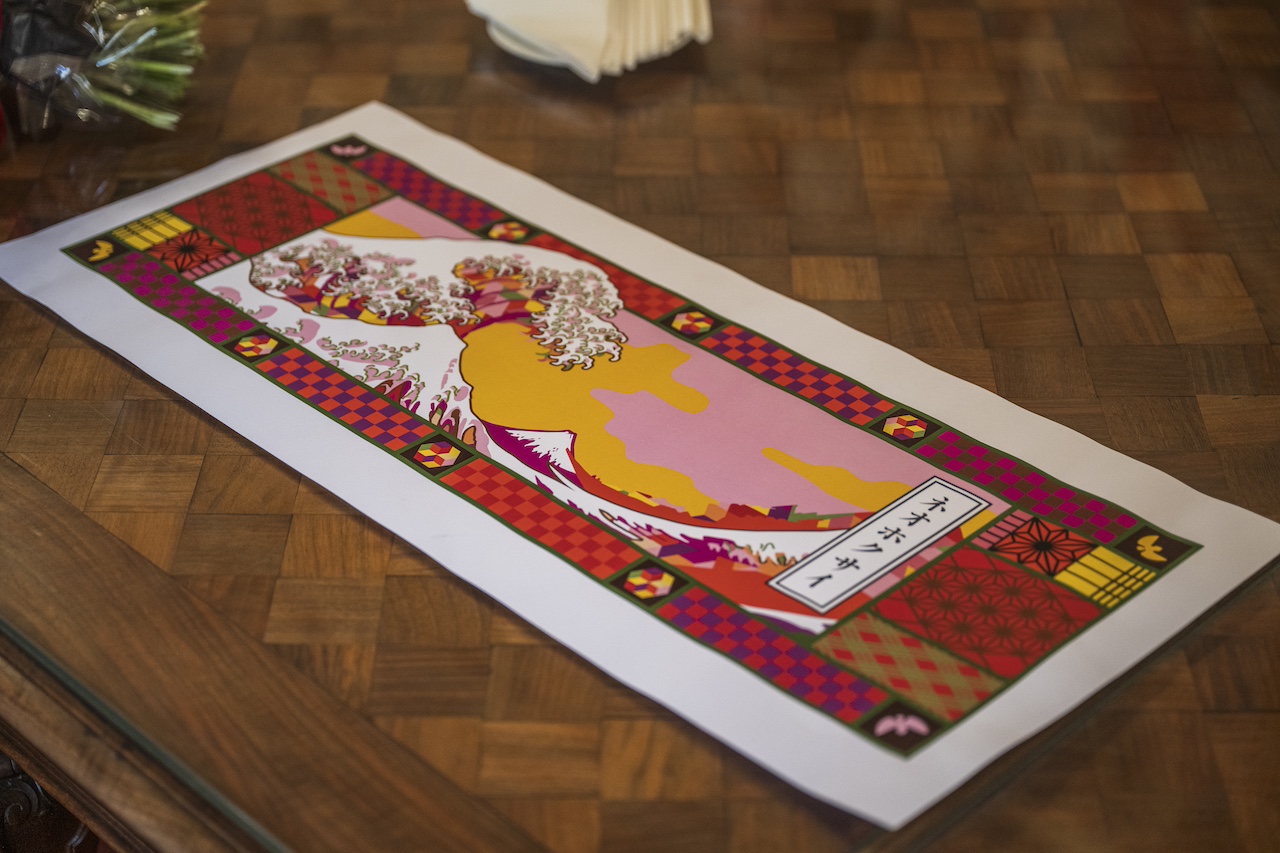


Hokusai’s iconic Great Wave off Kanagawa will take centre stage in this year’s edition of the flower carpet, which covers Brussels’ Grand-Place for four days next week.
The event usually attracts visitors from around the world, and this 24th edition promises to delight flower lovers, admirers of the celebrated Japanese artist, and anyone eager to witness one of Belgium’s most colourful traditions. Covering nearly 1,680 m², the carpet will be composed of around 700,000 flowers.
This year’s edition introduces two major changes. The traditional begonias have been replaced by dahlias, as begonia cultivation in Belgium has declined in recent years. Dahlias were also chosen for their wider range of vibrant colours. And for the first time, a second flower carpet, inspired by hops as a tribute to Belgium’s brewing heritage, will be installed at the Brussels Bourse.
The design for the main carpet was proposed by Japan, an honour traditionally reserved for the partner country, while the planting itself is carried out by the Belgian non-profit organisation Tapis de Fleurs. Each flower is inserted by hand into rolls of turf and watered throughout the event, particularly during periods of intense summer heat.
More than 100 volunteer gardeners assemble the carpet in under six hours before filling the remaining gaps with turf the day before the opening. Packed so densely, the flowers create their own microclimate, allowing the display to remain fresh throughout its four-day run.
The reinterpretation of Hokusai’s masterpiece was created by Japanese contemporary artist and Kyoto University of the Arts lecturer Hiro Sugiyama together with his Tokyo-based creative collective Enlightenment, known for blending pop culture with contemporary Japanese aesthetics.
Sugiyama, who began producing digital art after co-founding Enlightenment before returning primarily to analogue painting in 2010, said the project seeks to bridge tradition and modernity.
“Through this synthesis, I seek to connect the past and the future, the analogue and the digital, Japanese culture and contemporary art. In this pivotal year marking 160 years of friendship between Belgium and Japan, I am delighted to bring this work to life in the form of a Flower carpet,” he said.
Japan’s ambassador to Belgium, Takeshi Osuga, highlighted the symbolic role that flowers play in both Japan and Belgium.
“The love of flowers is a universal language. In both Japan and Belgium, flowers hold a special place in our cultural and social lives,” he said.
The Grand-Place, often described as one of the world’s most beautiful squares, combines Gothic, Baroque and neo-Gothic architecture. Dating back to the 15th century, it was rebuilt by the city’s guilds after the French bombardment of 1695 and has been a UNESCO World Heritage Site since 1998.
This is the second Flower Carpet celebrating Belgium-Japan friendship. In 2016, the Grand-Place was transformed into a Japanese-inspired landscape featuring traditional motifs, birds, koi carp and natural scenery to mark 150 years of diplomatic relations between the two countries. Those eager for an early glimpse can already head to nearby Mini-Europe, where a miniature version of the 2026 Flower Carpet has been recreated on its scale replica of the Grand-Place ahead of the official opening on 13 August.
Practical info
Open 13–16 August 2026. Access to the Grand-Place is free. A panoramic view of the carpet is available from the balcony of the Hôtel de Ville (tickets required). For a full 360° view over the city and the carpet, the separate View Tower Experience takes visitors up the 200 steps of the City Hall Tower.