


Brussels Airlines is giving astronomy enthusiasts a unique chance to observe the partial solar eclipse on 12 August 2026 from above the clouds. The airline is organising a special evening flight in collaboration with Urania Public Observatory, the University of Antwerp and Vrije Universiteit Brussel (VUB). The flight will depart from Brussels Airport and head towards France aboard an Airbus A320. During the journey, passengers are expected to witness a solar eclipse with a maximum obscuration of 96%, meaning that almost the entire surface of the sun will be covered by the moon.
The flight is expected to attract both aviation and astronomy enthusiasts, as opportunities to observe such a deep eclipse from the air are extremely rare. Check-in at Brussels Airport will begin at 5:20 pm, before the Airbus A320 departs for France at 7:20 pm. The eclipse is expected to reach its maximum at 8:21 pm, with the aircraft returning to Brussels at around 9:20 pm.
Only 100 seats are available because the aisle seats will remain empty, giving passengers a better view through the windows. Travellers will also receive special eclipse glasses and will be accompanied by experienced Urania guides throughout the flight. According to the organisers, a similar eclipse flight departing from Belgium will not be possible again until 23 September 2090.
Although the eclipse will also be visible from Belgium, observing it from the ground may prove difficult. During the event, the sun will be very low above the horizon, making visibility highly dependent on local weather conditions. Even a thin layer of clouds could hide much of the phenomenon. Flying above the cloud cover offers passengers a much greater chance of enjoying an uninterrupted view.
A partial solar eclipse occurs when the moon moves between the Earth and the sun, covering part of the sun’s disc. In this case, up to 96% of the sun will be hidden from view, leaving only a thin crescent of sunlight visible. This level of obscuration is considered exceptionally high for an eclipse that can be observed from Belgium. Once the eclipse reaches around 90% obscuration, observers may even see the moon’s shadow moving across the cloud layer or the landscape below as a dark band.
The eclipse flight is not only designed for passengers looking for a memorable experience. Researchers and students from the University of Antwerp and VUB will also use the flight to study how the atmosphere behaves during a deep partial solar eclipse. The research will be supervised by Prof. Dr Katrien Kolenberg and Prof. Dr Valéry Ann Jacobs.
The team will measure several effects that occur as the moon blocks more and more sunlight. These include changes in light intensity, the darkness of the sky, temperature variations and the blue-green twilight effect that can appear during a deep eclipse. The same measurements will be carried out simultaneously on the ground in Spain. By comparing both sets of observations, researchers hope to better understand the influence of the approximately 11 kilometres of atmosphere between the aircraft and the Earth’s surface.
Participants will also be invited to a preparation evening at Urania’s observatory in Hove on 8 August 2026. During the session, experts will explain how the eclipse develops, present the flight programme and organise a planetarium show. The €299 ticket includes the information evening, the two-hour eclipse flight towards Nantes, eclipse glasses and onboard guidance from Urania specialists.
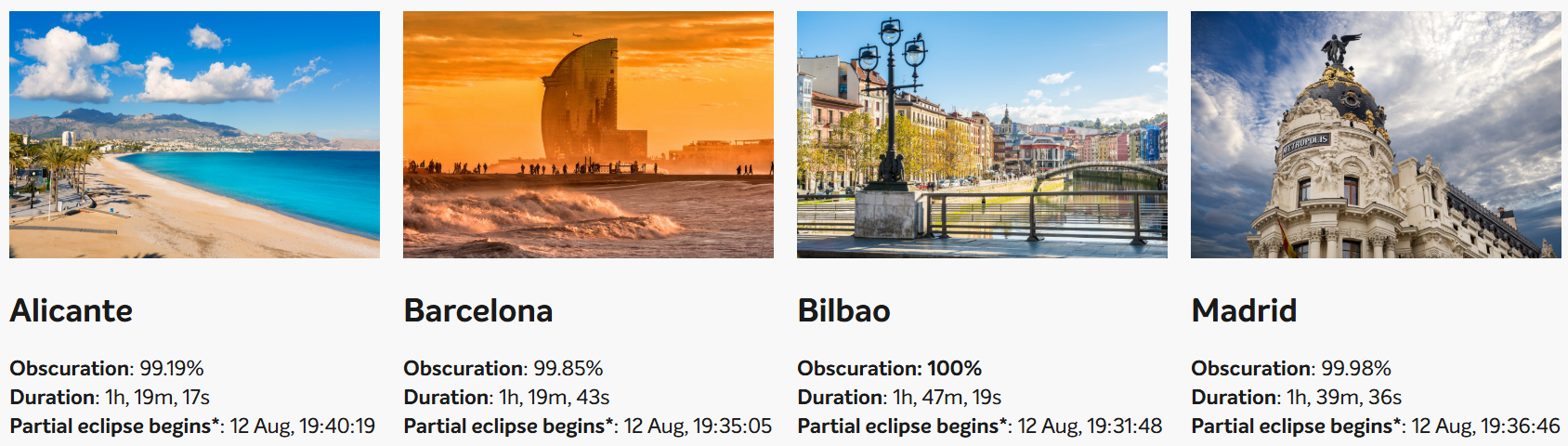
Travellers who prefer to stay on the ground can also experience the eclipse in southern Europe. Brussels Airlines has highlighted several destinations in Spain, as well as selected cities in France and Portugal, that lie close to the eclipse’s path. Depending on the location, visitors will be able to experience between 97% and 100% obscuration, making them some of the best places in Europe to watch the event.
Among the destinations, Bilbao, Valencia and Palma de Mallorca are expected to experience 100% obscuration, while Madrid will reach 99.98%. Barcelona is forecast to see 99.85% obscuration and Alicante 99.19%. Toulouse in France and Porto in Portugal will also offer excellent viewing conditions, with obscuration levels of 97.87% and 98.26%, respectively. Brussels Airlines notes that travellers may even be able to observe the eclipse from certain regular flights passing over northern Spain, although visibility will depend on the weather, flight path and operational conditions.
The eclipse on 12 August 2026 is expected to attract visitors from across Europe, with Spain among the most popular destinations for those hoping to enjoy clear skies. Whether viewed from a dedicated eclipse flight or from the ground, it promises to be one of the continent’s most remarkable astronomical events in the coming years.