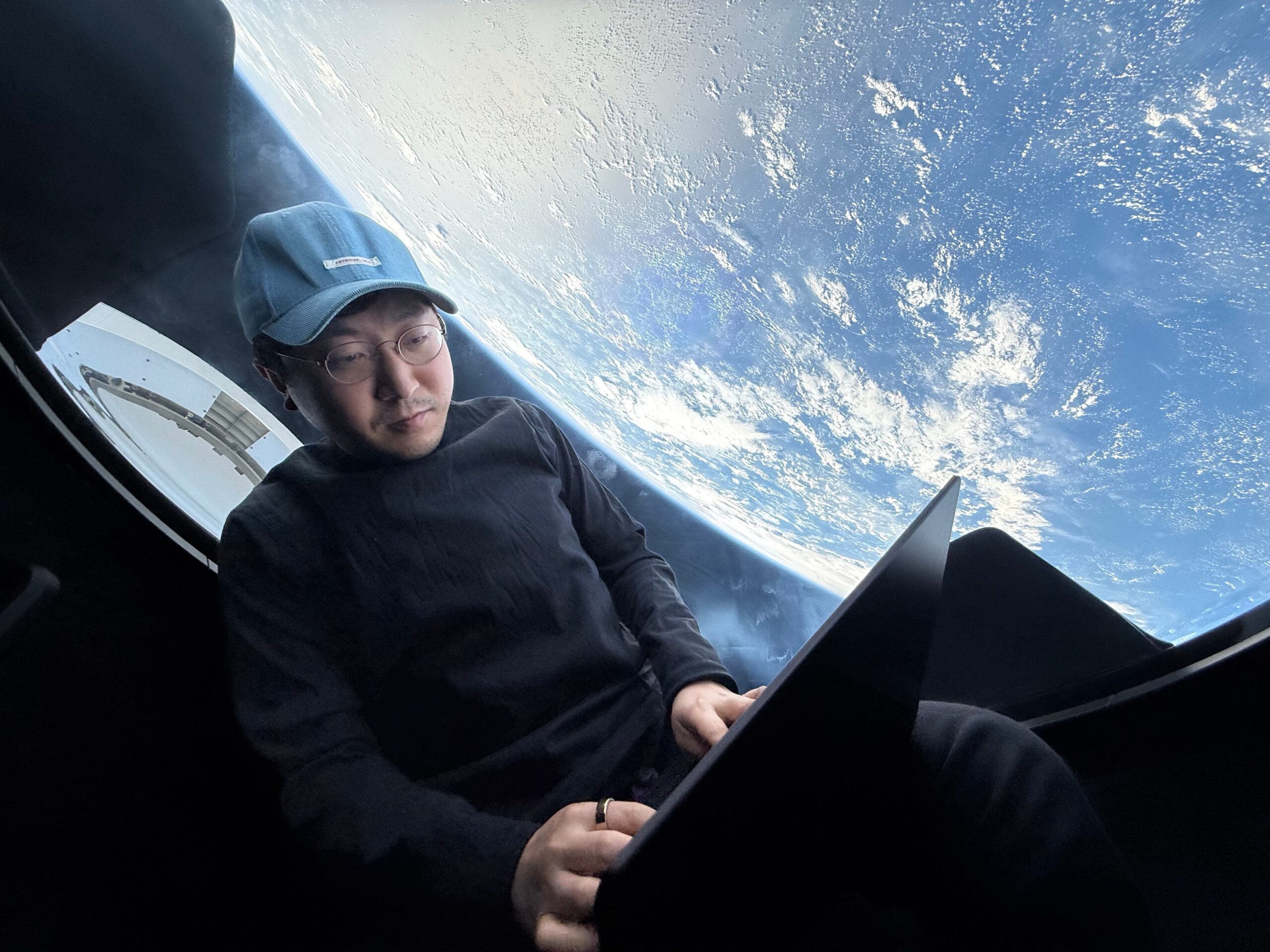



Millionaires go to the Moon, billionaires go to Mars. It sounds like the tagline of a new sci-fi blockbuster, except this one is real and the billionaire gets both.
SpaceX has announced plans to send crypto billionaire Chun Wang on a flyby mission of Mars, roughly 225 million kilometres away. The 43-year-old revealed the mission during a live SpaceX webcast, confirming that he will serve as mission commander.
The Chinese-born entrepreneur made his fortune after dropping out of university, by developing one of the country’s most successful Bitcoin mining pools. He hit the jackpot just before the Chinese government shut down all crypto activities in 2021.
Starship will fly us to Mars. 🚀 pic.twitter.com/3Zyx64ugpt
— Chun (@satofishi) May 21, 2026
This will not be his first ride with SpaceX. In April 2025, he funded and flew aboard the Fram2 mission – the first human spaceflight to orbit directly over Earth’s poles. Christopher Combs from the University of Texas described the mission as “a notch above a gimmick, but not exactly a groundbreaking milestone”.
Before the Mars mission, Wang is also expected to join Dennis Tito, the 85-year-old investor who became the world’s first space tourist in 2001, on a private Moon mission.
The Mars mission will take up to two years and will be much more challenging. Nevertheless, Wang insisted he was unconcerned, saying he could “stare at the map view on aeroplanes from take-off through to landing, so I think I’m going to enjoy the trip”.
Fram2’s Mission Commander @satofishi is set to fly aboard Starship’s first interplanetary human spaceflight mission → https://t.co/7ehxZJSGXd pic.twitter.com/YkzvgDxMC9
— SpaceX (@SpaceX) May 21, 2026
The rest of the crew has yet to be announced, and SpaceX has revealed little about the cost or timeline of the mission.
For now, ambitions are deliberately restrained. Rather than promising colonies and Martian cities, Wang has framed the mission as a first symbolic step.
“A lot of people are talking about how Mars will be like ‘We’re going to fly to Mars, we’re going to land on Mars, we’re going to build a city on Mars’. But let’s get this started with a flyby. It will light the fire. It will ignite the imagination, and it will build the momentum.”
The project remains heavily dependent on SpaceX’s troubled Starship launch vehicle, which has suffered repeated technical setbacks. The company was forced to abandon another test launch of its upgraded spacecraft last week.
Falcon Heavy will launch the Rosalind Franklin rover to Mars in late 2028 https://t.co/Dis4Y11v5U pic.twitter.com/ekR2r8uAJr
— SpaceX (@SpaceX) April 17, 2026
Wang, now a Maltese citizen living on the remote Norwegian Arctic archipelago of Svalbard, documents his globetrotting lifestyle extensively on X, where he once posted that “Mr Musk is my God”.
His stated ambition is to visit every country in the world, an obsession that began after his grandfather returned home one day with a world map he had found on a walk.
“What truly caught my eye was the empty space at the bottom of the map – the polar regions,” he told reporters last year. “From that moment on, I was fascinated by the mystery and excitement of these distant and unknown places.”
Meanwhile, SpaceX itself continues its own astronomical ascent. The company is expected to reach a record valuation of $1.74 trillion when it goes public next month.
Not everyone seems eager to see the Mars mission succeed, however. Social media reactions quickly turned cynical, with some users joking that “all the crypto billionaires” should be sent along.
There is also a practical complication: Mars launch windows only open roughly every 26 months, when Earth and Mars align correctly in their orbits around the Sun. Miss the departure slot by even a few days, and the crew could find themselves waiting more than two years for another chance.