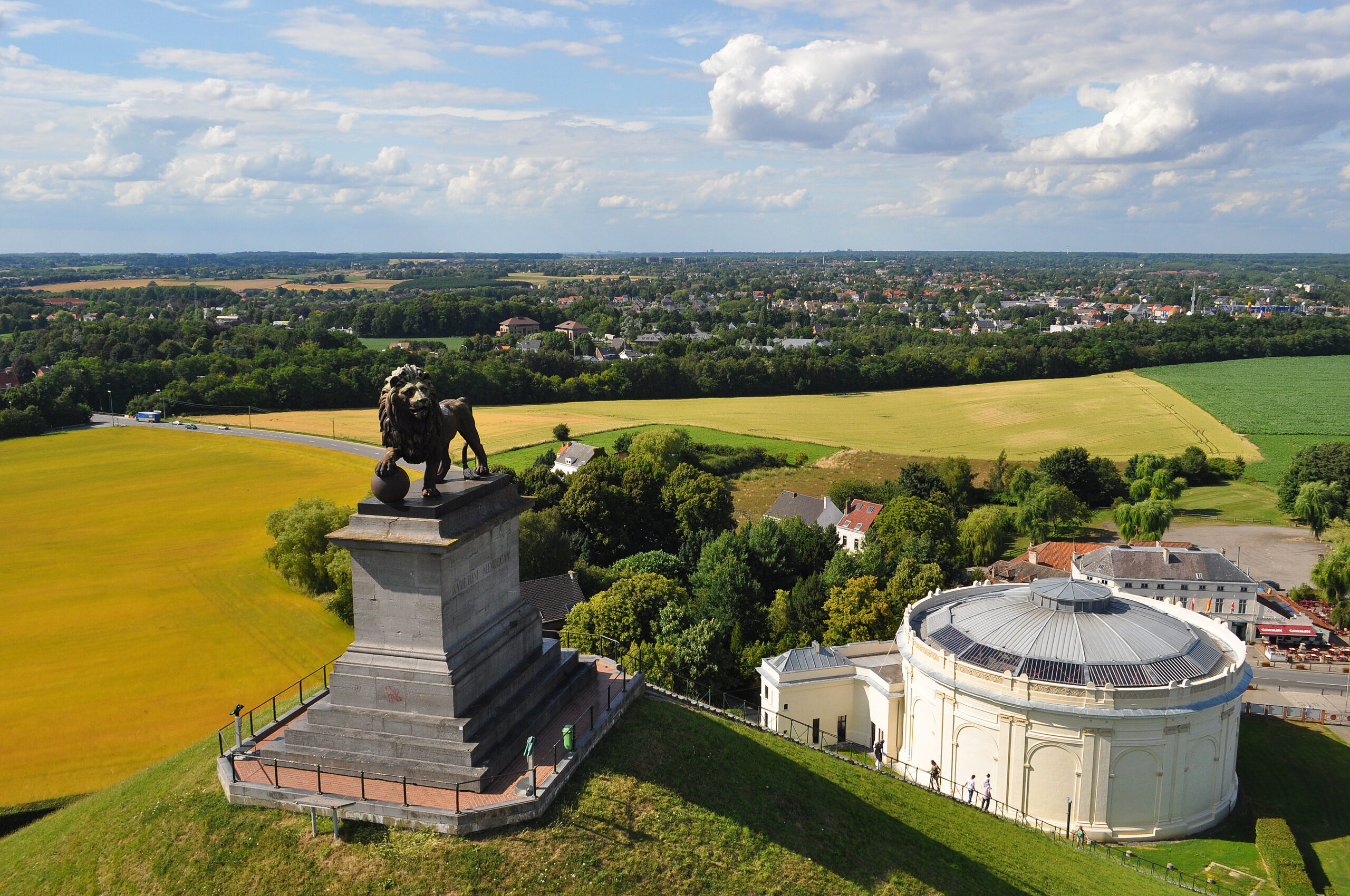



In a field south of the Belgian capital, stands a hillside monument to a battle so famous it has become a metaphor and a winning Eurovision song. The Lion of Waterloo, or the Lion’s Mound, a memorial to the Battle of Waterloo fought on 18 June 1815, has now seen the end of renovation works intended to mark its 200th anniversary.
Inaugurated on 1926, having been commissioned by King William I of the Netherlands, to commemorate the location on the battlefield of Waterloo where a musket ball hit the shoulder of his elder son, the then Prince of Orange, the Lion’s Mound is a cone-shaped hill, 46-metres in height, scaled by 226 steps and topped by a statue of a Medici-style lion, with its paw upon a ball.
It has become a symbol for the end of the Napoleonic Wars, when the French Imperial Army under the command of Napoleon was defeated by two allied forces of the Seventh Coalition, one of which was led by the British Duke of Wellington. Visible from the road, the Mound is uncontroversial and is driven past by thousands of cars a day, but at the time of its creation, it was criticised by Victor Hugo, who said the man-made hill meant the “real relief” of the landscape “had been taken away, and history, disconcerted, no longer finds her bearings there. It has been disfigured for the sake of glorifying it.”
Two hundred years and five months of renovation work later, costing the Belgian federal government €650,000, with funding contributed by the National Lottery, the restored lion was unveiled on Friday 22 May at a ceremony attended by Federal Minister responsible for State Property Management Vanessa Matz, responsible for State Property Management, Vanessa Matz, and Walloon minister for Heritage, Valérie Lescresnier.
The works involved repairs to the long staircase to the top, including its steps, balustrade, and handrail. Stone and cast-iron elements were refurbished, as well as the statue of the lion itself.
Comprising nine parts, the 4.45-metre-high lion received work to improve its assembly and stability after drone and borescope inspections showed failings. The lion also received a “time capsule,” containing technical documents describing the work undertaken, a tool, a lottery ball, and a newspaper, as well as an admission ticket for the historic visitor attraction.
Various events are lined up to mark the battle’s 200th anniversary throughout the year. These will include a free “Iconic Lion” exhibition of photos, which is set to run until 31 December and features artistic interpretations and historic imagery tracing the 40-meter-high monument’s evolution. In addition, a weekend of celebrations with concerts will take place on 15 and 16 August, and a show themed “200 years of history” is programmed for 12 September.