
The Green Claims Directive, now apparently abandoned, was used by certification businesses to create additional demand for their services, particularly in countries of the global south. It is still being used. A palpable degree of fear has been created to secure sales of certification.
Businesses that are taking responsibility need to be able to secure differentiation in the marketplace, use their positive impacts in their PR to secure market advantage from their efforts and enable consumers to make sustainable choices. Concern in the parliament about the impact of the Green Claims Directive on small businesses was one of the major reasons that it was abandoned.
Green hushing won’t help us travel more responsibly – and neither will certification.
If you are being told that you must certify to protect your business from mis-selling, reflect on the fact that certification has been remarkably unsuccessful across Europe. Recent research by Xavier Font and colleagues reveals that only 9.3% of European hotels in a sample of 82,301 properties on the Booking.com platform were certified in 2024. Certification is highly concentrated among chain-affiliated, large, high-end hotels.
The Empowering Consumers for the Green Transition Directive (ECD) will apply across the EU from September 2026 and will address further areas of mis-selling. The changes most likely to impact tourism businesses are:
- making an environmental claim that is unsubstantiated, or not based on a product’s entire life cycle
- making an environmental claim without “clear, objective, publicly available and verifiable commitments.”
It is no longer acceptable to claim that a product is green without considering how it is dealt with as waste. Obviously, this would make it impossible to suggest that potable water in a plastic bottle was “green” or that potatoes sold in non-biodegradable bags were “environmentally friendly.”
I am deeply sceptical of the value of certification schemes, most of which are based on tick boxes. Having a certificate will not provide “clear, objective, publicly available and verifiable commitments.” Nor will a certificate carry any meaning or make any connection with your potential guest. From the beginning of the Responsible Tourism Movement in the 2002 Cape Town Declaration on Responsible Tourism in Destinations, we have recognised the importance of “more enjoyable experiences for tourists through more meaningful connections with local people, and a greater understanding of local cultural, social and environmental issues.”
I cannot be sure from a certificate that a hotel composts food waste or pays above the minimum wage. Certification is opaque; the consumer cannot find out what specifically the business does. An issue hammered home to me during the drought in Cape Town in 2018. It was impossible to find out which hotels used the least water per bednight and make an appropriately informed choice about where to stay.
Worse when, as requested, you place your used towels back on the rail to reuse them, the room attendant replaces them with freshly laundered towels you cannot seek redress. The consumer who finds that the hotel fails to deliver on sustainability has little chance of securing redress; the guest cannot find out what the hotel has been certified for and has no contract with the certifying agency from which they might otherwise secure compensation for mis-selling.
Way back in 2017, I posted on the WTM Global Hub Certification: what comes next?
“Certificates are awarded for effort rather than achievement. I am less concerned about how a hotel reduces its energy consumption per bed night than that it reduces the consumption. Wouldn’t it be amazing if certificates were awarded for achieving an acceptable level of water and energy consumption per bed night, for paying wages above minimum wage levels, and meeting a minimum set of labour standards?
Wouldn’t it be even more amazing if hotels and operators published their operational performance against the standard, and the certifiers audited that performance and signed off on the evidence, thereby taking real responsibility for their certificates? Metered electricity consumption would quickly reveal the real performance of the hotel – and whether or not the room key light switches were being overridden. We need to know what the business has achieved that makes them worthy of the certification, and we need to know how they compare with others. Then, when travelling to a water-scarce region, I could choose to stay in one of the hotels with the lowest water usage per bed night or the one with the best employment conditions. Then certification would carry real meaning.
Responsible Tourism takes a much more transparent approach:
- Consider what issues arise in or from the impacts of your operations and affect your neighbours.
- Which of these issues could you address through your business, alone or working with others?
- Decide what you can afford to do without bankrupting your business and destroying jobs.
- Tell you suppliers, customers, neighbours and other businesses what you are doing and how?
- Report your impact using verifiable evidence.
Booking.com has annually reported for some time that large majorities of tourists want to travel more sustainably, but the same consumers say that there are few sustainable options available.
“Our research indicates that as many as 68% of travelers want to travel more sustainably in the coming year. However, the supply of options meeting credible sustainability criteria remains limited, and standards are often inconsistent or difficult to assess. As a result, travelers face uncertainty and lack clear, trusted information to guide their choices.” Booking.com stated in its 2025 Sustainability Report.
It just may be the case that certificates are opaque and fail to meaningfully communicate what responsible travellers are looking for. If you want to see examples of effective Responsible Tourism marketing, take a look at Responsible Travel with user content collateral.
Professor Xavier Font wrote a series of guides for tourism businesses more than a decade ago. The one produced for Failte Ireland using local examples opens with a quote from Simon Ashe of Ballynahinch Castle:” Your customers will only value your sustainability efforts if you make it fun and you communicate it with passion but without making them feel guilty.”
It is important to make your messages meaningful for your target customers – you can’t do everything, as we have seen, you need to choose. Consider your market, amongst other things, when you choose what to take responsibility for.
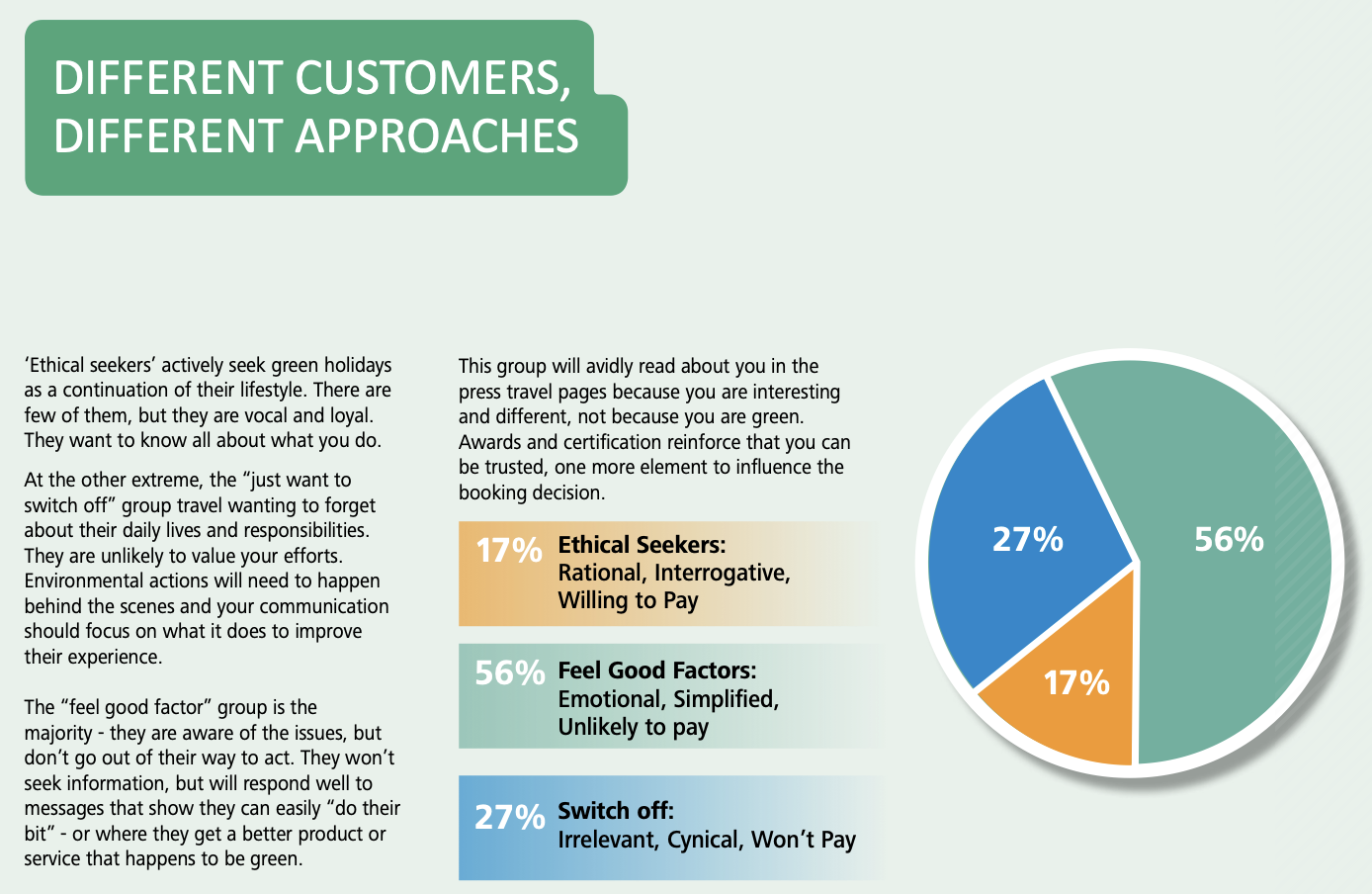
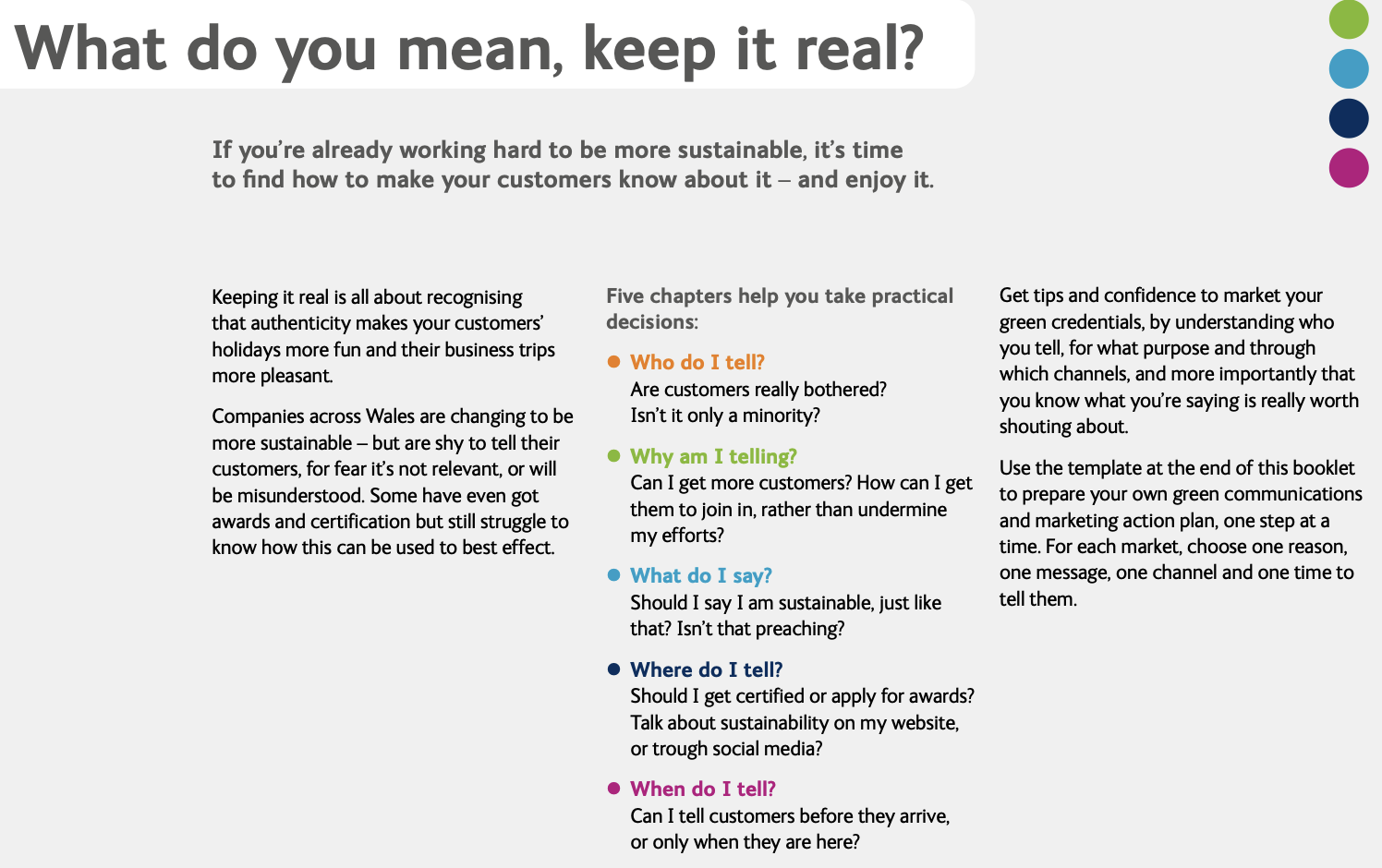
The Failte Ireland “Green Marketing Toolkit” was published back in 2011, and VisitWales published “Keep it real” in 2012.
In February 2025 Accor, Booking.com and the University of Surrey published cutting edge research on how to engage travellers and “deliver effective and engaging sustainability communications to guests.”
- Highlight sustainability practices – including for less sustainable amenities – and show how guests can easily contribute
- Balance appeals to pleasure and comfort for optimal results
- Empower guests, don’t constrain or dictate to them
- Help guests act as responsibly as they do at home
Follow the link for really helpful guidance.
The most recent research by Booking.com reveals that 85% of travellers say that more sustainable travel is important or very important to them. Older generations demonstrate greater commitment to specific, more sustainable behaviours than their younger counterparts. Less than half (47%) of the Boomer survey respondents (61+) say they want to travel more sustainably in the coming 12 months, compared to 60% of Gen Xers (45-60), 71% of Millennials (29-44) and 75% of Gen Z (18-28). Research shows that perhaps their actions speak louder than words.
- Of those who intend to travel more sustainably over the next year, two thirds of Boomers (67%) say they will reduce general waste when travelling compared to 56% of Gen X, 52% of Millennials and less than half of Gen Z (48%).
- 60% of Boomers intend to reduce energy consumption (such as turning off air conditioning and lights in their room when they aren’t there), compared to 51% of Gen X, 46% of Millennials and 42% of Gen Z.
- 59% of Boomers say they will shop more at local, independent stores on their trips compared to 50% of Gen X, 44% of Millennials, and 42% of Gen Z.
- And perhaps, unsurprisingly, older generations were much more likely to report plans to travel outside of peak season: Boomers (63%), Gen X (48%), Millennials (41%) and Gen Z (36%).
The market is increasingly complex, requiring businesses to carefully evaluate what truly matters to their clients and target audiences. Success depends on identifying and building meaningful connections that drive sustainable growth and long-term value.