

Europe’s climate-conscious travellers would love to choose the train over the plane this summer, but antiquated booking systems are making this absurdly difficult and often more expensive. On some of the continent’s busiest routes, it is still outright impossible to buy a single ticket for the full rail journey.
A new EU “single ticketing” legislative package could finally ease the hassle of connecting journeys across borders. To address this, Transport & Environment (T&E) is calling for the upcoming package to include a binding mandate requiring operators to display and sell competitors’ tickets under fair conditions.
While the aviation sector continues to face challenges, European travellers are showing a clear preference this year for staying within the continent. Demand is rising back to pre-2020 levels, driven in part by younger, environmentally conscious travellers. In theory, this should be a time when rail can step up. In practice, however, the system is holding it back.
According to analysis by Transport & Environment (T&E), it is impossible to buy a single ticket covering the entire rail journey on 20% of the EU’s busiest air routes. On a further 27%, tickets can only be purchased from one operator, forcing passengers to navigate multiple platforms.
Nine out of ten travellers turn to their national rail operator when booking. However, 61% of people who wanted to travel by train have abandoned the idea at least once because they found the process too complicated.
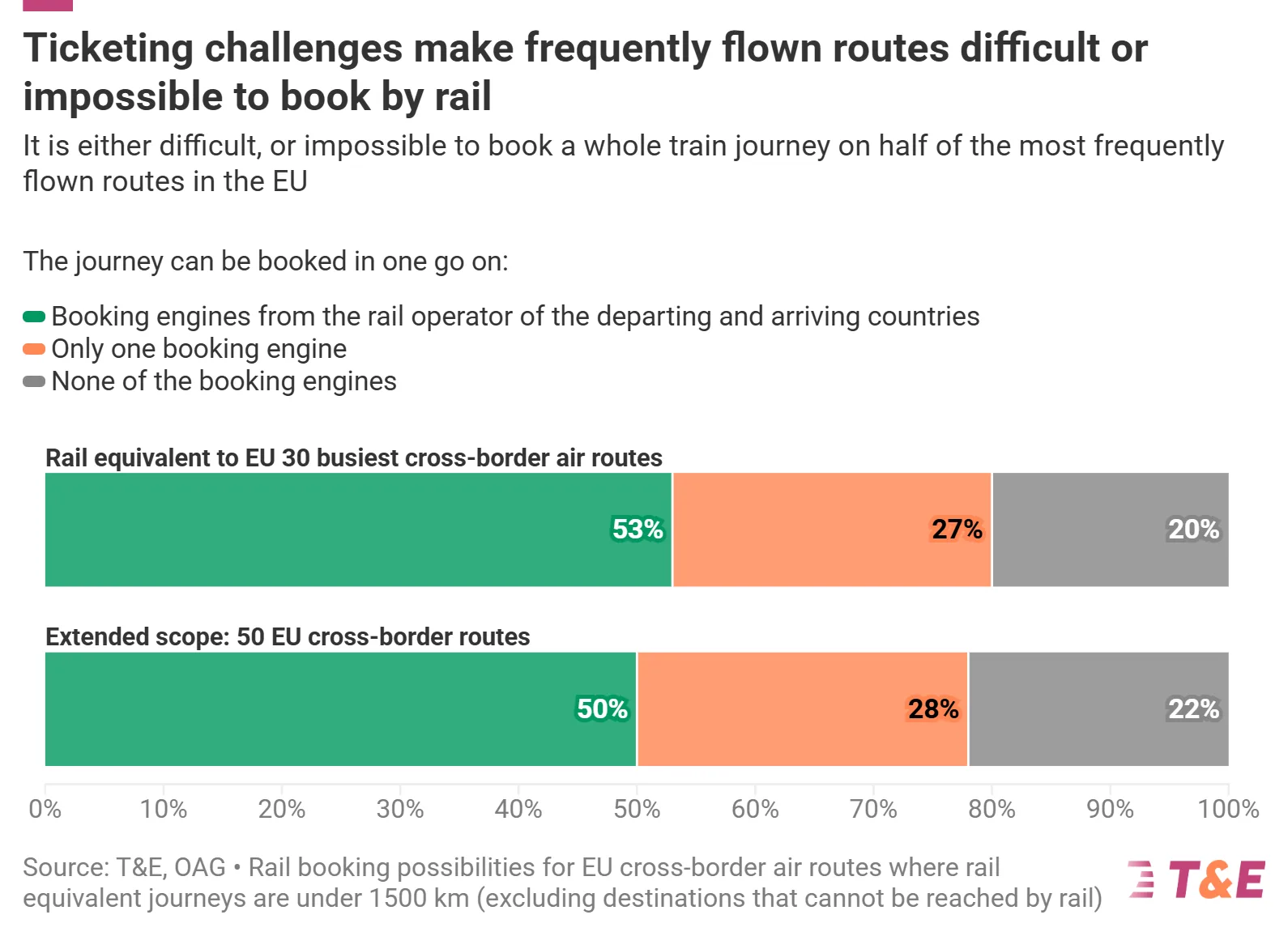
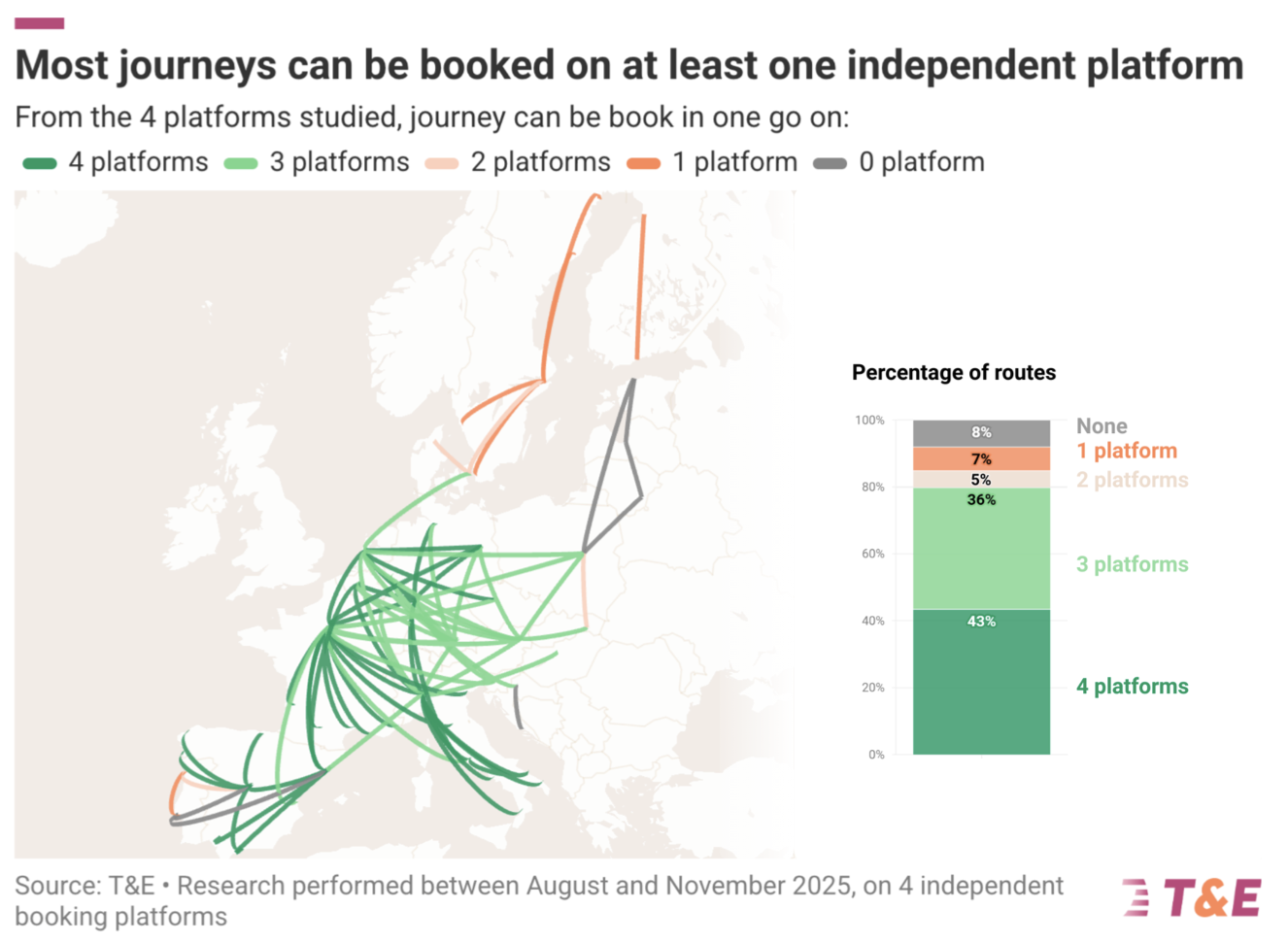
According to Austrian university research, booking a train journey can take up to 70% longer than booking a flight. Popular cross-border routes, such as Lisbon–Madrid or Barcelona–Milan, cannot be booked on any platform, while others, such as Paris–Rome or Amsterdam–Milan, are only partially available.
“This report exposes a ‘Stone Age’ system,” said Brian Caulfield, a transport researcher at Trinity College Dublin. “We are making it structurally difficult for even the most climate-conscious travellers to choose the greener option.”
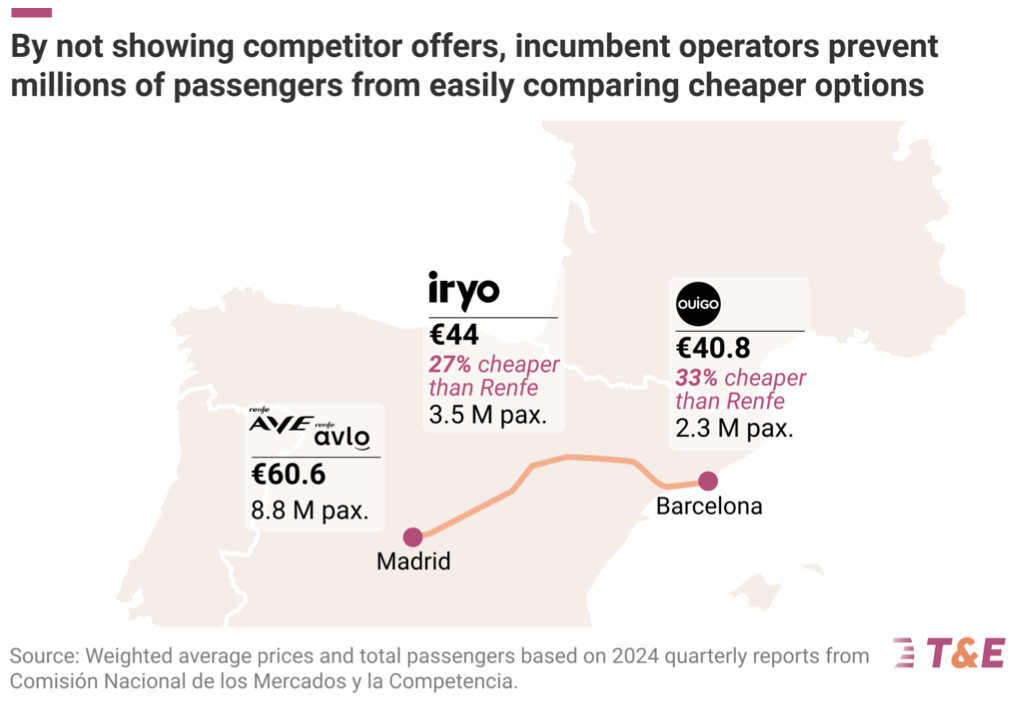
Where competition exists, it is often hidden. On 86% of route segments with multiple operators, incumbent websites do not sell competitors’ tickets and do not even display them on 59% of these segments. In Spain, Renfe tickets are, on average, about 30% more expensive than those of competitors.
Even between popular destinations such as Barcelona and Milan, where around 15,000 flights operate annually, rail passengers cannot currently purchase an end-to-end ticket.
Georgia Whitaker, a rail campaigner at T&E and author of the report, points out that price is one of the biggest barriers to travelling by rail, as it is often more expensive than flying. She adds that “passengers are often unaware that cheaper options exist because other competitive services are not displayed or sold”.
The Youth on Track Coalition has highlighted the particular challenges faced by younger travellers, who are more climate-conscious than previous generations yet still have to contend with high prices, insecure passenger rights and complex ticketing systems.
“The barriers that young people face when considering travelling by rail in the EU are huge,” said the coalition. “It shouldn’t be so hard to book a ticket for your entire journey in one place.”
Aviation is one of the hardest sectors to decarbonise, and its emissions are expected to rise sharply as passenger numbers grow. Whitaker says it “almost feels a bit silly” that such an outdated and clunky system is holding back climate action.
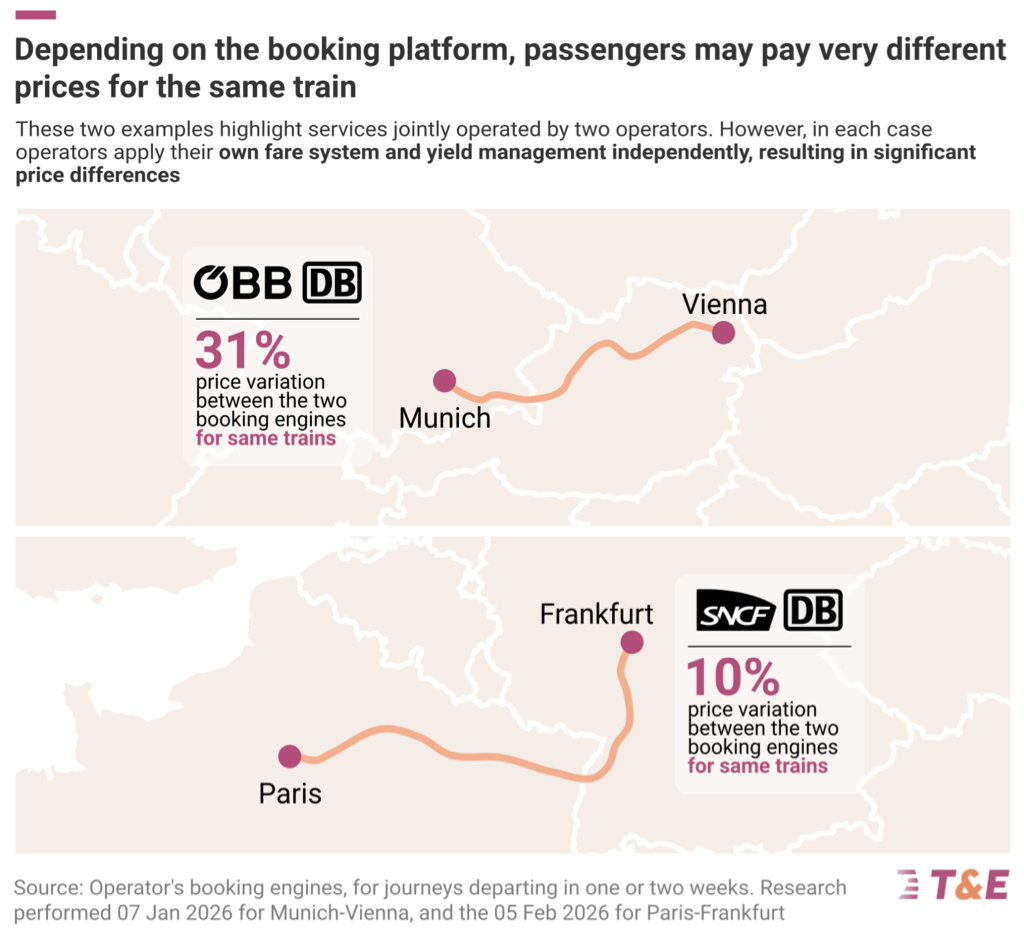
Whitaker further warns that unless rail matches the “one-click” convenience of other modern services, its potential for decarbonisation will remain unrealised.
Support for reform has already come from Ursula von der Leyen, who in her 2024 political guidelines called for a system allowing passengers to book multi-operator journeys on a single platform while retaining full rights, building on an idea first floated in 2021. The proposal is expected on 13 May 2026.