

The current Middle East crisis means oil firms will make an extra €24 billion in profits from European drivers alone, according to a new analysis from clean transport and energy advocates T&E. The campaign group is calling on European law and policymakers to tax the “excess” revenues and put the funding towards European fuel and energy resilience.
Following the US-Israeli attack on Iran on 28 February 2026, oil prices rose “rapidly,” a T&E statement said, hitting €2.06 per litre for diesel, and €1.89 per litre for petrol, by 23 March—increases of €0.49 and €0.27, respectively. Filling a 55-litre diesel tank now costs almost €27 more than it did before the conflict began, and €15 more for a petrol car, the green group points out.
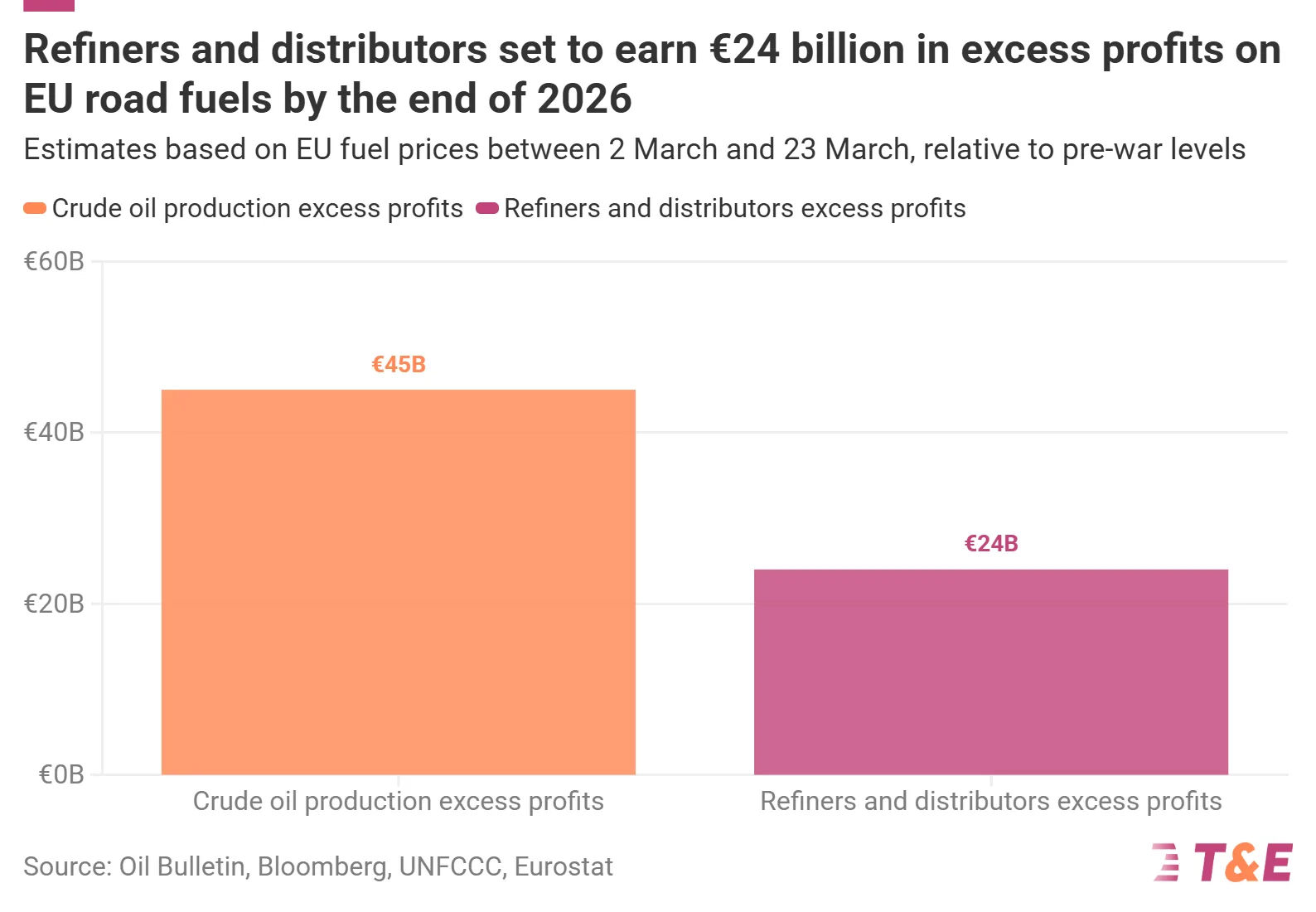
Commenting on the price inflation, Daniel Quiggin, senior policy advisor at T&E, said: “Once again drivers’ pain is oil companies’ gain. Oil companies have every incentive to keep Europe hooked on fossil fuels, as they’re the ones benefiting from price spikes. The EU should reinstate its tax on excess profit and invest the proceeds in the electrification and renewables that will finally break that cycle.”
By “reinstatement” Quiggin is referring to the EU’s introduction of a 33% levy in 2022, charged on fossil fuel profits above 20% the 2018 to 2021 average. The tax raised an estimated €28 billion between 2022–23 and is a mechanism that “exists and should be used again,” says T&E.
The group also notes that European diesel refining margins have risen at a rate above other regions, reflecting what it calls Europe’s “structural shortfall” in domestic refining capacity. By contrast, it says, petrol margins have been “more subdued due to high inventories in the US and Europe, as well as weak seasonal demand, whereas the EU remains more structurally dependent on diesel than petrol imports.”
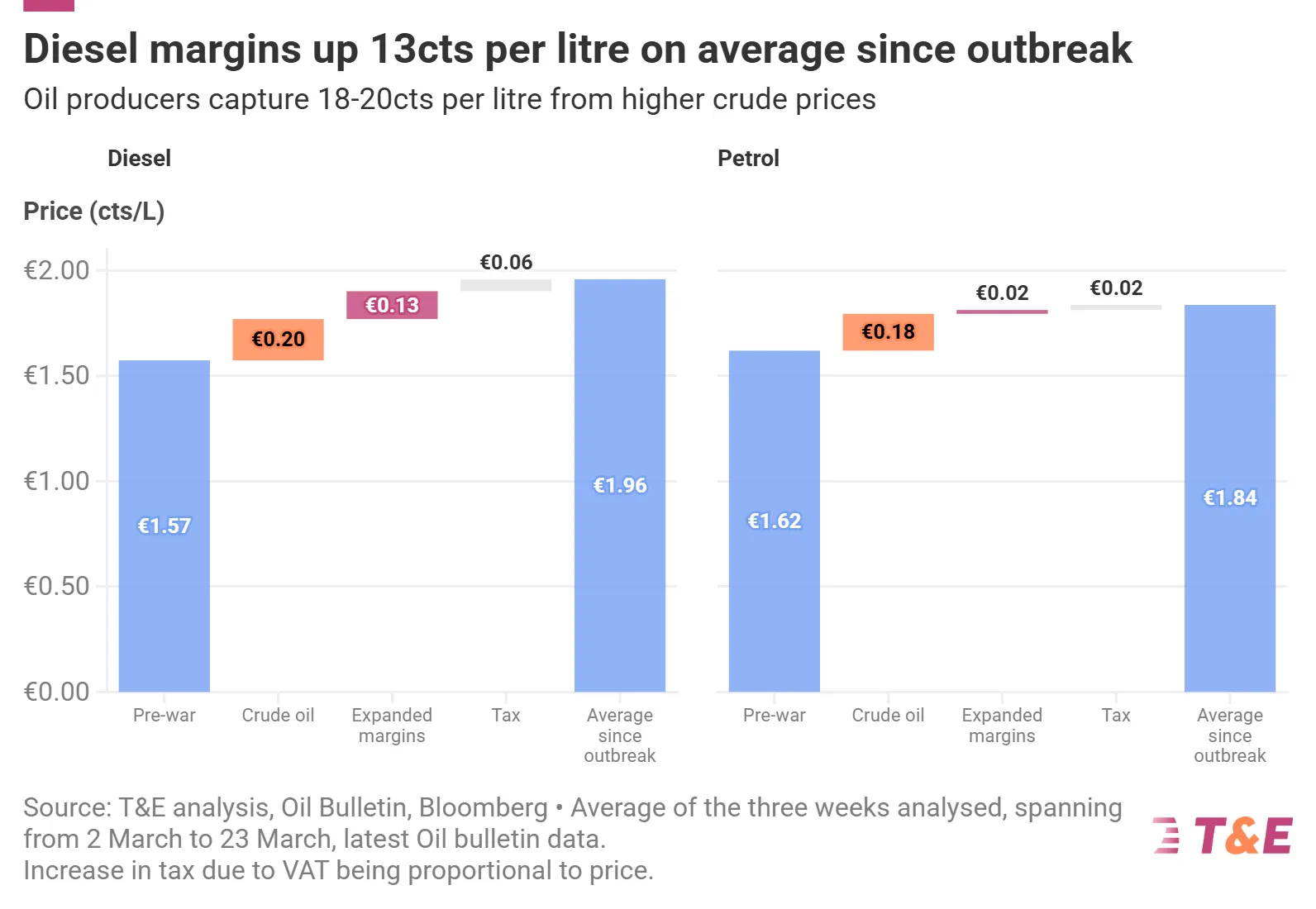
With around 20% of Europe’s diesel imported, even with a levy imposed on excess profits, most of that money will be made by companies headquartered in non-EU jurisdictions, which T&E acknowledges limits the effectiveness of any EU-based windfall tax.
Aside from the immediate human cost of the conflict, the hostilities in the Middle East have also raised environmental concerns about Asian countries turning back the clock on the green transition. With supplies of Liquefied Natural Gas (LNG)—considered a key transition fuel because it emits up to 50% less and significantly fewer pollutants than coal and oil—stuck for weeks in the Strait of Hormuz, major coal producers and importers such as Bangladesh, India, Japan, Kazakhstan, and South Korea are boosting domestic coal production and stockpiling, causing fears that climate goals are being deprioritised. T&E is just one of many campaign groups arguing that the Gulf crisis is a reason to step up the green transition, not slow it down.