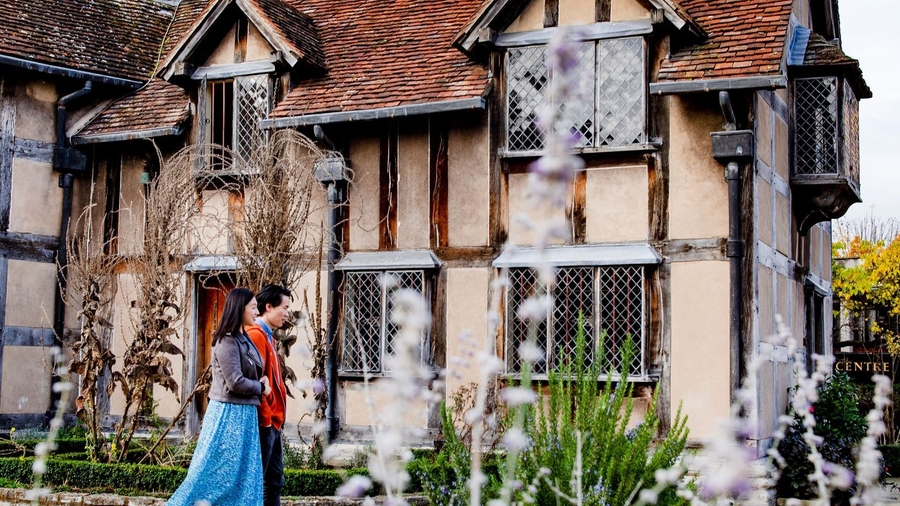



The film adaptation of Maggie O’Farrell’s Hamnet, a tale of Shakespearean love and loss, has inspired a huge uptick in visitors to the Bard’s birthplace and other Shakespeare-related attractions in the UK’s Stratford-upon-Avon, according to tourism data revealed by the Shakespeare Birthplace Trust.
The Trust manages a suite of local destinations linked to Shakespeare, including his childhood house and his wife, Anne Hathaway’s cottage, which is proving particularly popular. Hathaway is a prominent figure in O’Farrell’s novel and the film.
Richard Patterson, the Trust’s chief operating officer, told the press: “Visitor numbers have increased by about 15 to 20% across all sites since the film was released back in January. I think that will only continue as we go throughout the year.”
Stratford’s Shakespearean attractions are not in short supply of tourists, usually recording around 250,000 visitors annually. Nonetheless, Patterson believes the film’s impact (it has already received 11 BAFTA award nominations and eight for the Oscars) could be transformative for the destination, even though the shooting did not take place there.
“I think it’ll be extraordinary for the town,” he said. “I think the benefits are huge, because albeit we understand that it wasn’t filmed in Stratford, it shines a light on Anne Hathaway’s cottage.”
Hathaway’s home is one of five Shakespeare-linked homes owned by the Trust, and its idyllic rural surroundings feature heavily in the book since Hathaway is portrayed as a woman with a deep connection to nature. But due to the real cottage’s existing role as a tourist attraction, it was substituted in the film by a National Trust farmhouse called Cwmmau, in Weobley, Herefordshire, near the border between England and Wales.
Cwmmau is surrounded by country lanes, woods, wildflower meadows, and orchards, helping to portray Hathaway’s wild side. The traditional Jacobean timber-framed, five-bedroomed farmhouse depicted in the film has now even been made available for overnight stays, with money from the film helping to pay for some sensitive renovations. Destination managers and stakeholders there, about 96km from Stratford, will be hoping for a similar visitor surge to the one seen in Stratford.
Herefordshire county councillor for Weobley, Nick Mason, has described the impact of filming in what is one of the best preserved Tudor villages in England: “The sleepy village of Weobley really woke up,” he said. “It was a little bit of Hollywood in Hereford.” But more importantly perhaps, he has hailed the film as “the marketing or advertising that money just can’t buy.”