


A Scottish airline is set to become the first commercial carrier in Europe to operate a fleet of electric planes, bringing in at least five all-electric planes by 2029, according to press materials.
Loganair, the UK’s largest regional airline, successfully trialled electric operations with US aerospace firm BETA Technologies in March this year, when it undertook a number of demonstration flights across Scotland’s mail routes, including between Glasgow and Dundee, and in the skies over Aberdeen, Inverness, Orkney and Wick.
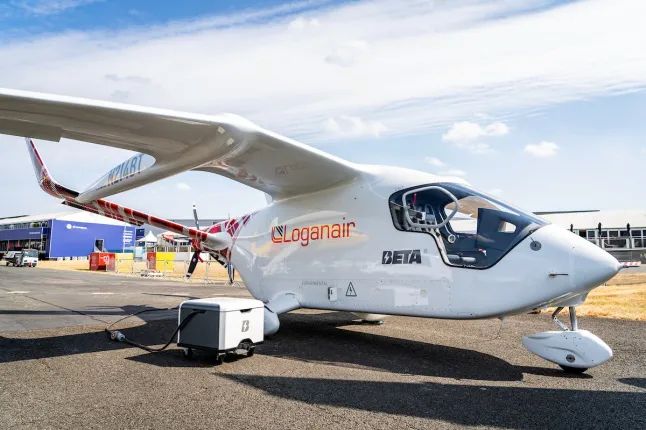
It has now signed a deal to purchase the Beta Alia CX300 all-electric plane, with an option for a further five. The contract was confirmed on the opening day of the Farnborough Airshow on 20 July.
Most of Loganair’s flights are around 160 km, the carrier said, well within the CX300’s 622-km range. Importantly, the planes can use existing runways, and another key factor for Loganair will have been the turnaround time. With a recharge delay of just 20 to 40 minutes, the planes allow the carrier to maintain what Loganair chief executive Luke Farajallah called the “reliable regional connectivity our customers and communities depend on.”
With aircraft fuel prices soaring this year amid the geopolitical crisis in the Middle East, the all-electric operation of the CX300 gives Loganair “the potential to reduce operating costs by up to 80%,” Farajallah said.
He also described the deal as a reflection of Loganair’s “confidence in the technology, our partnership with Beta, and our ambition to remain at the forefront of sustainable regional aviation.”
Meanwhile, Kyle Clark, founder and chief executive of BETA Technologies, underlined the company’s credentials, saying the aircraft manufacturer had met Loganair’s “high” standard “the only way it can be met, by flying more than a thousand nautical miles across their network, on their routes, and in their conditions.”
Simple Flying reports that the ALIA CX300 is a competitor to the Cessna Caravan and similar planes. While BETA advertises 5.77 m³ of interior space, which is less than the Cessna’s, the CX300 is “much cheaper to operate,” the outlet said.
The Pipistrel Velis Electro, launched in 2020, was the first fully certified production plane with electric propulsion. Since then, competitors have been lining up, including the Eviation Alice, which is currently seeking funding, and Sweden’s hybrid-electric ES-30 from Heart Aerospace.
Commentators note that electric planes present a game-changing option for operators of short commuter or freight routes, offering substantial benefits both in terms of decarbonisation and lower operating costs.