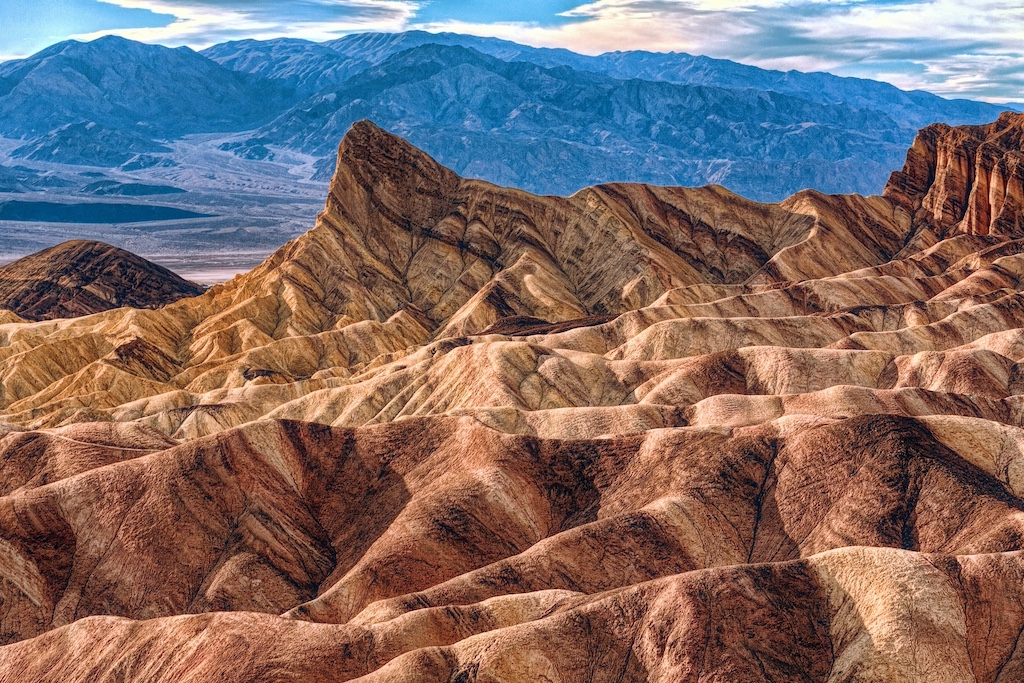


When this writer was a child growing up in the UK, every year a greeting card would arrive for her mother from an old friend who had emigrated to Death Valley. Upon it, a pressed flower from all the way from California’s dusty valley floor. Those cards were how I learned that deserts are not in fact dead, but one of Earth’s most vibrant habitats—and they were the reason why I fell in love with those environments, growing up inspired to camp in Australia’s “Red Centre,” to drive through Namibia’s Kalahari, and, of course, to watch sunrise over Death Valley.
In 2026, Death Valley is about to prove its life-affirming qualities once more, with a year that some are calling a “superbloom.” Such years are rare, requiring a concerted meteorological effort. Thanks to “well-spaced” but relatively heavy rainfall in the preceding autumn of 2025 (all of 6.1cm!), flower seeds were drenched enough for water to soak through the protective coat or testa that usually helps them withstand extreme temperatures and dryness. A damper-than-usual winter then allowed them to root and maintain moisture levels. Winds stayed mercifully low, leaving buds on stems to grow.
And now those buds are blooming, festooning the desert in the yellows of desert sunflowers, the purples of grape soda lupine, the orange of wavyleaf paintbrush, and the spangled whites of desert stars and brown-eyed primroses. It is no coincidence that the names of these wildflowers evoke a thirst quenched, an artist’s tools, or the jewels of the night sky. It’s a nomenclature of nature’s craft.
The US National Park Service is, however, holding back in its own language. Its officials point out that the flower count is not as high as in previous superbloom years, which occurred in 1998, 2005, and the last time, a decade ago, in 2016. Instead of “superbloom,” the NPS is using the term “above-average bloom year.” Not quite as spectacular-sounding or newsworthy perhaps, but accurate, a sight to behold, and still an attraction for the large numbers of pollinators, such as bees, butterflies, and hummingbirds that might not otherwise visit Death Valley.
@avecnicole The Death Valley superbloom is officially on, and it’s waiting for you to visit 🫶 Superbloom is located south of Badwater Basin near Ashford Mills. Be respectful of the flowers and watch where you walk ✨ #deathvalley #superbloom #springtok ♬ original sound – AvecNicole
People, too, will flock there, but hurry. The blooms are short-lived. The ephemerality of the flowering is what enables the plants to conserve enough energy to survive and flower again the next year. At low elevations, the display is anticipated to last through to the end of March. Later visitors to the desert will still be able to witness the phenomenon on higher ground from April until around June.
And, unlike my mother’s friend, all those years ago, visitors should, of course, refrain from picking flowers. Regulations prohibit it, and left alone, the flowers will produce seeds so that the spectacle returns another year.