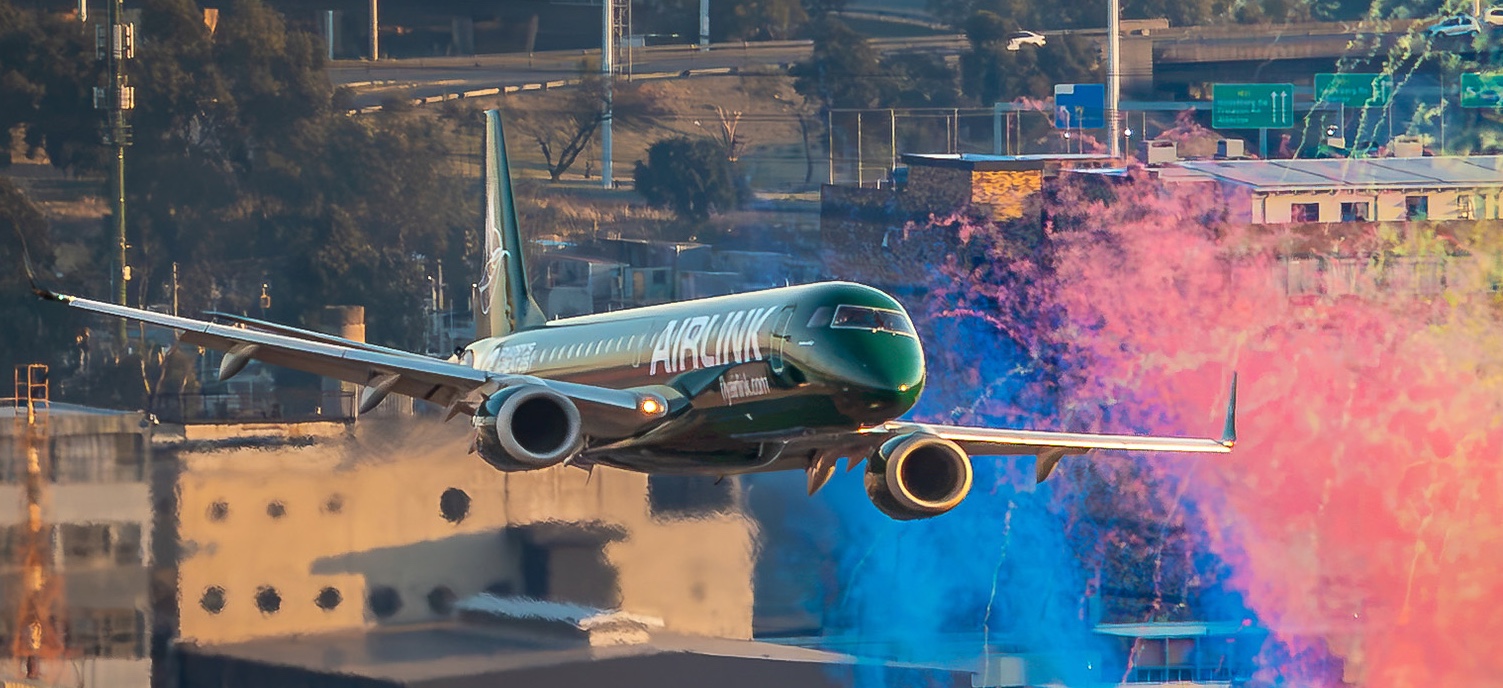


On Saturday 29 August 2029, the South African airline Airlink carried out an awe-inspiring flyover during a Rugby’s Greatest Rivalry tour match in Cape Town. Footage of the two aircraft flying above the stadium quickly spread online, prompting the airline to address the public’s concerns in a statement.
At the moment of writing, a rugby tournament between the South African Springboks and New Zealand’s All Blacks is in full swing. Called Rugby’s Greatest Rivalry, the tour consists of four matches between the two teams. The South African airline Airlink announced it would be the official carrier of Rugby’s Greatest Rivalry 2026, responsible for flying the players, coaches, management, and support staff of both teams.
Planning. Precision. Performance. ✈️✈️
— Airlink (@Fly_Airlink) August 29, 2026
Spectacular scenes of Airlink’s double Embraer flyover at the DHL Stadium.
Airlink is Proud Official Sponsor of Rugby’s Greatest Rivalry, presented by Castle Double Malt 🏉#Airlink #FlyAirlink #FlyTheLink #Skybucks #RugbysGreatestRivalry pic.twitter.com/3tPNepftLS
On Saturday 29 August, the Springboks and the All Blacks met at the DHL Stadium in Cape Town, South Africa, for their second encounter, following a 33-16 victory for New Zealand’s team a week earlier. Airlink performed a flyover with two Embraer E-Jets before the start of the match, just as it had done one week earlier.
Although flyovers aren’t unusual in the sport’s world, footage of the event immediately went viral online. Members of the public, especially those present at the DHL Stadium, were shocked by the altitude at which both aircraft were travelling. A feeling confirmed by the flight-tracking platform Flightradar24: according to their calculations, the planes flew less than 15 metres (50 feet) over the 55,000-capacity stadium. Low enough to make some people panic.
However, according to Airlink, there was nothing to worry about. Both flights were reportedly within the safety altitude and speed limits applied by the South African Civil Aviation Authority (SACAA). Due to its low altitude and low speed (278 kilometres per hour or 150 knots), the stunt was preceded by careful planning and rehearsal, in which the airline was guided by the SACAA and Air Traffic Navigation Services.
Nevertheless, Airlink responded to the concerns and criticism shared online following the viral footage.
“Airlink notes the concerns expressed in various social media and online forums regarding yesterday’s formation flyby over Cape Town’s DHL Stadium. The two aircraft were flown by highly experienced crew, with each comprising three senior captains operating in the roles of commander, co-pilot and safety/technical officer. The flight data recorded by both aircraft confirms that the flights were performed within the SACAA’s approved and rehearsed safety altitude and speed limits for the flypast,” the airline said in a statement published on the South African transport website Arrive Alive.
It is unclear whether or not the third march of the Rugby’s Greatest Rivalry tour will also be preceded by a flyover, given the concerned reactions of the public.
Ever since the 1995 Rugby World Cup Final between the Springboks and the All Blacks, when a South African Airways 747 jet performed a flyover carrying the message “Good luck Bokke”, which might or might not have led to the South African victory later on, important rugby matches in South Africa are often accompanied by a flyover.