


The 2026 edition of the European Hotel Distribution Study by European hospitality organisation HOTREC shows an imbalance in hotel bookings through OTAs in Europe. As Booking Holdings and Expedia Group control 85% of the market, the association calls for firm EU action to ensure fair and transparent digital markets.
For the 2026 European Hotel Distribution Study, Professor Roland Schegg of HES-SO Valais-Wallis and HOTREC surveyed 2,713 hotels throughout Europe. 1,882 of those concerned individual hotels from 28 countries, while 831 were hotel-chain properties.
The results are remarkable. On the one hand, direct bookings prove to remain resilient. Approximately half of hotel bookings (51.3%) are made directly with the hotel. This includes bookings through websites, email, telephone, and walk-ins.
On the other hand, Online Travel Agencies (OTAs) seem to be deeply embedded in hotel distribution. I 2026, they accounted for 29.9% of hotel room bookings, up grom 19.7% in 2013. An increase of more than 10 percentage points over 12 years, while the share of direct bookings declined by 6 percentage points.
The OTA market is also increasingly dominated by a small number of stakeholders. Booking Holdings accounted for 60% of European OTA bookings in 2013, while it stands at almost 70% in 2026. Together with Expedia Group, the two largest global groups now account for more than 85% of all OTA bookings in Europe. For Europe’s independent hotels and SMEs, this means an increased dependency and a risk to innovation in the sector.
“Hotels need digital platforms, but they also need genuine choice. Growing concentration must not translate into growing dependency. Europe’s hotels, most of them SMEs, need a competitive and transparent marketplace where they can choose how to reach their guests and remain in control of their own business,” stated Alexandros Vassilikos, President of HOTREC.
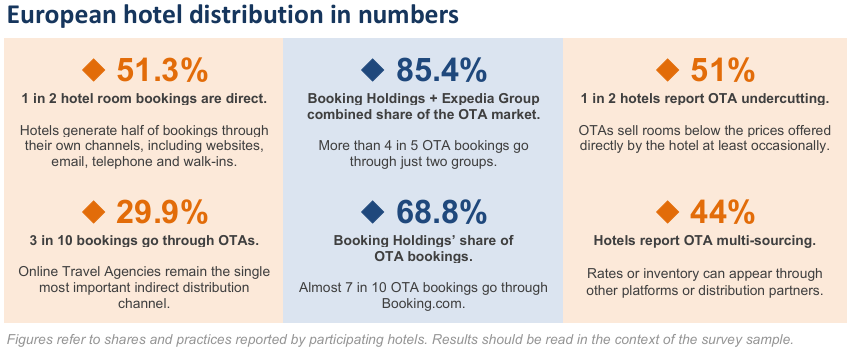
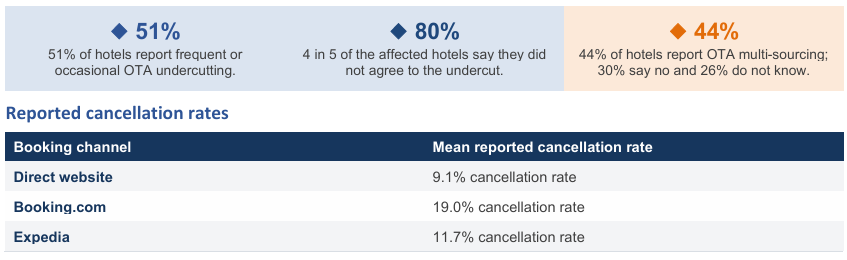
Moreover, bookings through OTAs do are not only a concern when it comes to market share and commission costs. According to the European Hotel Distribution Study, 51% of hotels report that OTAs undercut their prices frequently or occasionally, while 80% of those did not agreed to the lower price being offered. Meanwhile, more than 44% of hotels report OTA multi-sourcing, meaning rates or availability can be redistributed through other platforms or intermediaries, leading to price inconsistencies, guest confusion, billing difficulties, incorrect information, and reduced control over inventory.
“Europe’s digital rules are not only about search engines, social media or app stores. For thousands of hotels, a gatekeeper platform stands directly between the business and its guest. With 85% of OTA bookings going through just two global groups, robust enforcement of the Digital Markets Act is essential to protect competition, expand consumer choice, support innovation and safeguard Europe’s SMEs,” commented Marie Audren, Director General of HOTREC.
HOTREC finds the survey underlines the importance of Europe’s digital rules for the hospitality sector. The association sees Booking Holdings as a gatekeeper under the Digital Markets Act (DMA), while the Platform-to-Business Regulation (P2B) is at risk under the proposed Digital Omnibus. The DMA thus needs to be effectively implemented and enforced, and the P2B Regulation’s essential transparency and fairness safeguards need to be preserved.
In the study, HOTREC underlines that such protections are vital to ensure that hospitality SMEs retain meaningful control over pricing, payments, distribution, data, and guest relationships, while giving the next generation of hospitality entrepreneurs room to grow.