

For decades, France has occupied an almost unassailable position at the top of global tourism. In 2025, it did so again, welcoming a record 102 million international visitors and retaining its title as the world’s most visited country.
But the balance of European tourism may be shifting.
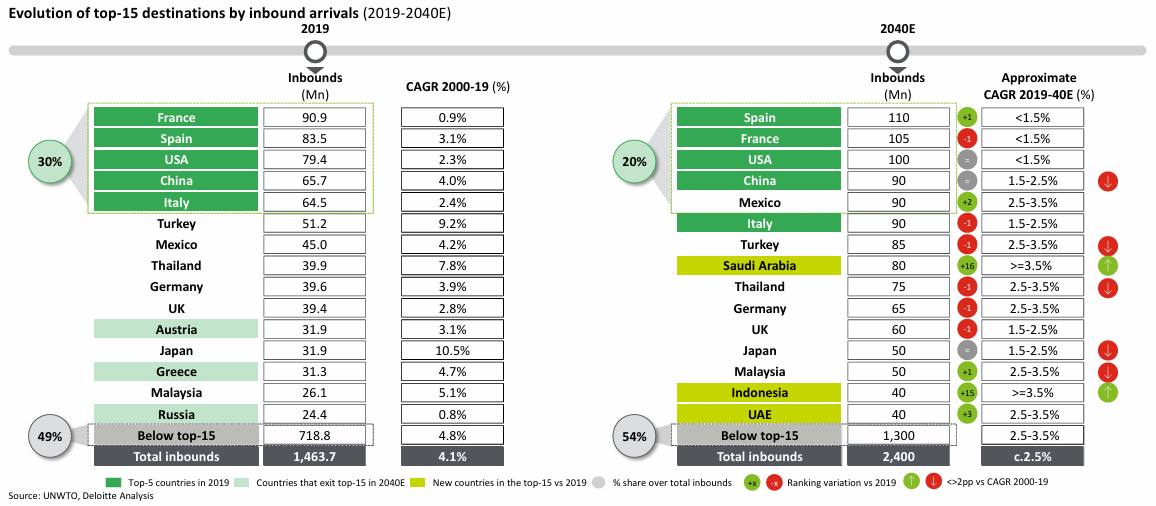
A major study by Deloitte and Google forecasts that Spain will overtake France by 2040, receiving around 110 million international tourists a year compared with 105 million in France.
The difference may appear relatively small, but the forecast points to a larger transformation of global tourism. International travel is expected to expand from around 1.5 billion trips in 2019 to 2.4 billion by 2040, while the traditional dominance of a handful of countries gradually gives way to a more diversified tourism map.
For Spain, however, the most striking point is that a forecast once looking relatively distant is beginning to appear increasingly plausible.
In 2025, Spain welcomed a record 96.8 million international tourists, up 3.2% from the previous year. As Travel Tomorrow reported in July, the country is now on course to approach or potentially surpass the symbolic threshold of 100 million visitors in 2026.
If that happens, Spain could effectively reach within the next year a level that leaves it only around 10 million visitors short of Deloitte and Google’s projection for 2040.
A global tourism market heading towards 2.4 billion trips
The Deloitte and Google research looks at how international travel has evolved over several decades and models how demographic, economic and geopolitical changes could reshape the sector up to 2040.
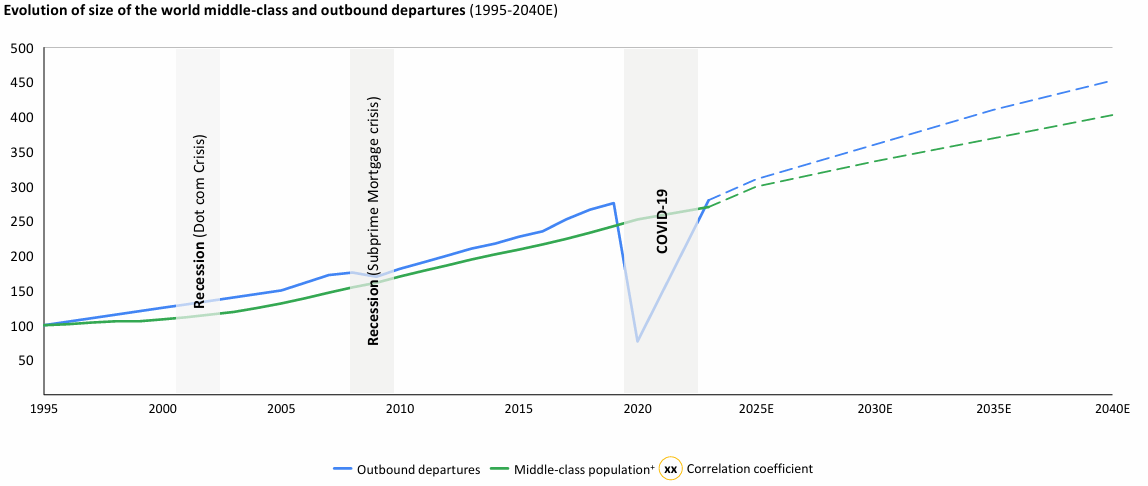
Between 1975 and 2019, global international arrivals roughly doubled every 15 years, eventually reaching almost 1.5 billion before the Covid-19 pandemic disrupted that trajectory.
The long-term growth story is nevertheless expected to continue. By 2040, the study anticipates around 2.4 billion international trips globally.
Europe will remain the largest destination region, capturing 38% of the additional international arrivals generated between 2019 and 2040. That represents more than 362 million incremental tourists. Asia-Pacific follows with more than 278 million additional visitors.
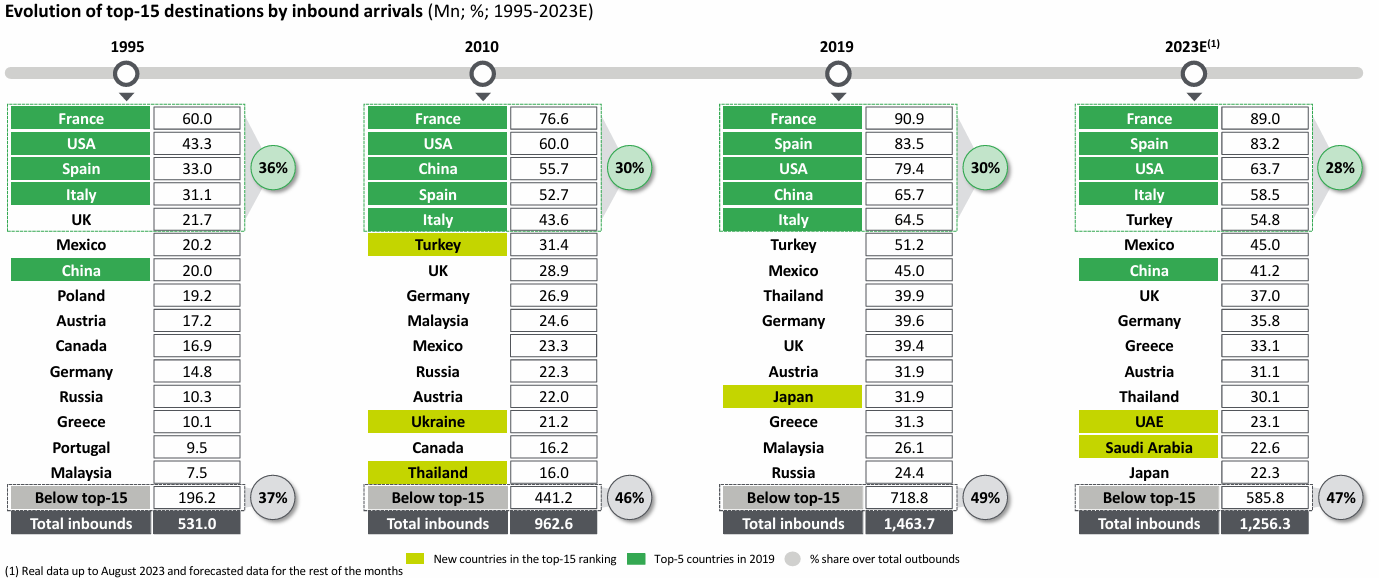
The five leading destinations accounted for around 30% of global arrivals in 2019. By 2040, Deloitte and Google expect their combined share to fall to approximately 20%, even though most of today’s tourism giants will remain near the top.
Spain, France, the United States and China are all expected to retain positions in the global top five. Mexico is projected to rise to fifth place, pushing Italy into sixth, while destinations such as Saudi Arabia, Indonesia and the United Arab Emirates could enter the top 15.
The Mediterranean, Southeast Asia, the emerging tourism markets of the Middle East and the Caribbean are collectively expected to account for around 45% of international travellers.
Spain is already closing the gap
France remains number one today and its latest figures underline the scale of that achievement.
As Travel Tomorrow reported earlier this year, France welcomed 102 million international visitors in 2025, compared with 100 million in 2024. Those travellers generated 743 million overnight stays, while international tourism receipts reached a record €77.5 billion, an increase of 9% year-on-year.
France therefore still welcomed around five million more international visitors than Spain in 2025.
Spain earned €134.7 billion from international tourists in 2025, up 6.8% from €126.3 billion in 2024, according to official Spanish figures. That means Spain generated considerably more international visitor spending despite receiving fewer tourists.
📈 El turismo internacional se mantiene como un motor clave de nuestra economía.
— Ministerio de Industria y Turismo (@minturgob) August 3, 2026
En el primer semestre, España recibió la visita de 46,6 M de turistas internacionales (+4,6% que en 2025), quienes realizaron un gasto de más de 63.800 M € (+7%).
ℹ️ https://t.co/B5b9o5WET0 pic.twitter.com/vbimq9mKNZ
Part of the difference comes from length of stay. International visitors to Spain tend to remain longer than those travelling to France, allowing accommodation, restaurants, attractions and other tourism businesses to capture more spending per trip.
The comparison also highlights one of the increasingly important questions facing mature tourism destinations: is success best measured by the number of people who cross the border, or by the economic, social and environmental value generated by each visitor?
France itself is increasingly emphasising the latter. Its tourism authorities aim to increase international tourism receipts to €100 billion by 2030 while positioning the country as a leading sustainable destination, rather than simply focusing on maintaining the highest arrival figures. Spain is moving in a similar direction.
From record arrivals to ‘calm growth’
Spain’s rise has been driven by a combination of factors that are difficult for competitors to replicate: an enormous tourism infrastructure, strong aviation connectivity, beaches and islands, major cultural cities, a broad hotel supply and a climate that allows tourism to operate throughout much of the year.
Its tourism geography is also remarkably diverse. Barcelona, Madrid, Seville, Valencia and Málaga compete alongside the Canary and Balearic Islands, the Mediterranean coast, northern Spain, historic inland cities and increasingly popular rural and nature destinations.
Changing travel patterns are helping too. Shoulder-season tourism is growing, while warmer temperatures and changing traveller preferences are making spring, autumn and even winter increasingly attractive periods for visiting southern Europe.
But Spain’s government has begun signalling that it does not want the next chapter of tourism growth simply to be a race towards ever greater numbers.
Tourism Minister Jordi Hereu has described the preferred model as “calm growth”, with authorities seeking to spread visitors geographically and seasonally rather than concentrating ever larger numbers in the country’s established hotspots.
As Travel Tomorrow reported when looking at Spain’s prospects of reaching 100 million visitors in 2026, the government has been promoting inland destinations, gastronomy, nature, cultural tourism and travel outside the traditional summer peak.
This year’s total solar eclipse has provided one example of how a major event can redirect international visitors towards rural and lesser-known parts of the country.
Yet if Deloitte and Google are right and Spain eventually reaches 110 million annual visitors, redistribution will become more than a marketing objective. It will be an economic and political necessity.
The overtourism paradox
Spain’s rise to the top of world tourism would represent an extraordinary commercial success. But it would also sharpen one of the country’s most difficult debates.
Anti-overtourism demonstrations have become a recurring feature in Barcelona, the Canary Islands, the Balearic Islands and other heavily visited destinations. Protesters have focused on housing shortages, short-term holiday rentals, congestion, pressure on public services, water use and the perception that local communities increasingly bear the costs of a tourism industry whose benefits are unevenly distributed.
The Spanish authorities have responded with measures at national, regional and municipal level.
The government has ordered tens of thousands of properties that failed to meet requirements for tourist and seasonal accommodation to be removed from the relevant rental register. Barcelona intends to end licences for around 10,000 tourist apartments by 2028, effectively eliminating the city’s legal short-term apartment stock under the current system.
Cruise tourism has also come under greater scrutiny. Barcelona has already reduced the number of terminals used by cruise ships in its central port area, while other cities are examining ways to manage passenger flows.
In the Balearic Islands, tighter restrictions have targeted alcohol-fuelled tourism and party boats, while Málaga has launched campaigns asking visitors to respect local residents, keep noise down and behave appropriately in public spaces.
These interventions show the contradiction at the heart of the 2040 forecast.
For national tourism accounts, another 10 or 15 million tourists represent billions of euros in additional economic activity. At neighbourhood level, however, the same growth may translate into additional pressure on rents, transport systems, beaches, historic centres and natural resources.
Spain therefore faces the challenge of becoming the world’s most visited country without allowing the volume of tourism to undermine the very qualities that make people want to visit.
France is unlikely to surrender its crown quietly
It would also be premature to regard Spain’s takeover as inevitable.
Forecasts extending to 2040 inevitably depend on assumptions about economic growth, population, aviation, climate change, geopolitics, disposable income and the expansion of the global middle class.
France also possesses formidable structural advantages.
Paris remains one of the world’s most powerful destination brands, but French tourism extends far beyond the capital. The Alps, Mediterranean and Atlantic coasts, wine regions, villages, gastronomy, cultural heritage and extensive rail network give the country an extraordinarily broad tourism offer.
France is also attempting to distribute tourism more evenly through wine tourism, agritourism, memorial tourism, nature tourism and lesser-known regional destinations.
After receiving 102 million international tourists in 2025, it needs only modest growth to reach Deloitte and Google’s 105 million forecast for 2040. Spain, by contrast, would need to accommodate around 13 million more international arrivals than in 2025 to reach 110 million.
In numerical terms, neither projection looks particularly radical. The real question is what happens between those figures.
Being number one may no longer be the most important target
For decades, tourism rankings have rewarded volume. The country receiving the largest number of international arrivals takes the crown, generating headlines and political prestige.
But the Spain-France comparison increasingly exposes the limitations of that metric. Spain already generates substantially more international tourism expenditure than France despite welcoming fewer visitors. Both countries are simultaneously trying to increase tourism revenues while reducing congestion, spreading demand into different regions and seasons, and mitigating the impact on residents.
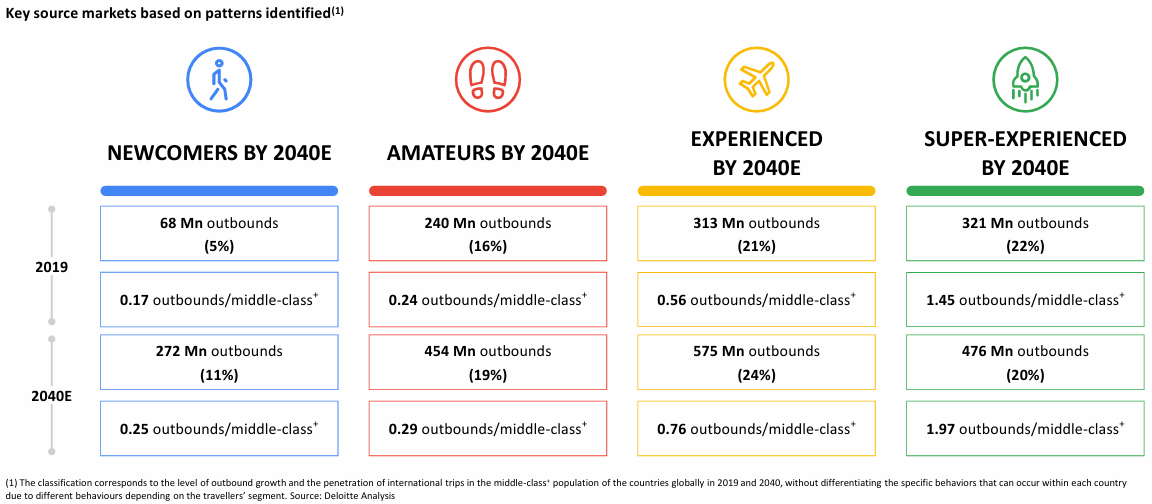
The global tourism industry itself is changing. By 2040, hundreds of millions of additional people are expected to travel internationally, fuelled particularly by the expansion of middle classes in Asia, the Middle East, Latin America and Africa.
That creates an enormous economic opportunity for Europe. It also means that destinations already dealing with overtourism cannot simply assume that absorbing more visitors is the objective.
Spain may indeed overtake France and become the world’s most visited country by 2040. At its current rate of growth, it could even happen considerably sooner.
But the more consequential test will not be whether Spain reaches 110 million tourists, or whether France manages to remain ahead.
It will be whether Europe’s two tourism superpowers can demonstrate that record demand can coexist with affordable housing, liveable cities, protected natural resources and communities that continue to see tourism as an asset rather than a burden.
By 2040, that may be a far more meaningful measure of tourism leadership than the number at the top of an arrivals table.