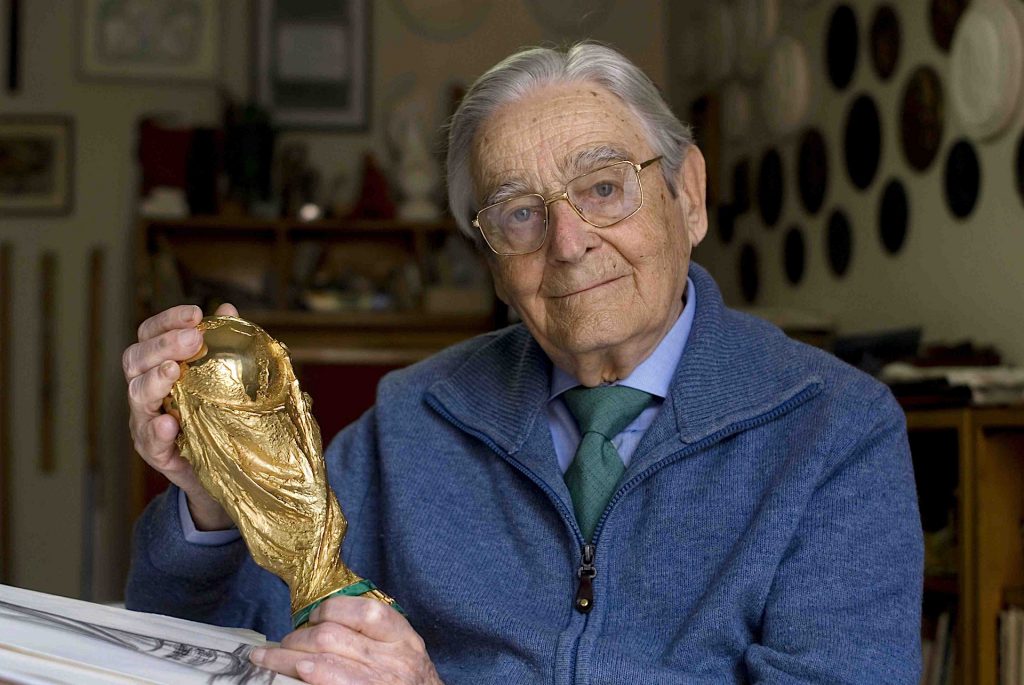



Every four years, one football captain experiences the ultimate sporting honour of lifting a 36-centimetre golden trophy before a jubilant stadium, kissing it and carrying it aloft as teammates celebrate around them.
This year was no exception. Following Spain’s dramatic 1-0 victory over Argentina after extra time, Captain Rodri Hernández hoisted the FIFA World Cup Trophy before passing it to his teammates, among them teenage sensation Lamine Yamal.
Yet while billions recognise the trophy instantly, far fewer know the name of the artist who created it, or that it is not the first World Cup trophy.
The current FIFA World Cup Trophy was designed by Italian sculptor Silvio Gazzaniga, who won an international competition in 1970 after Brazil’s third World Cup triumph. Under the rules then in force, winning the tournament three times entitled the winners to keep the trophy permanently.
Gazzaniga, a 54-year-ols Milanese sculptor already renowned for creating prestigious sporting trophies, including the UEFA Cup and European Super-Cup, beat 53 competitors from around the world. While most entrants submitted sketches, he arrived with a full-size plaster model of his design.
“To create a universal symbol of the harmony of the sports world, I took inspiration from two fundamental images: the triumphant athlete and the world,” Gazzaniga explained.
The sculpture depicts two stylised footballers lifting the globe. The rough surface between the two opposing faces expresses “the vigour, energy and toughness of football, and the intense commitment to sport”, according to the sculptor’s website. Its flowing lines create a sense of movement and capture the moment of victory.
“He was sketching a huge number of drawings and finally developed the idea of having the world and this symbol that looks like two DNA spirals moving upwards,” recalls his son Giorgio Gazzaniga, who was a teenager at the time.
The trophy weighs 6,175 kilograms and is made of 18-carat gold on a base of two bands of malachite.
The original World Cup trophy, known as the “Jules Rimet trophy”, after the FIFA president who introduced the competition in 1930, was designed by French sculptor Abel Lafleur. It depicted the Greek goddess Nike holding an octagonal cup above her head and was crafted from gold-plated sterling silver on a lapis lazuli base.
It went to Brazil after the country’s third World Cup victory but was stolen from the headquarters of the Brazilian Football Confederation in 1983 and has never been recovered.
It was the second time the trophy had been stolen. The first was in 1966 while on public display in England. A dog named Pickels found it under a hedge in south London.
The disappearance of the Jules Rimet Trophy ultimately led FIFA to change its rules. Since then, World Cup winners celebrate with the original trophy during the presentation ceremony, but it remains FIFA’s property. The champions receive a gold-plated replica to take home instead.
More than half a century later, Gazzaniga’s Milan studio still houses his original drawings and the plaster prototype that won the competition. Earlier this year, a commemorative plaque was unveiled there in tribute to the sculptor.
Gazzaniga died in Milan in 2016 at the age of 95. Every four years, however, his work returns to the centre of the footballing world as another captain lifts the World Cup into the air.
“Were I to ever redo it, I wouldn’t change a thing”, said the sculptor. FIFA appears to agree as it has decided that the trophy will remain in use until at least 2038.