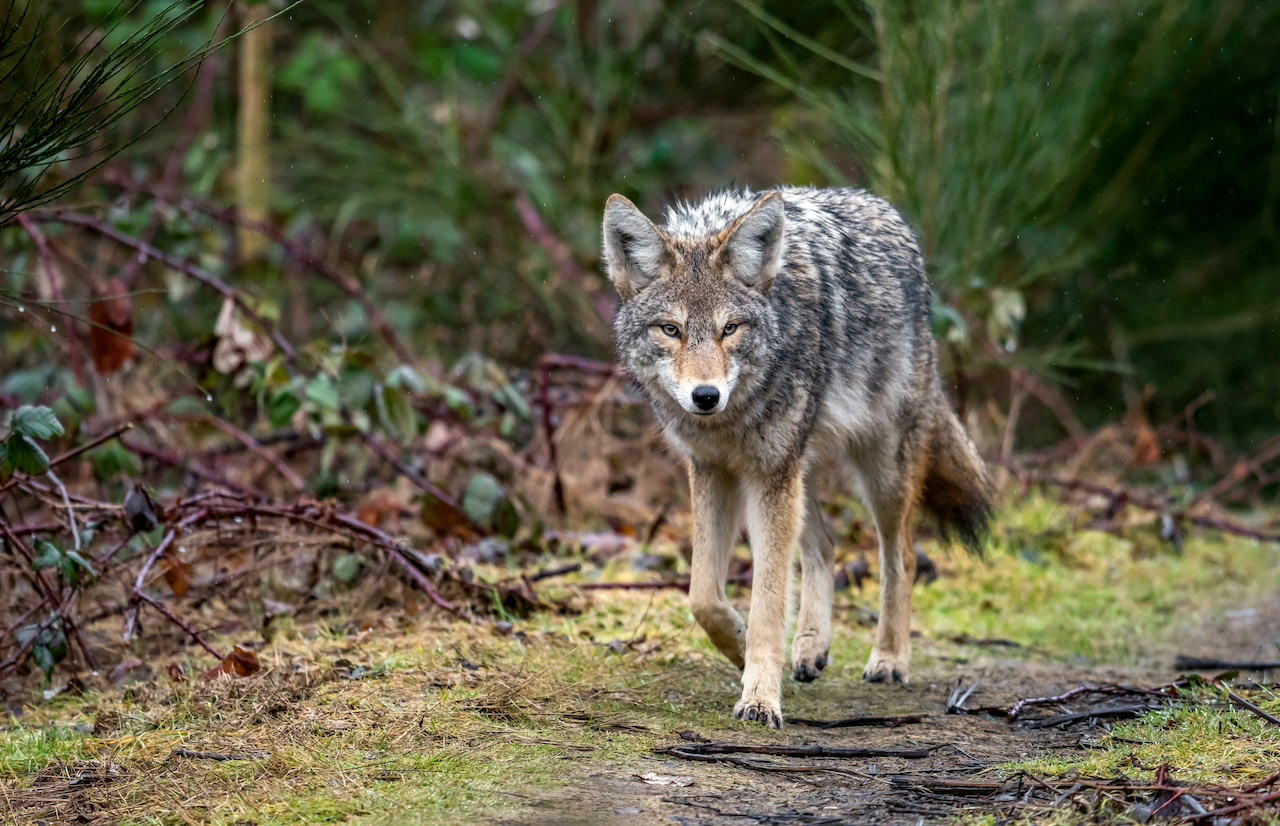



Tourists visiting western Denmark are being advised how to respond if they encounter a wolf, after authorities recorded young animals approaching people, dogs and holiday homes in one of the country’s popular coastal tourism areas.
The municipality of Varde and local tourism organisation Visit Vesterhavet have distributed information leaflets at tourist offices, campsites and holiday homes around Oksbøl, Vejers and Blåvand. Available in Danish, English and German, the guidance tells visitors to remain calm, maintain eye contact and avoid approaching or feeding wolves.
@abs.ability Hierbij ook originele audio, to keep it real.. Het was echt bijzonder om een wolf van zo dichtbij te zien, hoewel het tegelijkertijd ook spannend aanvoelde ondanks het feit dat wij veilig in een auto zaten. We waren onder de indruk van hoe kalm de wolf leek en hoe groot hij was. Hij bleef rustig bij ons in de buurt en hield alles goed in de gaten. Zeker wel 5 minuten. Er is veel ophef over deze filmpje en hoe de wolf zich gedraagt. Volgens wolvenexperts legt deze wolf waarschijnlijk verbanden met auto's en voedsel. Dat hoop ik toch echt van niet!! Ik hoop dat deze doorgaans niet al te schuwe wolf toch iets schuwer wordt voor zowel onze veiligheid als die van de wolven zelf. Province Gelderland wil een vergunning geven om paintbalgeweren te gebruiken om wolven af te schrikken. Schrikken ze dan ook alle wolven die alle schaapjes etc vermoorden (meervoud!!) ? Het is ook duidelijk dat de wolf een beschermd dier is, maar waar is onze/de boeren hun bescherming en van al die schaapjes! Ik hoop ook dat deze filmpjes een wake-up call is voor het groeiende problem waarmee onze samenleving wordt geconfronteerd: de toenemende nabijheid van wolven tot menselijke bewoning. De consequenties voor zowel mens als wolf worden steeds ernstiger op veel verschillende gebieden en manieren. #wolf #wolfnederland #wolves #wolfermelo #wolfpack ♬ Spooky, quiet, scary atmosphere piano songs – Skittlegirl Sound
The campaign follows several incidents in which young wolves displayed unusually low levels of fear towards humans. According to the Danish Centre for Environment and Energy (DCE), observations around Oksbøl in May indicated that at least one young wolf was exhibiting “significantly reduced shyness” and approaching people.
Authorities stress that there have been no recorded wolf attacks on humans in Denmark and that the current behaviour does not represent an immediate risk of aggressive attacks.
However, visitors are being encouraged to understand how to behave during an encounter, particularly as the Oksbøl area attracts significant numbers of tourists staying in summer cottages and campsites.
Tourists told to stand still and maintain eye contact
Government advice recommends that anyone encountering a wolf should remain still and maintain eye contact. If the animal does not leave, people can shout, clap their hands and wave their arms to discourage it from approaching further.
Visitors should not follow wolves or turn their backs on an approaching animal. Children under 10 are also advised to be accompanied by an adult in the Oksbøl area.
In the unlikely event of an attack, the guidance tells people to defend themselves using kicks, blows or available objects. If a wolf attacks another person or a dog, authorities recommend directing resistance towards the animal’s hindquarters.
Varde’s second deputy mayor, Sandie Eis Ravn, said the information campaign was introduced following requests from local businesses to ensure visitors know what to do if they encounter one of the animals.
“If you are visiting somewhere and you know there is a wolf in the nearby forest, [it is important] to make sure you have the right code of conduct when you meet this creature,” she told The Guardian.
49 wolves recorded in Denmark
Wolves disappeared from Denmark after the country’s last known wolf was shot in 1813, but began returning naturally in 2012 after an absence of almost two centuries. By 2017, the first wolf pack had established itself in western Jutland.
According to monitoring by the Natural History Museum of Aarhus, 49 wolves have been recorded in Denmark this year. The population is concentrated in Jutland, with monitoring identifying 10 territories, including seven pairs with pups born in 2025, three pairs without pups and one territorial male.
Wildlife experts believe the behaviour observed near Oksbøl involves young animals becoming accustomed to human presence.
@harreby_wildlifep Ulvene i Danmark lever primært af vilde klovdyr som rådyr og krondyr. Rådyr og krondyr er deres foretrukne byttedyr, og den danske bestand af disse dyr er store, så det sikrer ulvene en stabil fødekilde. De kan også godt spise dådyr. Ulvene supplerer deres kost med mindre dyr som harer, mus og rotter. De kan også jage fugle, fisk og ræve. Ulvene er også gode til at rydde op. Så finder de et påkørt dyr tager de det og spiser. #ulv #ulven #danmark #vildnatur #rovdyr ♬ original sound – harreby_wildlifephoto
Peter Sunde, professor of wildlife ecology at Aarhus University, said at least two young wolves had been observed approaching humans during the winter and spring of 2026, with markedly reduced flight distances.
Such behaviour can develop when young wolves are repeatedly exposed to humans. Authorities are therefore asking residents and tourists not to approach the animals or leave food that could attract them, in an effort to prevent future generations from becoming accustomed to people.
The warning comes as European countries adapt to the recovery of wolf populations. Wolves remain protected under European legislation, although their protection status under the Bern Convention was downgraded in 2025 from “strictly protected” to “protected”, giving governments greater flexibility in managing populations.
For Denmark, where wolves have only recently re-established themselves, authorities are seeking to balance their conservation with public safety as humans and the growing wolf population increasingly share the same landscapes.