

Thailand is targeting at least 33 million foreign tourists in 2027, according to reporting from the Vietnam News Agency (VNA) on an announcement by the Tourism Authority of Thailand.
In what they are calling a “Value over Volume” strategy, officials intend to attract higher-spending visitors by enhancing the country’s tourism reputation through better destination management practices, driving improvements to services, and leveraging digital transformation.
As well as appealing to more affluent guests and encouraging repeat visits, the Thai strategy will promote the destination to new overseas source markets, including Belarus, Brazil, and South Africa, local media say. Thai officials are also reportedly in talks with Chinese airlines about increased air connectivity.
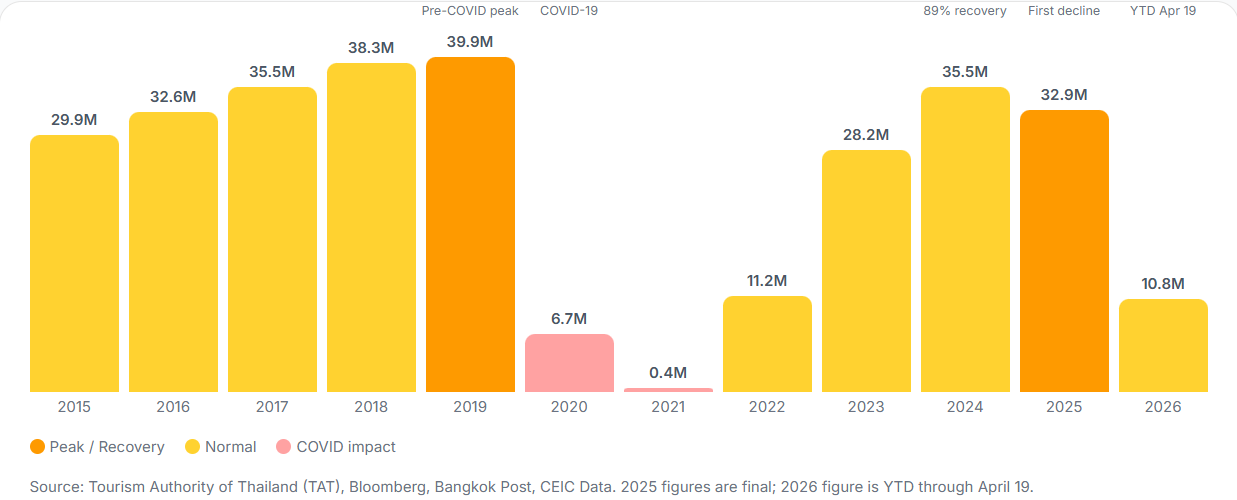
But visitors from overseas are only part of the picture. On top of bringing in more international arrivals, Thai authorities want to drive more domestic tourism and have set a goal of 203 million internal trips, which they are planning to achieve partly through encouraging more frequent travel through incentive schemes in partnership with private sector partners.
“Thailand’s goal does not measure success merely by visitor numbers,” said Natthriya Thaweevong, Permanent Secretary for Tourism and Sports, “but prioritises the quality of tourists, the revenue generated, and the benefits distributed to the public and entrepreneurs in all areas, making tourism a core engine to drive the country’s economy stably and sustainably.”
Thailand welcomed over 14 million foreign tourists during the first five months of 2026, for the third consecutive year, recording 14.76 million in 2024, 14.36 million in 2025, and 14.03 million in 2026, and pitched that stability as a win in a competitive and uncertain global tourism market.
Since then, more recent figures have emerged showing 17.36 million foreign tourists between 1 January and 18 July, generating an estimated 838.73 billion baht in tourism revenue, according to the Ministry of Tourism and Sports. However, that data would represent a drop of more than 3%.
Digging into the data, China was the largest source market, sending 2.86 million visitors, followed by Malaysia with 2.25 million, India with 1.31 million, Russia with 1.06 million and South Korea with 631,777.
Amid intensifying competition in the Asian tourism market, Thailand has trialled a number of strategies to boost its performance, including permitting afternoon alcohol sales for the first time since 1972, in a move that responded to hospitality industry lobbying and aligned the Southeast Asian country’s laws with modern values.
It will also host the Tomorrowland music festival for the first time in December 2026, in what the Tourism Authority of Thailand said was “an important milestone in our ambition to position the country as a leader in global tourism and creative experiences.”