

Most people associate Paris with the Eiffel Tower, Haussmann façades, a thriving art and fashion scene, café terraces, and its famously feisty and opinionated inhabitants, and rarely think of La Défense for a Paris getaway. When I mentioned my planned trip to the district, the reactions were incredulous at best. At worst, people wished me luck.
The district is known for its skyscrapers and office towers, as well as the world-famous Grande Arche, not so much as a tourist destination. Straddling Puteaux, Courbevoie and Nanterre in the Hauts-de-Seine department, the district sits at the western end of Paris’s historic axis, a mere 8 km and fifteen minutes by RER from the centre of the French capital.
La Défense’s historical significance and how it came to close a circle in French history that began in 1806 with Napoleon’s victory and the construction of the Arc de Triomphe at the opposite end of this same axis, escapes most of its visitors.
And who can blame them? Most are either business travellers or conference delegates, visible during the lengthy lunch hour at the Hilton restaurant or, at the end of the day, sipping cocktails at the rooftop bar of the Meliá, which, incidentally, offers a formidable panoramic view of the Paris tourists usually come for, namely, the Eiffel Tower rising above the trees, the Arc de Triomphe, Gehry’s Fondation Louis Vuitton, the Bois de Boulogne and, on a clear day, the Sacré-Cœur and Montmartre in the distance. Paris, from up there, is incredibly green.
Officially designated a site of “major architectural creation”, La Défense remains the only high-rise district in France and today counts around sixty skyscrapers. The tallest is The Link, which at 242 metres recently overtook Tour First to become the tallest building in France, and will soon house TotalEnergies’ new headquarters. Hekla, with its jagged, volcanic silhouette, is probably the most striking; and Tour Total is known for its “organ pipe” stack of polygonal volumes, catching the light differently through the day.
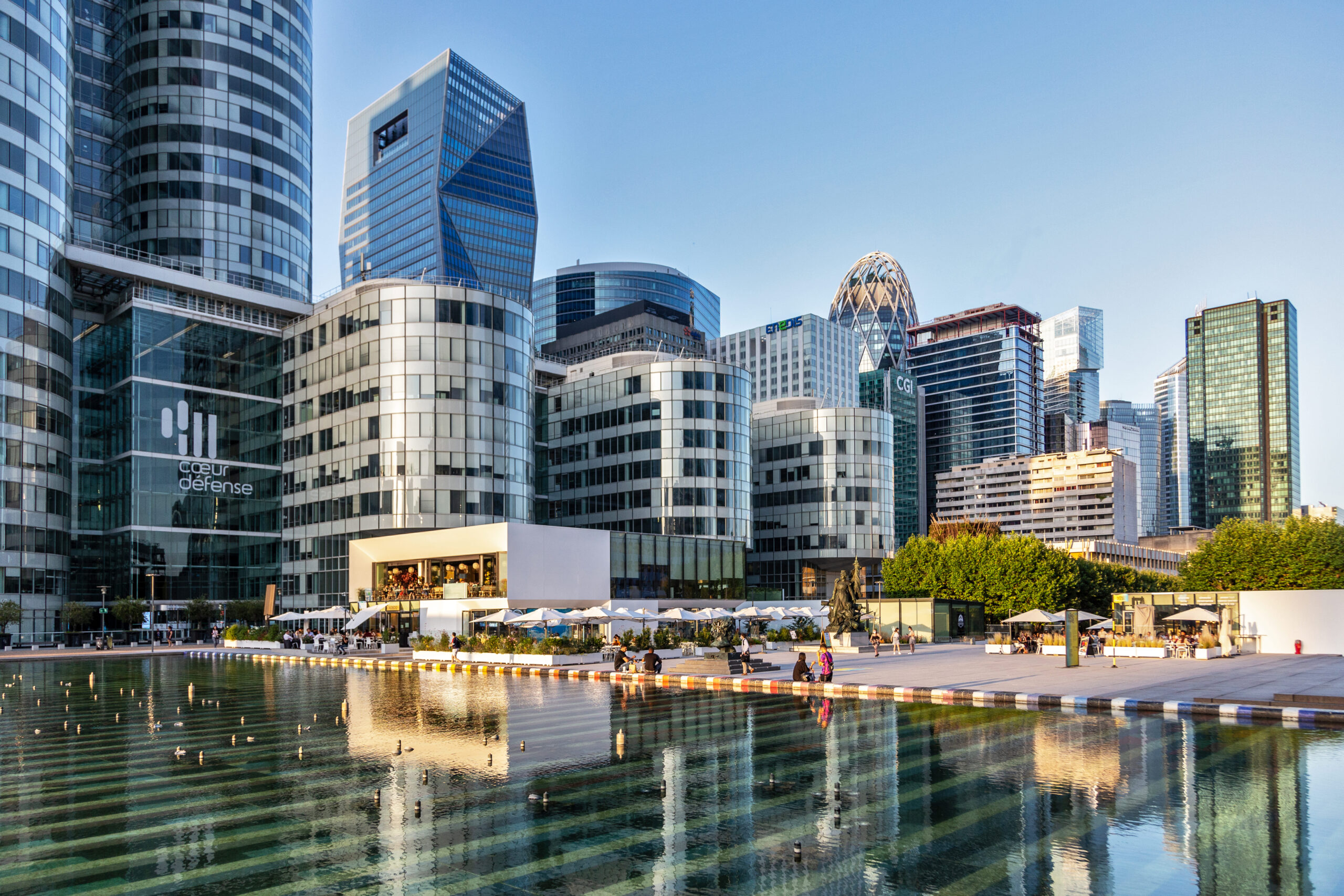
Unlike London’s business district, built at the city’s centre and known simply as “The City”, Paris’ rose on its outskirts and took its name from a statue.
Unveiled in 1883, La Défense de Paris by sculptor Louis-Ernest Barrias, chosen over proposals by Rodin and Bartholdi, commemorates the city’s resistance during the siege of Paris in the Franco-Prussian War of 1870-71. The monument depicts Paris as a woman dressed in the uniform of the National Guard, leaning against a cannon, sword in one hand and flag in the other. At her feet, a wounded young soldier loads a final cartridge into his rifle, while behind her stands a young girl, cold and destitute, embodying the suffering of the civilian population during the long winter siege.
The name spread first to the roundabout, then to the whole district.
Had the French won, France’s business district might be called La Victoire today.
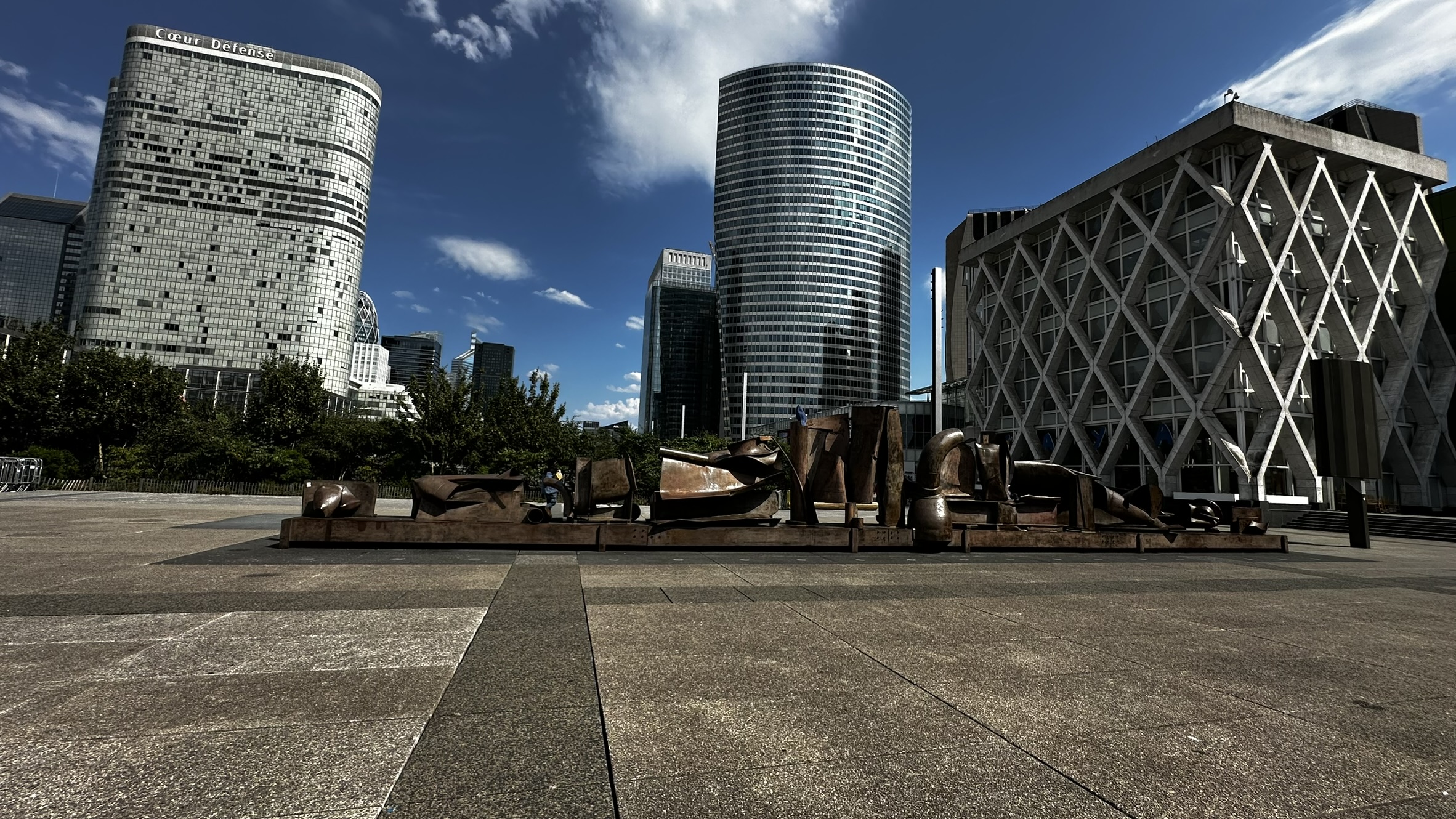
Walking the esplanade, past glass towers, it is hard to imagine the same place seventy years ago, when the area, still pockmarked from wartime bombing, consisted of bidonville-like shanties, workshops, small factories, and a handful of farms. For decades, the statue stood in its centre, in near isolation.
It would take a war, and its aftermath, to transform the area. Inspired by the United States, de Gaulle decided Paris needed its own business district, one that would help launch France back onto the world stage after years of occupation and destruction.
Construction began in 1958, when the state created the planning body EPAD and began clearing the neighbourhood. The district’s oldest structure, the CNIT, a gigantic triangular concrete shell, dates from that year.
From the offices of Cœur Défense, Europe’s largest office complex by floor space with some 160,000 square metres of office space across two 40-storey towers, a guide explained how EPAD went on to expropriate roughly 9,250 housing units and relocate more than 25,000 residents, in stages, between 1960 and 1971. The guide’s grandparents were among them, happily relocated to Drancy, she told us, though most went elsewhere, into transit housing and HLM blocks built locally in Nanterre and its neighbouring towns.
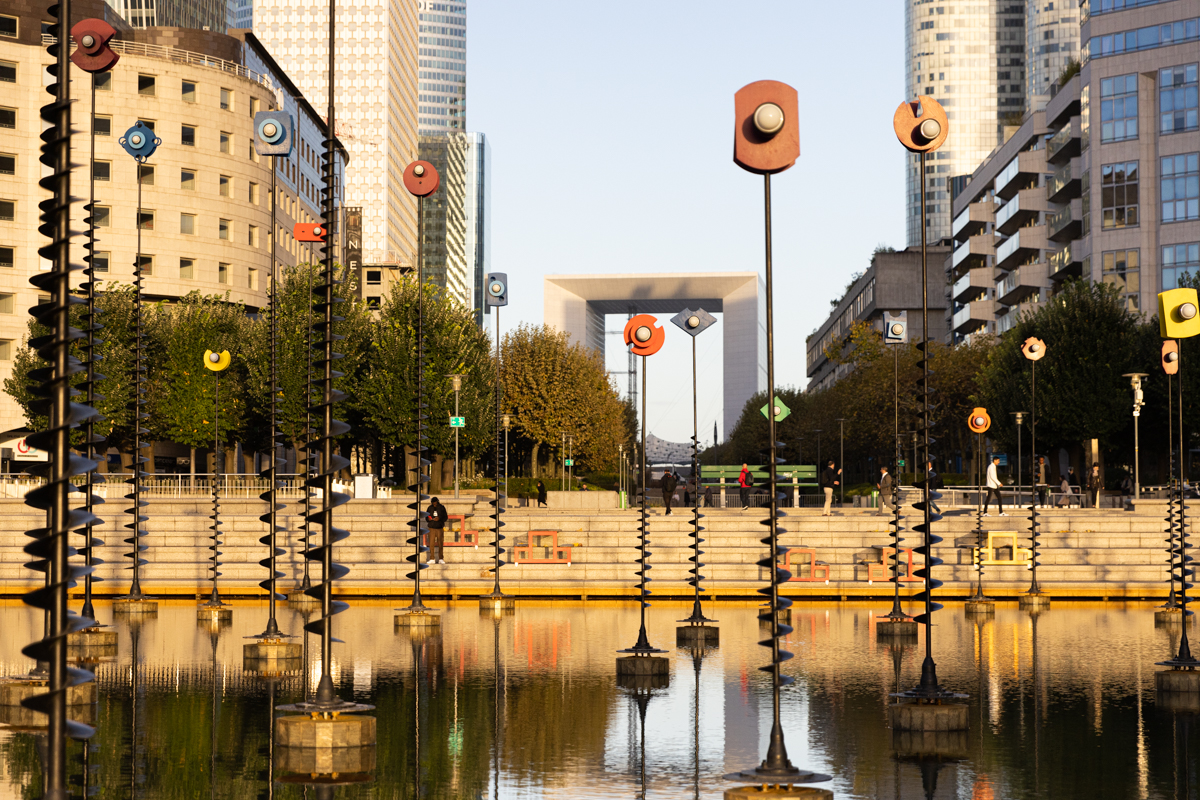
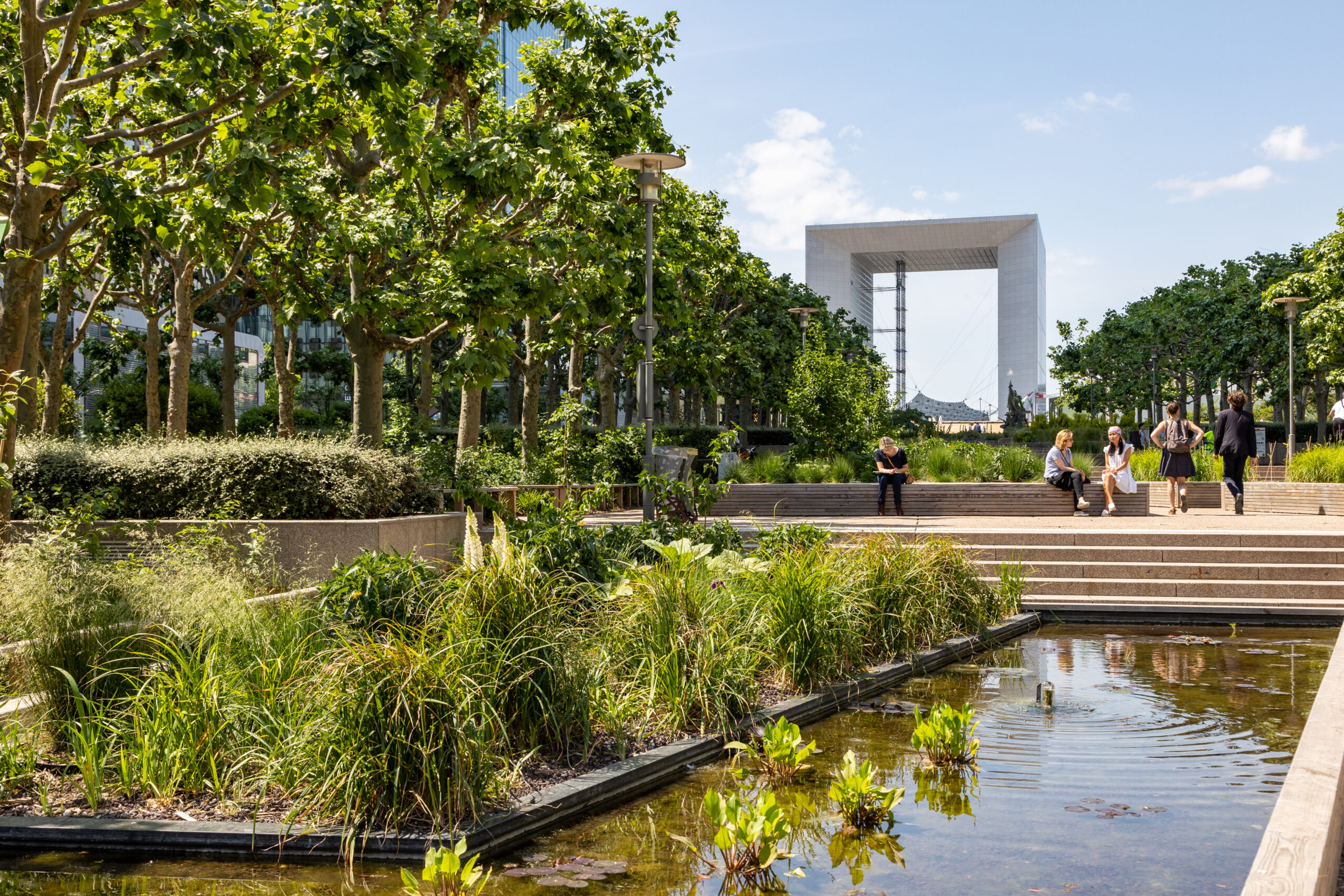
Today the district is delimited by the Seine on one side and the Grande Arche at the end, in a direct line facing the Arc de Triomphe. Johann Otto von Spreckelsen, the visionary architect who won the competition launched by François Mitterrand in 1982, wanted his Arche to be a monument to humanity, not to military triumph.
Between Napoleon’s celebration of victory in 1806 and Spreckelsen’s structure in 1989 lies almost two centuries of French history, passing through empire, defeat, occupation, liberation and reconstruction.
More than three decades after the Grande Arche opened, the results are hard to ignore, and France, it seems, has won its victory after all. Roughly 40% of its companies are French, the rest foreign, and it’s now said to be the fourth most attractive business district in the world, behind two in New York and one in Tokyo, and, as of the latest ranking, the top business district in Europe, having just overtaken London. The numbers are staggering: 180,000 people commute in daily to fill the towers, while only 20,000 actually live there.
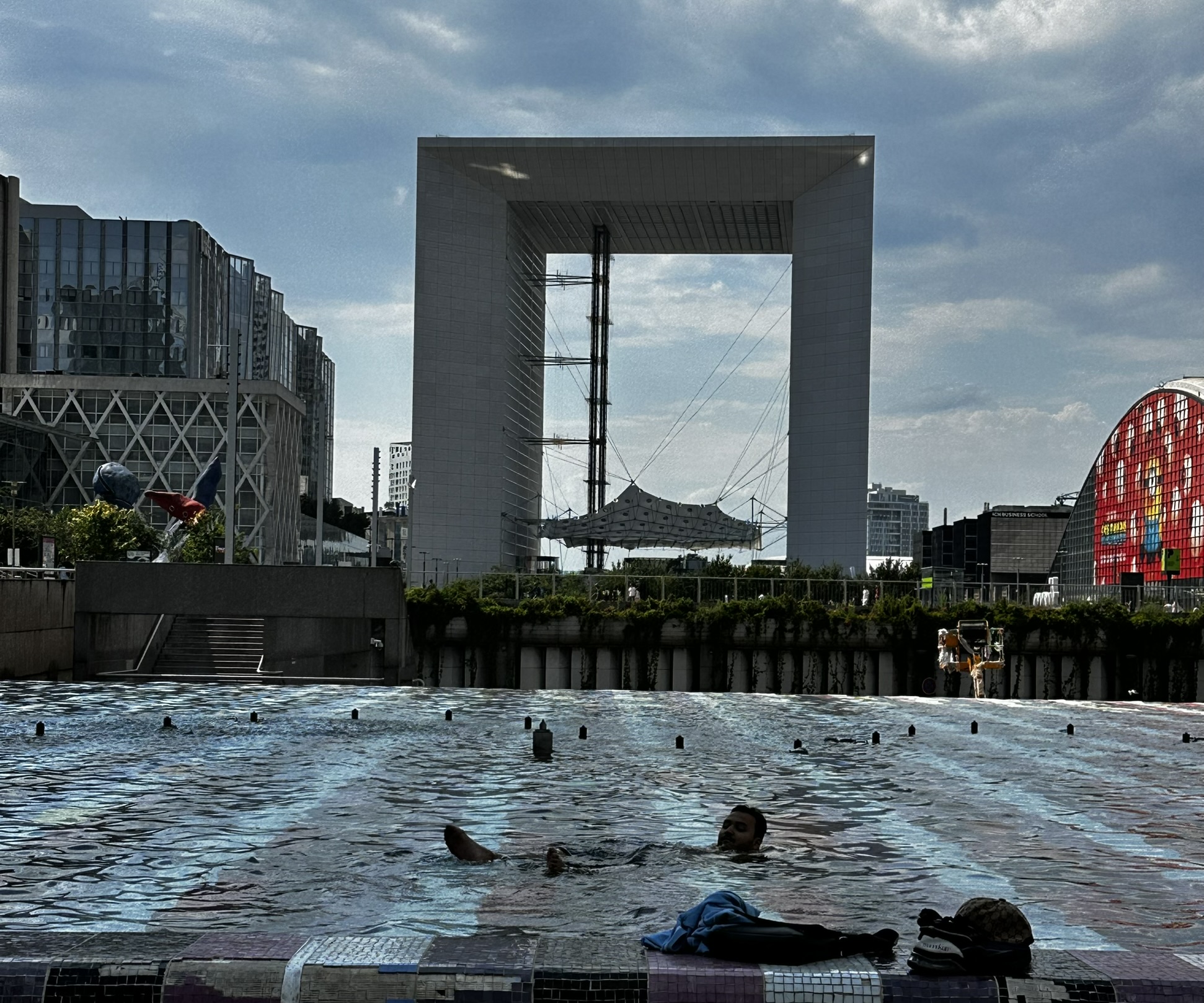
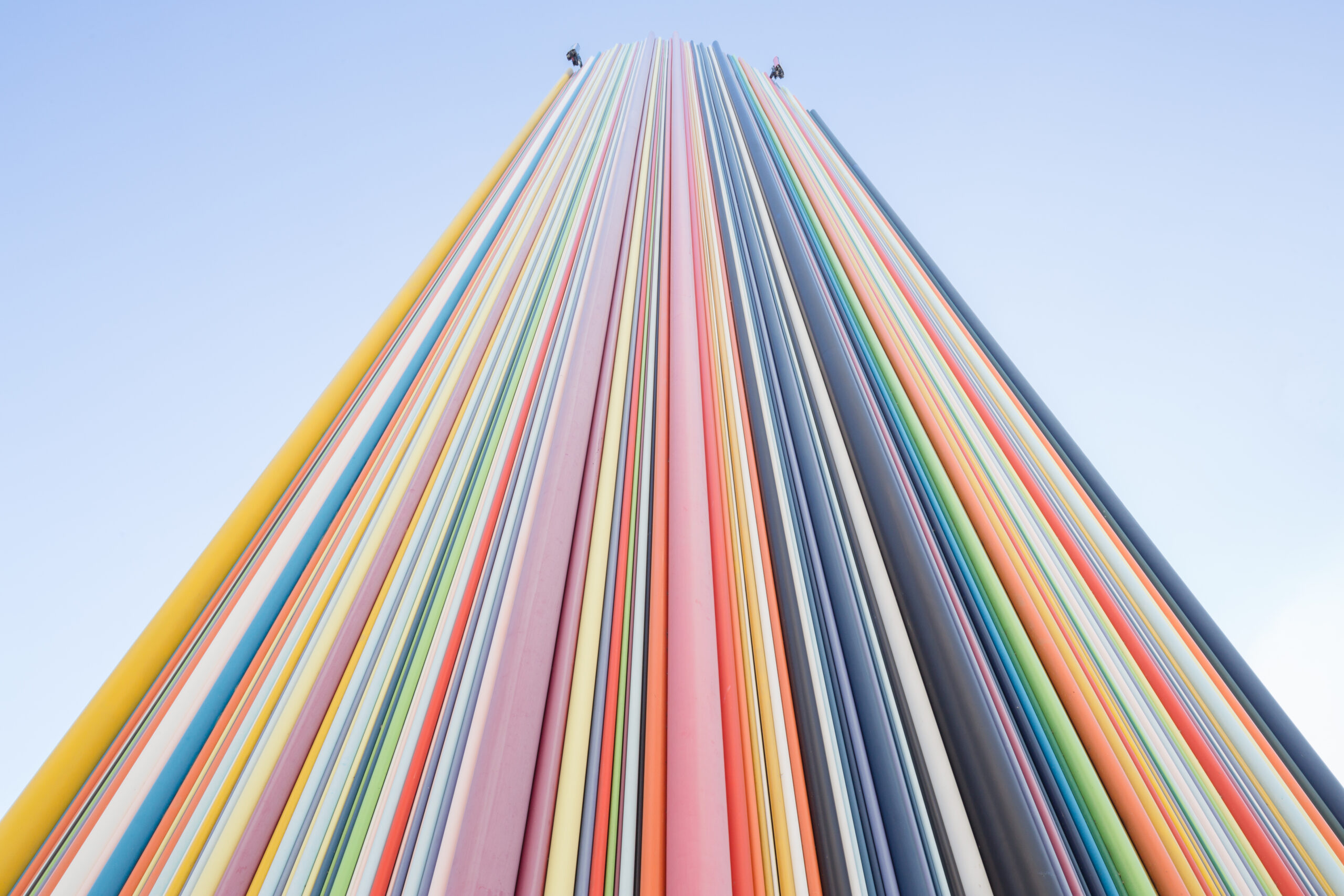
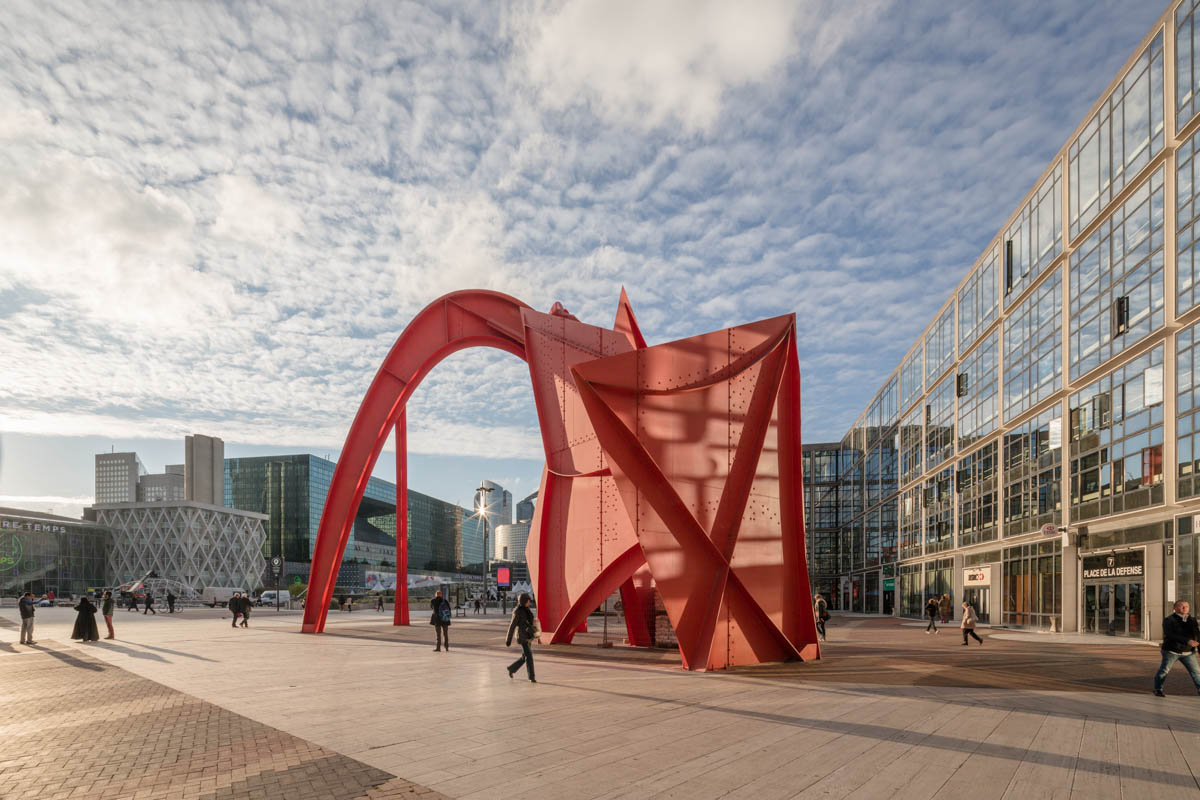
Yet office towers alone do not make a city district, and Paris is now investing heavily in turning La Défense into a destination in its own right. Once the eyes get accustomed to the high-rises, one is struck by the abundance of major artworks dotting the place: not one or two but 70 of them, among them Agam’s Fountain, Calder’s Spider, and Raymond Moretti’s rainbow-striped Chimney, a 32-metre ventilation shaft wrapped in coloured fibreglass tubes that looks like a giant Paul Smith design.
Even the benches are part of a public art initiative run by the district’s public body. No two of them alike, and they are scattered all along the Esplanade, offering a place to rest and stare at the surrounding architecture.
The last stretch of the esplanade is watched over by Daniel Buren’s La Ronde: sixteen ten-metre masts flying colourful windsocks, giving it an unmistakable beachy air.
Tucked away from all of it, are some of the most charming hidden gardens; 23% of the site is now green. Increasingly, the district’s future is being framed in terms of urban sustainability. Paris La Défense aims to halve greenhouse-gas emissions by 2030 and eventually become the world’s first post-carbon business district. New parks, cycling infrastructure and one of Europe’s largest pedestrian zones are all part of that ambition.
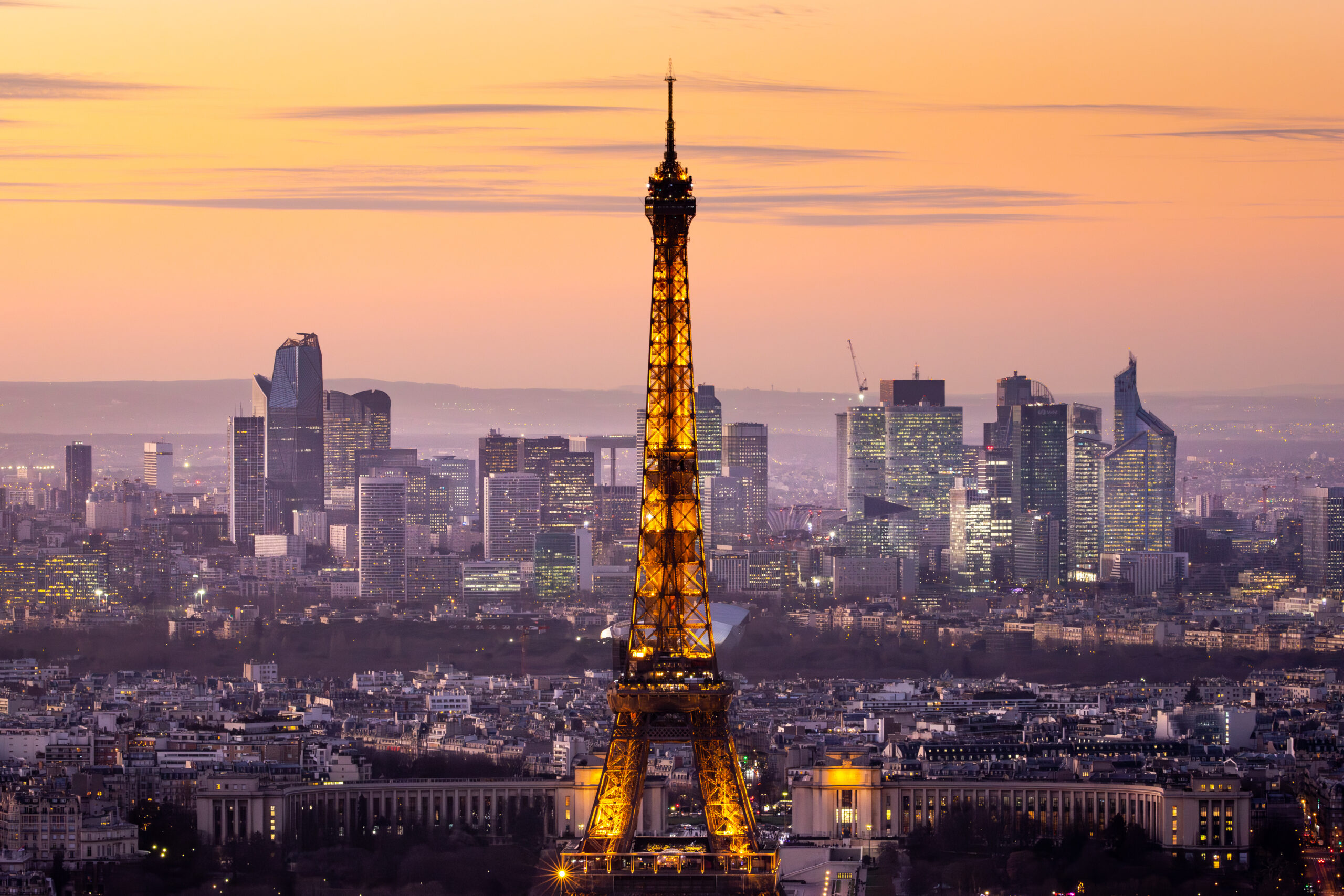
The shift is partly born of necessity. La Défense has survived the 1973 oil shock, which froze construction for years, the 2008 financial crisis, which hit especially hard in a district built on banks and trading floors, and Covid, which turned it into a ghost town and highlighted the risks of relying too heavily on office workers alone.
Since then, Paris has made little secret of its ambition to make the district more welcoming to visitors. The opening of the Paris La Défense Arena, Europe’s largest concert and event venue, has accelerated that transformation, bringing concerts, sporting events and entirely new crowds to an area once deserted after office hours.
It will remain a business district, but the ambition now is to have it both ways. Fifteen new restaurants opened here in the last year alone, proof of how quickly its character is evolving.
Le Collège de Paris, which opened a campus inside the Grande Arche in 2017 bringing together business, design and digital schools under one roof, is another sign of that evolution.
For travellers, the district’s functional design offers an unexpected perk. Because the offices empty out over weekends and holidays, La Défense quietly opens up to tourists. Its proximity to Paris, and excellent transport links, make it a smart choice for anyone who wants everything Paris offers without Paris prices. Hotels are reportedly around 30% cheaper than in the centre, a saving families in particular might appreciate, staying here and commuting into town each day. There’s also a direct train to Disneyland Paris.
Like a “mille-feuilles”, the district is built on three levels: the lowest for the métro, RER and underground transport; the middle for the highway and cars; and the upper platform, resting on both, entirely pedestrian. Walking from the Seine to the arena takes about 20 minutes for an able-bodied walker.
While La Défense may not justify an entire trip on its own, there are many reasons to spend a day here. Walk this axis end to end, and you’re really walking through three different ideas of what a monument owes its people: conquest, endurance, and, finally, humanity.