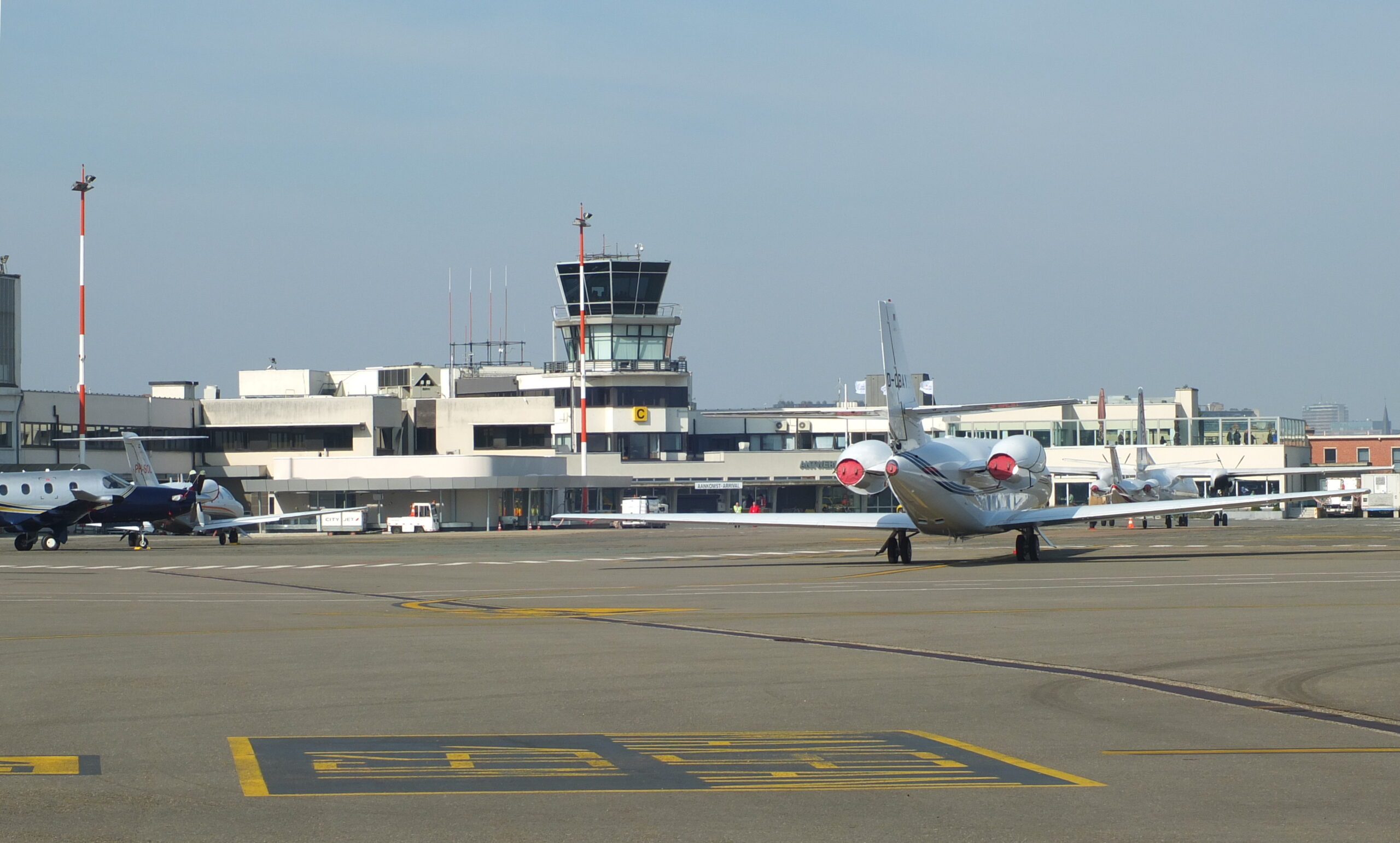


According to the Belgian business newspaper De Tijd, the Flemish government is planning on reducing the financial support for Flanders’s regional airports in Antwerp, Ostend, and Kortrijk. The aim is for the airports to be less financially dependent but is still unclear how this should be achieved.
In 2024, Flanders’ regional airports in Antwerp, Ostend, and Kortrijk received some €13 million worth of operating subsidies, along with investment funding. However, despite those subsidies, the airports of both Antwerp and Kortrijk recorded losses during the same year, while Ostend’s profit was mainly due to a non-recurring income boost of €0.5 million, according to Flemish Mobility minister Annick De Ridder.
Overall, the airports of Antwerp and Kortrijk have been encountering financial problems for a while. In 2022, a cost-benefit study showed that closing both regional airports would be the most financially viable solution. And in October 2025, it became known that Antwerp’s operator was the subject of a so-called “alarm bell procedure”, meaning that any creditor may apply to the court asking the company to be wound up.
However, Flemish Mobility Minister Annick De Ridder is not planning on closing the regional airports. Previously, she said that another cost-benefit study had proven that Ostend’s added value would add up to €100 million, while Antwerp’s amounted to €70 million. And although an official report has not yet been published, in February 2026, De Ridder stated that Ostend and Antwerp are once again making a profit.
At the time of writing, the Mobility minister is working on a document concerning new funding agreements in order to determine how to make the regional airports less dependent on government funding, with the aim of lowering the subsidies in the future. Some of the proposed tactics include developing unused land, increasing passenger numbers, improving bus connections, and installing solar panels.
However, the plan has already been rejected multiple times by the Flemish government. According to critics, the document does not successfully determine how the three regional airports that are struggling financially are supposed to become financially independent.
“Cutting subsidies without a clear vision is not a policy. As long as there is no viable business model for the regional airports, no recovery plan for their alarming financial situation, and no serious answer to the question of what outstanding subsidy arrears remain, those funds will continue to disappear into a bottomless pit”, commented Bogdan Vanden Berghe, member of the Flemish Parliament.
Industry expert Luk De Wilde adds that the airports’ main issue is a lack of traffic, both regarding passengers and cargo.
The news comes at a time when the European Commission is planning on introducing stricter rules for government subsidies, particularly in the aviation industry. The plan includes limiting operating aid to a period of five years, ending investment subsidies for all airports handling over three million passengers a year, and cancelling the support for starting new routes. Industry stakeholders, including the Airports Council International Europe, are criticising the proposed changes.