


New data indicate Southern Europe and Greece, Spain, and Italy in particular to show the strongest growth in travel demand for the Summer of 2026. Strong air connectivity and a feeling of familiarity are considered to be some of the main drivers behind the trend.
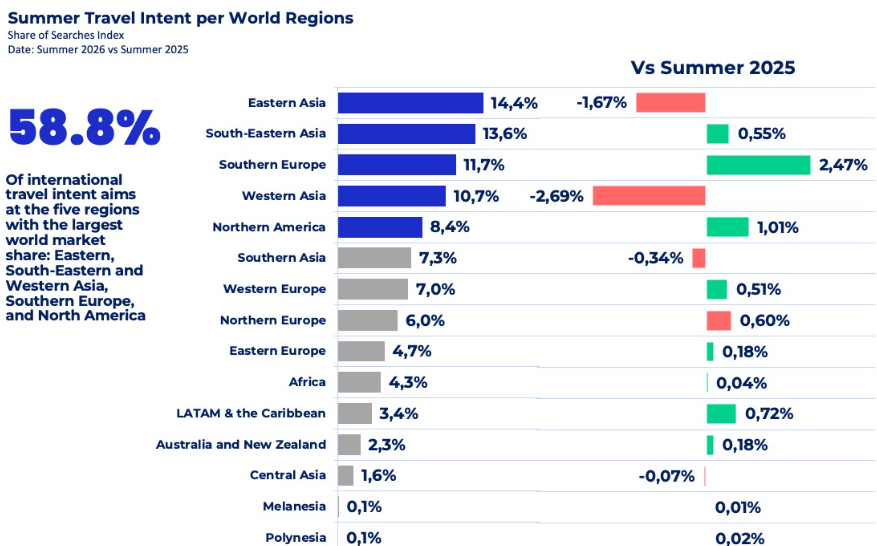
Where do people choose to travel in times of geopolitical uncertainty? According to a new analysis from The Data Appeal Company/Almaviva Group, Southern Europe comes out as the region showing the strongest year-on-year growth in travel demand. Greece, Spain, and Italy inn particular seem to be popular choices among travellers, with the region representing 11.71% of global international travel intent between June and August 2026 – up 2.47% when compared to 2025.
Athens comes out as the top grower of the Southern European destinations, capturing 0.77% of global travel intent, which can be explained through the fact that it functions both as a city destination and a gateway to the Greek islands. Barcelona (capturing 1.01% of global travel intent), Rome (0.85%), Madrid (0.91%) and Milan (0.76%) remain important city hubs in the region.
“Summer travel intent data suggests that, as air connectivity and flight corridors are disrupted by rerouting, higher costs and geopolitical uncertainty, long-haul demand is naturally reorganising towards destinations that feel closer, more familiar and more accessible,” explains Carlos Cendra, Chief Marketing and Communications Officer at Data Appeal.
Other trends for Summer travel in 2026
The second-biggest grower in terms of travel intent is North America. With 8.36% of global international travel intent during the Summer of 2026, interest grew by +1.01 percentage points year-on-year. The main driver seems to be the FIFA World Cup 2026, which boosts tourism in destinations such as New York, Los Angeles, Miami, and Orlando, although other cities that aren’t concerned by the World Cup such as Vancouver and Calgary in Canada scored well too.
Meanwhile, Eastern Asia (14.41%) and South-Eastern Asia (13.58%) remain the region capturing the largest share of international travel demand for summer 2026. Although more than a quarter of international travellers will thus be heading to the region over the coming months, interes in Eastern Asia is down by -1.67 percentage points, while South-Eastern Asia shows an increase of +0.55 percentage points compared with the Summer of 2025.
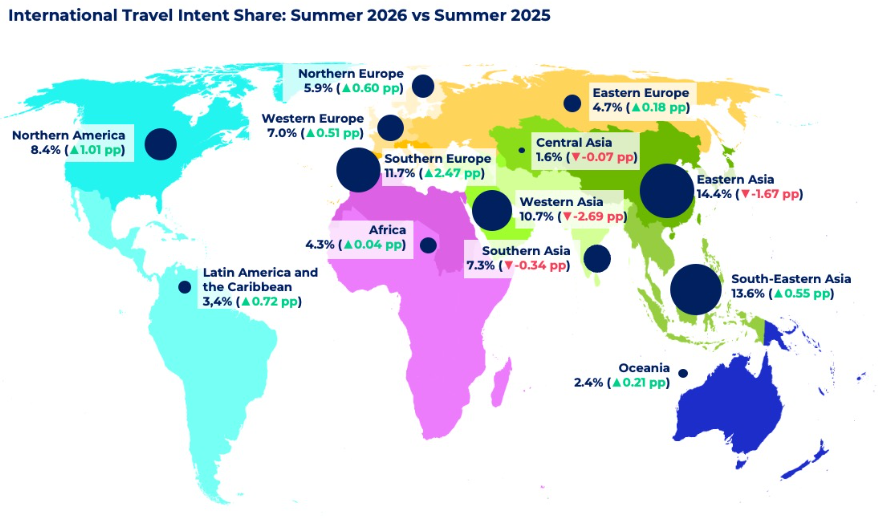
“Western Asia is also losing ground in summer 2026, recording a very significant decline of -2.69 percentage points in international market share compared with summer 2025, as geopolitical uncertainty continues to weigh on global demand. Nevertheless, intra-regional travel, demand from Gulf markets, and the strong summer appeal of destinations such as Türkiye, Cyprus and Georgia are helping the region mitigate the impact of ongoing uncertainty, allowing it to retain 10.71% of global travel intent”, The Data Appeal Company report reads.
The analysis further mentions Latin America and the Caribbean, accounting for 3.38% of international travel intent during the Summer of 2026. With an increase of 0.72 percentage points year-on-year, the region seems to be benefiting from the boost promised by Data Appeal Mabrian after the start of the U.S.-Israel war on Iran.
Finally, the international travel intent towards Northern European destinations has grown over the past year. The region captures 5.96% of global international travel demand, gaining 0.60 percentage points in travel intent year-on-year. The so-called coolcation destinations are being led by London, Edinburgh, Dublin, Copenhagen, and Iceland – proving Europe’s travel appeal goes beyond the classic sun-and-sea holidays.