


Bread and wine are among life’s greatest pleasures, as well as among the most symbolic of human activities, and new research now shows that we may have been cultivating the two for over 8,000 years.
According to a paper published in the Proceedings of the National Academy of Sciences (PNAS), a team of international researchers led by Professor David Lordkipanidze, General Director of the Georgian National Museum, found archaeological evidence that the nation of Georgia, at the crossroads of Europe and Asia, may be one of the world’s cradles of breadmaking and wine growing.
Radiocarbon dating was carried out on wheat grains found in the South Caucasus, placing them at a time period between 5922 and 5747 B.C.E. The grains were identified as Triticum aestivum, a species still associated with 95% of global wheat consumption, enabling the scientists to draw a direct line between modern breadmaking from Indian chapatis to San Francisco sourdough, to Neolithic bakers.
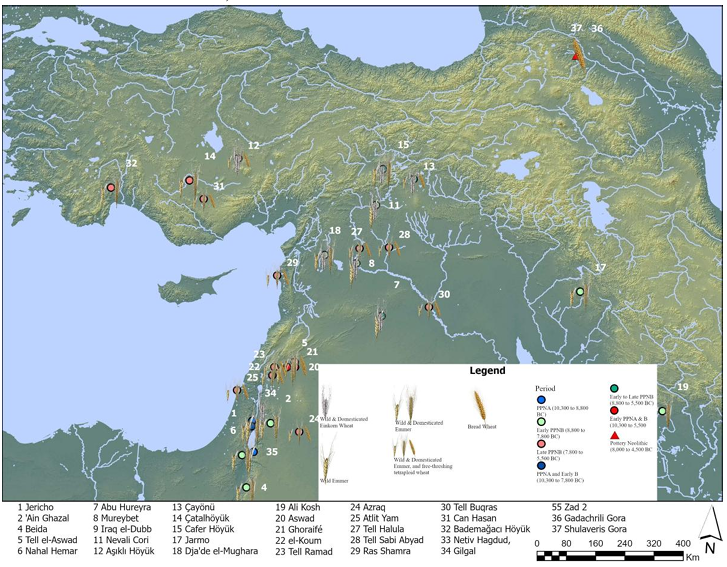
Einkorn and Emmer wheats and Bread Wheat © Lordkipanidze, D. et al.
“It is the first documented evidence of bread wheat,” Lordkipanidze told Discover. “Our ancestors were hunter-gatherers, and they were becoming farmers, which is a big shift in human history. Here we can see the evidence.”
What’s more, existing research suggests that the same ancestors at sites in Gadachrili Gora and Shulaveris Gora were cultivating wine during the same period, making Georgia “a very special place,” Lordkipanidze said. “Here we have 8,000-year-old traces of bread wheat, as well as evidence of winemaking from the same period. This is a major scientific discovery. It shows how innovative our ancestors were — they were among the first farmers, and their legacy allows us to better understand life 8,000 years ago.”
The team has also highlighted how the discovery challenges notions of the South Caucasus as a “peripheral region” that adopted practices from elsewhere. Instead, they point out, these earlier Georgian agricultural workers were innovators. “The Caucasus is an important region where key innovations to the development of the Near Eastern World, and by extension our current ways of life, were first created,” said Professor Stephen Batiuk of the University of Toronto, who co-led the archaeological excavations.
Going forward, more research is planned for the region between Anatolia and the Caucasus, but in the meantime, Georgia’s travel and hospitality stakeholders are likely to be folding the new discoveries into their mix, developing ways to offer visitors a taste of historic bread and winemaking practices from the regions now known to be among the original experts.