


Long-haul flyers can expect to pay €88 more per passengerfor their air tickets, according to a new report on the impact of the Middle East crisis on jet fuel prices from the green transport and energy lobby.
The analysis from T&E notes that the effects of the Middle East hostilities and the blockade of the Strait of Hormuz, a vital sea passage for worldwide oil, are wide-ranging. While some Middle East airlines are still grounded, others have rerouted flights, cancelled routes, and changed schedules, to adapt to airspace insecurity, fuel supply issues, and changing customer demand.
Those fuel supply shortages, and costs, have pushed up not only traditional jet fuel but the price of Sustainable Aviation Fuel (SAF) as well. These increases will be passed onto customers, T&E says, adding an average of €88 more per passengerfor long-haul flights, and around €29 per passenger on shorter intra-European routes.
The T&E briefing acknowledges that, amid the global shock of the crisis, some in the aviation sector are questioning climate strategies and schemes, such as the EU ETS (Emissions Trading System) and ReFuelEU. However, these are twin approaches to achieving Europe’s “Fit for 55” goals and boosting the bloc’s fuel resilience. ETS places a price on carbon emissions (driving operational efficiency), while ReFuelEU lays down a minimum quota for Sustainable Aviation Fuel (SAF) blending at EU airports, rising to 70% by 2050.
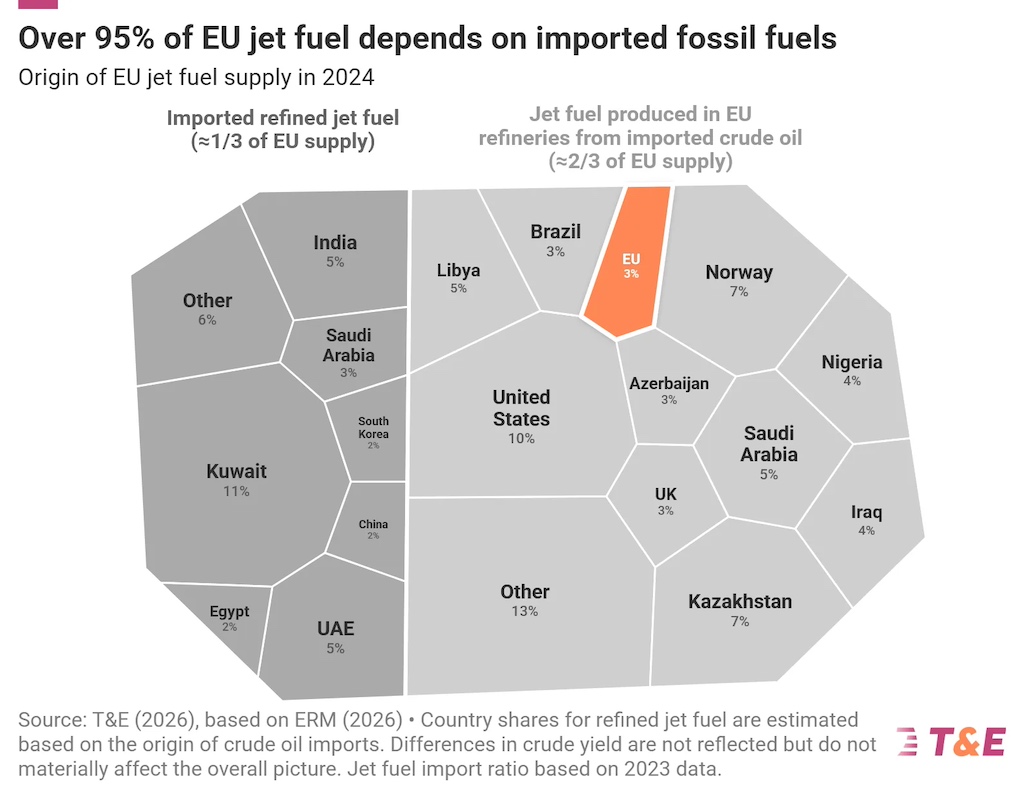
T&E argues that the current crisis should not prompt a U-turn on these policies. Rather, the situation “underscores that European aviation’s greatest vulnerability is its fossil fuel dependency, not the climate regulations,” the group says. It points out that the EU currently imports around 95% of its crude oil (including nearly all the crude oil used for the bloc’s jet fuel refining). Additionally, roughly a third of European jet fuel demand is met by directly imported refined jet fuel, with the Middle East as the main supplier. Overall, the group calculates around 30% of EU jet fuel supply, including both crude oil refined within the EU and imported refined jet fuel, relies on imports via the Strait of Hormuz.
Against that backdrop, the compliance costs of the ETS and ReFuelEU, vital parts of the bloc’s long-term energy security strategy, “are negligible compared to volatile fossil fuel price spikes.” As a result, the bloc should redouble its efforts, by continuing to protect the ETS and reinvesting its revenues, instead of surrendering to calls to provide oil price relief.
T&E also urges staying the course on SAF mandates, which it says will strengthen the domestic production capacity needed to ensure Europe’s long-term energy independence.
Finally, the environmental advocates say the bloc should Europe “consider demand-side measures that curb unnecessary flight growth, providing a quick win for energy security.”
If that were to happen, critics say, consumers could see the current period of high air ticket prices compounded by an ongoing phase of high demand and low supply. An EU Commission draft plan to address the oil supply challenge is expected on 22 April.