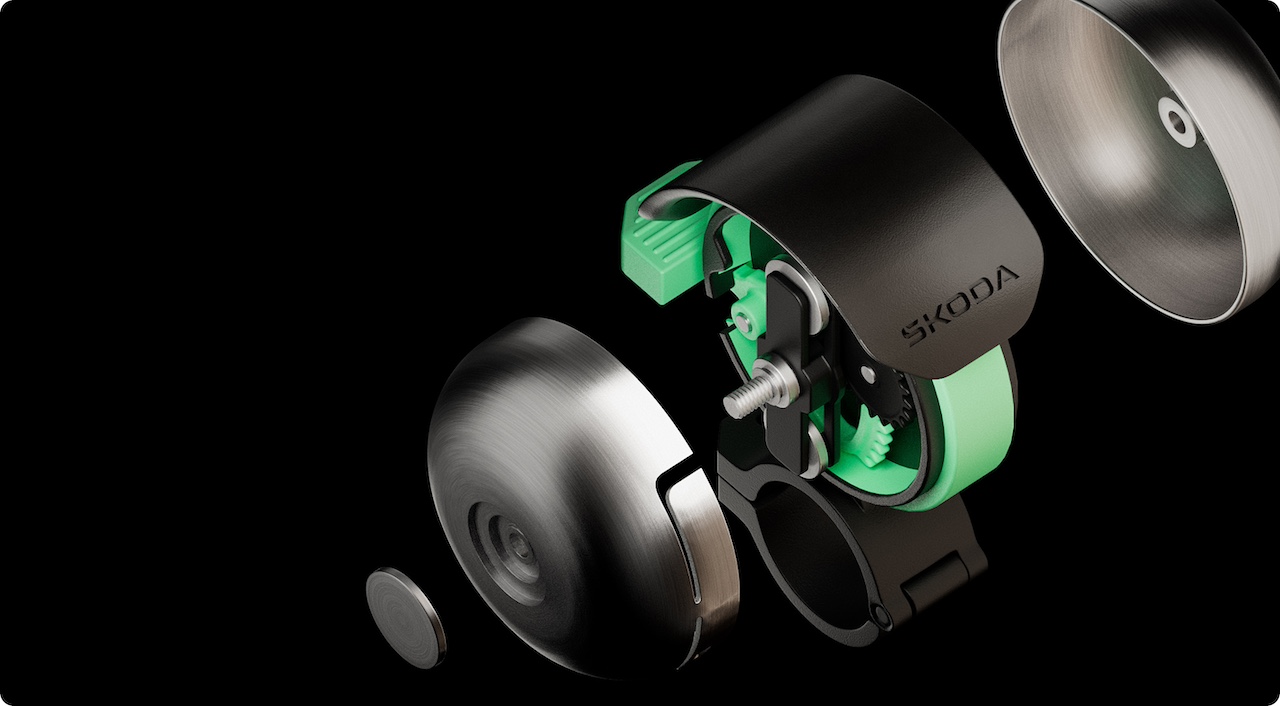



Czech automaker Škoda has launched the Duobell, a bicycle bell specifically designed in answer to the traffic challenges created by noise-cancelling headphones. In a world where the number of both cyclists and pedestrians wearing noise-cancelling headphones grows, the redesign of the classic bicycle bell might avoid numerous accidents.
In order to design the Duobell, Škoda joined forces with a team of scientists and audiologists from the University of Salford. Together, they examined how Active Noise Cancelling affects the audibility of conventional bicycle bells. Acoustic testing revealed that one narrow frequency band – a so-called safety gap – proved capable of penetrating ANC headphone filters, which work by generating an opposite sound wave to filter out noise before it reaches the wearer.
“Bicycle bells have remained almost unchanged for over a century, but the world around them has not. Škoda DuoBell is the first bell ever designed to penetrate noise-cancelling headphones. It is a smart analogue trick that outsmarts the artificial intelligence algorithms in these headphones. It is a small adjustment that will improve safety on city streets,” said Ben Edwards from AMV BBDO, the agency involved in developing the concept.
As the safety gap is located between 750 and 780 Hertz, this is exactly where the bell hits in order to beat Active Noise Cancelling. The name DuoBell refers to an additional resonator, which is tuned to a higher frequency and produces rapid and irregular strikes through a specially designed hammer mechanism. This generates sound waves that ANC algorithms are unable to process quickly enough to suppress. Altogether, the bell thus creates a sound wave that even the smartest of noise-cancelling headphones can’t suppress. Škoda has published the research behind the DuoBell in a white paper outlining the science behind its design.
“For Škoda, exploration has always been fundamental. This project is an excellent example of how a simple, yet clever idea can help make exploration safer for everyone,” said Meredith Kelly, Global Head of Marketing at Škoda Auto.
During testing, it was demonstrated that the DuoBell allowed pedestrians wearing active noise-cancelling headphones up to 22 metres of additional reaction distance, which translates into 5 seconds of extra reaction time. During a test of the product in cooperation with Deliveroo couriers in London in February 2026, “the bell proved so effective that couriers expressed a desire to keep it.”
With the rising use of noise-cancelling headphones in cities, innovations such as the DuoBell could play a key role in improving safety for both cyclists and pedestrians.