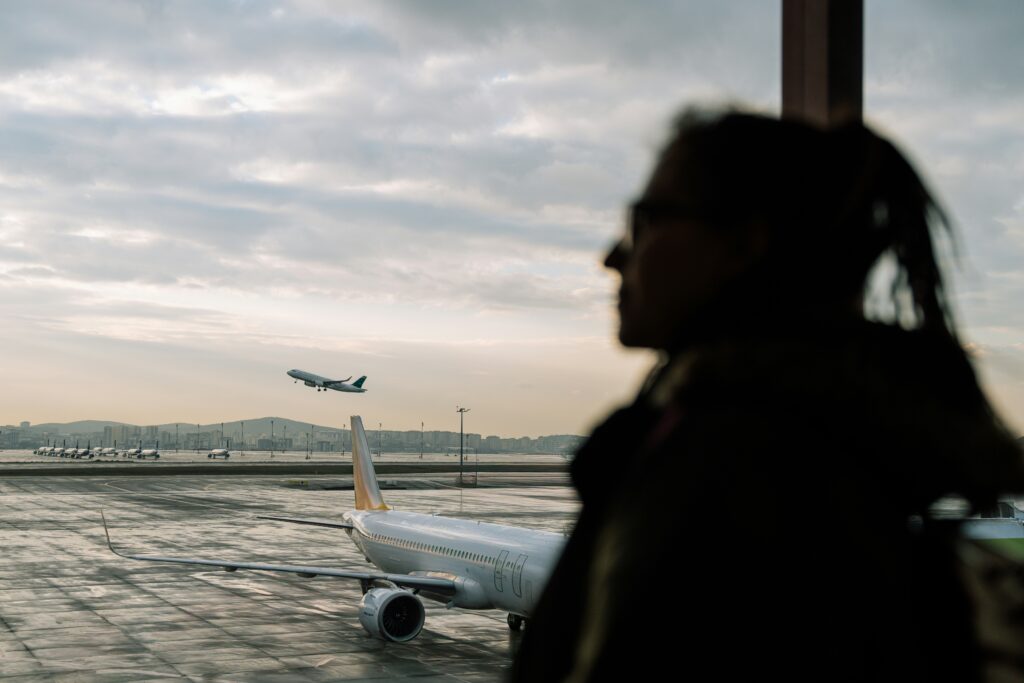
India’s main pilot union has asked the civil aviation authority to ground and inspect all operational Boeing 787 Dreamliners after a mid-air incident involving an Air India flight’s emergency power device. The unexpected activation of the ram air turbine (RAT) on Flight AI117 has raised serious concerns about potential electrical malfunctions in the aircraft model.
The ram air turbine (RAT) is a small, propeller-powered turbine that is designed to deploy from the underside of an aircraft’s fuselage; its purpose is to provide an emergency power supply to the plane in the event of a serious electrical issue. Typically, a RAT deployment signals a major engine problem. In this case, however, the engines of Flight AI117, en route from Amritsar in the northern Indian state of Punjab to Birmingham, UK, were running normally on 4 October 2025.
The pilots of the 12-year-old Boeing 787-8 were alerted when the RAT deployed during the approach to runway 33 during approach to Birmingham Airport. The aircraft landed without issues, but the return journey was cancelled as a safety measure. It was, however, cleared to resume service the following day on the Birmingham-Delhi route.
On October 4, 2025, an #AirIndia Boeing 787-8 (VT-ANO) operating flight #AI117 from #Amritsar to #Birmingham experienced an unexpected deployment of its Ram Air Turbine (RAT) at 500 feet during the final approach to Birmingham Airport. ⬇️
— FlightMode (@FlightModeblog) October 7, 2025
📷 ©️ @jagritichandra#India #UK #B787 pic.twitter.com/xZQ0xfSfKv
In a statement, Tata Group-owned Air India indicated that an initial assessment conducted after the incident found that “all electrical and hydraulic parameters were normal.” The airline also noted that the flight landed safely.
The Federation of Indian Pilots, which represents more than 6,000 pilots, condemned the incident as “unprecedented” and said that it could have been a signal of an electrical malfunction.
“I have never heard of the RAT being deployed automatically without any hydraulic loss, power loss, or failures,” Charanvir Singh Randhawa, president of the Federation of Indian Pilots, told the New York Times.
VIDEO | When asked about the RAT deployment in UK-bound Air India Dreamliner, Civil Aviation Minister Ram Mohan Naidu (@RamMNK) says, "First of all, whenever such incidents happen, we try to find out the root cause, once we get to understand the root cause, then we are going to… pic.twitter.com/9A2Zqk9ubt
— Press Trust of India (@PTI_News) October 7, 2025
Air India reported that it has provided a report to the industry regulator, following all protocols. The airline also added that “the safety of all passengers and crew remains our foremost priority.”
The call for grounding and inspection comes after recent incidents involving a Boeing 787 in recent months. In June 2025, the deadly crash of Air India Flight 171, resulting in 260 fatalities, also occurred after the RAT was deployed following a total loss of power.
Although the preliminary report on the June incident confirmed that the turbine deployed because the plane lost power, investigators have not yet determined the reason for that power loss. However, the report did state that just prior to impact, the Dreamliner’s fuel-control switches were deliberately moved to the “cutoff” position, halting the fuel supply to both engines.