

As of 15 September 2026, passport holders from 59 countries around the globe will see their visa-free allowance in Thailand reduced to 30 days. Since 2024, a special 60-day visa-exemption scheme has applied to visitors from 93 nations.
With 32.97 million international visitors in 2025, Thailand is heavily reliant on tourism. The industry which 13% of the country’s GDP, 12% of its jobs, and 1.54 trillion baht (€40 billion). In 2026, those numbers are likely to go up, as the government expects around 33.5 million foreign visitors.
However, as the number of tourists grows, so does the nuisance caused by them. On 28 August 2026, Thailand introduced the so-called Office Regulation on Deportation, a set of new regulations allowing authorities to deport foreign nationals who do not abide by the country’s laws or are deemed a threat to public order.
Starting from 15 September, those new measures will be joined by a new regulation regarding visa-free stays. Passport holders from 93 nations around the globe have been enjoying a 60-day visa exemption since July 2024, but 60 of those will now see that period reduced to just 30 days.
The new visa-exemption measures and visa privileges were officially announced through a publication in The Royal Gazette signed by Prime Minister and Interior Minister Anutin Charnvirakul on Monday, 31 August, after the idea was first floated in May 2026.
“The objective is to ensure that travel facilitation for foreign tourists reflects the current circumstances, prevents misuse of visa privileges, and adheres to the principle of ‘one country, one entitlement’. The revisions take into account economic and security considerations, international relations, and the principle of reciprocity. The Government expects this change to strengthen international relations, support negotiations for Schengen visa exemptions for Thai nationals, and facilitate bilateral economic agreements,” the Thai government previously said in a press release.
Full list of countries covered by the new 30-day visa exemption:
| Australia | Canada | Fiji | Hungary | Italy | Liechtenstein | The Netherlands | Portugal | Slovenia |
| Austria | Croatia | Finland | Iceland | Japan | Lithuania | New Zealand | Qatar | South Africa |
| Bahrain | Cyprus | France | Indonesia | Jordan | Luxembourg | Norway | Romania | Spain |
| Belgium | Czech Republic | Georgia | India | Kuwait | Malta | Oman | Saudi Arabia | Sweden |
| Bhutan | Denmark | Germany | Ireland | Kyrgyzstan | Malaysia | The Philippines | Singapore | Switzerland |
| Turkey | Ukraine | United Arab Emirates | United Kingdom | United States | Poland | Slovak Republic | Taiwan | Brunei |
Visitors from the above-mentioned countries arriving by land will be able to enter visa-free twice a year, in order to prevent so-called visa runs by foreigners who want to extend their stays in Thailand. Some exceptions will apply, including for passport holders from Malaysia, Brunei, Indonesia, and Singapore.
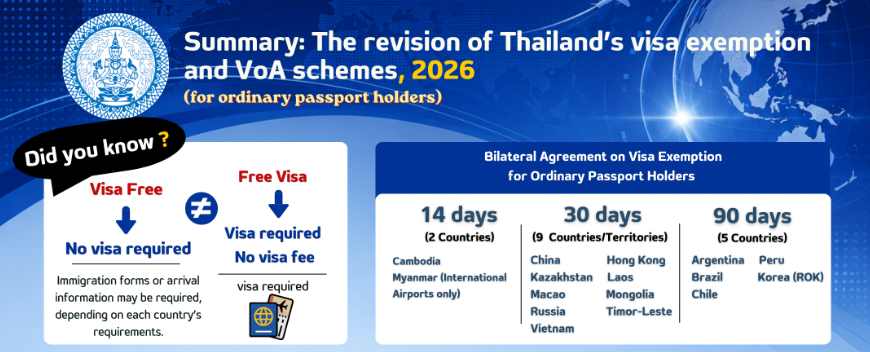
Moreover, visitors from the Seychelles and Mauritius will be able to enjoy 15-day visa-free stays, while Visa-on-Arrival (VoA) at designated checkpoints will be available for nationals of Azerbaijan, Belarus, and Serbia. India’s VoA will be removed to eliminate the overlapping visa privilege.
“Travellers who entered Thailand before the new measures come into force will continue to be allowed to remain in the country for the remainder of their stay permitted under the previous regulations,” the government specified.
Foreign nationals who wish to be able to stay longer still have the option to apply for a Destination Thailand Visa (DTV). The 5-year multiple-entry visa requires proof of a bank account containing at least €13,000 (500,000 baht), and remote workers must be able to provide proof of employment outside of Thailand. In return, DTV holders can stay for a maximum of 180 days per entry, which can be prolonged once for another 180 days.