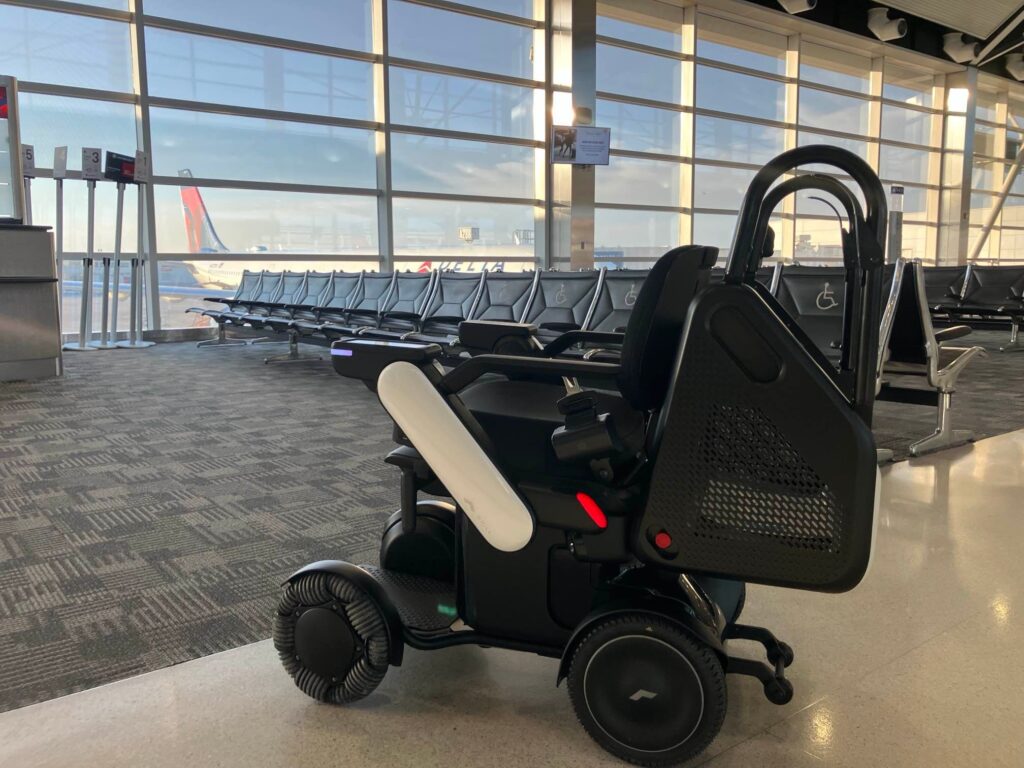


Airports across the U.S. are making autonomous wheelchairs available to travellers in order to increase their accessibility and to optimise the workforce. The service is mostly aimed at people who can stand and transfer independently, making their journey through the airport smoother.
Los Angeles International (LAX), Miami International (MIA), Seattle-Tacoma International Airport (SEA), Detroit Metropolitan Wayne County Airport (DTW)… The list of American airports deploying autonomous wheelchair services is ever-growing. The Warren Cleage Evans Terminal at Detroit Metropolitan Wayne County Airport and the Ted Stevens Anchorage International Airport (ANC) are among the latest to have debuted the service.
Detroit
In Detroit, Wayne County Airport Authority (WCAA) and Unifi joined forces to introduce a new series of autonomous personal mobility vehicles equipped with Blueberry Technology. Using artificial intelligence, the wheelchair provides travellers with a virtual map of the terminal, allowing them to easily reach their destination, while the obstacle detection and avoidance capabilities avoid collisions.
Autonomous wheelchairs are now operating independently in major U.S. airports, including Miami (MIA), Los Angeles (LAX), Seattle (SEA), and Detroit (DTW), with further expansion underway. pic.twitter.com/PnCTbyTFHR
— TRAVEL Esquire 🇺🇸🇮🇹🌍✈️ (@TravelEsquire) May 3, 2026
“The introduction of autonomous wheelchairs at the Evans Terminal represents yet another significant advancement in enhancing accessibility. This partnership with Unifi enables us to provide an innovative and efficient service for our customers, facilitating a more seamless and inclusive experience at DTW,” said WCAA CEO Chad Newton.
Travellers can embark on one of the vehicles in the dedicated loading area after completing their security screening. After receiving instructions on how to use the autonomous wheelchairs, they can still opt for a traditional wheelchair service if they wish to do so.
Alaska
At Alaska’s Ted Stevens Anchorage International Airport, NANA Management Services (NMS) and Alaska Airlines teamed up with WHILL Autonomous Service to introduce an autonomous mobility assistance program for the first time at the airport. With the support of trained NMS staff, passengers will be able to easily navigate the airport independently.
“Anchorage represents an important step in expanding access to autonomous mobility in North America. Our goal is to give passengers more independence and confidence as they move through the airport, while also helping our partners deliver more consistent and reliable service, especially during peak travel periods,” stated Shane Bogni, President, WHILL Autonomous Service, North America & EMEA.
According to information provided by WHILL, Alaska Airlines passengers at the airport will be able to book the service after completing multiple steps.
- Request wheelchair assistance through Alaska Airlines at the time of booking, prior to arrival, or upon entering the terminal.
- Visit an NMS assistance kiosk in the terminal, where NMS team members will coordinate wheelchair services.
- Eligibility screening. On site, NMS staff will screen passengers to confirm they meet the mobility requirements for use of the autonomous devices.
- TSA support and transition. Passengers will be assisted through the TSA screening process and then transferred to a WHILL autonomous wheelchair.
- Guidance and education. NMS agents will provide instruction so passengers can use the technology safely and confidently.
Ted Stevens marks the sixth U.S. airport to deploy WHILL autonomous wheelchairs. Seattle-Tacoma International Airport, Los Angeles International Airport, Winnipeg Richardson International Airport, Detroit Metro Airport, and Miami International Airport already rolled out their vehicles.